


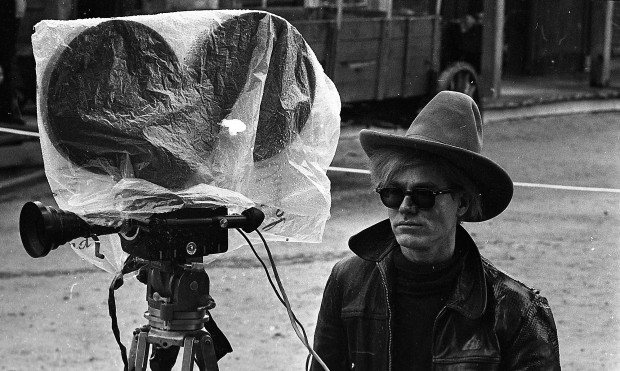
It didn't take long for the fledgling movie industry to discover the visual splendor and dramatic possibilities of life in the Old West.
Western movies, in fact, were invented at the same time as moviemaking itself - and Hollywood had nothing to do with it.
The first Western to become a giant success was Edwin S. Porter's "The Great Train Robbery," a topical 10-minute silent film that dazzled Americans in 1903. It was made in New Jersey.
William S. Hart, one of the first movie cowboys, made his first feature film, "The Bargain," on location at the Grand Canyon in 1914.
In January of that year, another silent feature film was made in Arizona: "Life in a Western Penitentiary," a documentary that took viewers inside the notorious territorial and state prison in Yuma. It showed the day-to-day life of a convict, including scenes in the prison's dungeon, inmates on death row, and the convict burial grounds.
It was also in 1914 that the first full-length movie was made in Hollywood. Naturally, it was a Western ("The Squaw Man").
The directors, Cecil B. DeMille and Oscar C. Apfel, considered making the picture in Flagstaff, but snow on the conspicuous San Francisco peaks nixed that notion because it conflicted with the story's sweltering heat.
So DeMille and Apfel headed west to the Hollywoodland district of Los Angeles, an area with lots of cheap land and not a snow-capped mountain in sight.
Other early moviemakers had already set up shop in Tucson, the state's largest city, by then. In 1914, "The Renunciation" was shot in Tucson, and until recently it was thought to be the first movie filmed in these parts.
One can only imagine the reaction of pioneering moviemakers when they first laid eyes on San Xavier del Bac, but they soon made the mission a movie star. The White Dove of the Desert was featured in "The Renunciation" and an unknown number of other silent films.
According to Jim Trottier, 41, a film historian and journalist who lives in Maine, the Lubin Production Company sent crews to Tucson in 1912, tasked with cranking out Westerns, a genre that was popular in the United States, and wildly popular in Europe.
On Jan. 11, 1913, Lubin released a short documentary called "San Xavier Mission, Tucson, Arizona."
But an even earlier film was discovered last year in the New Zealand Film Archives: Vitagraph's "The Better Man," about a Mexican-American who proves himself the better man, was filmed in Tucson and originally released in 1912.
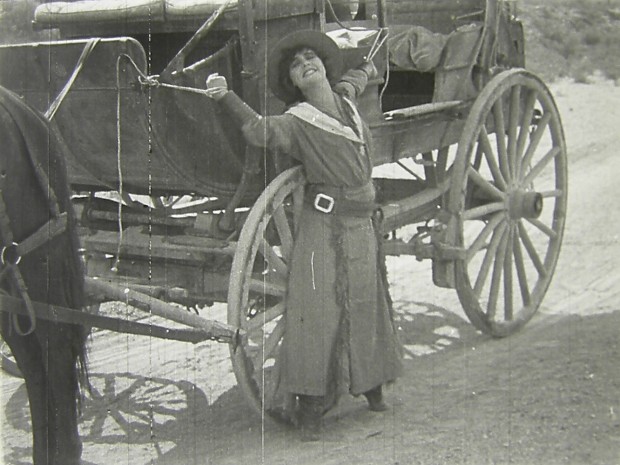
"The Better Man" will be restored, along with another Western that was filmed in Tucson and discovered last summer in the same archive: "The Girl Stage Driver," a 1914 film that was directed by Webster Cullison.
The film, which until last year was thought to be lost forever, starred Edna Payne.
Petite, with blue eyes and brown hair, Payne was the daughter of stage actors who started her career in vaudeville.
She made her movie debut in 1911, and went on to play the lead role in a series of two- and three-reel Westerns filmed in Tucson by Lubin and then by Eclair American.
Lubin lost almost all of its prints in a devastating fire at its New Jersey headquarters in 1914, and Eclair was among the studios that routinely recycled the films by melting down the flammable nitrate stock and reusing it.
In an article published in Classic Images magazine, Trottier says that Payne's star burned hot and bright during her brief career on the screen.
"During the winter of 1912, Lubin sent a stock company to Tucson for the purpose of shooting Western pictures on location. Winsome little Edna was chosen as the ingenue. A self-professed outdoors girl, she told a reporter: 'I took to outdoor work with enthusiasm. It was so different from the artificial atmosphere of the stage. Real trees, great plains and deserts, horses to ride, and genuine farm yards for a setting.' "
While in Arizona, Payne learned to ride horseback and soon became an excellent horsewoman, Trottier reports.
"In keeping with her adventurous spirit, she did many of her own stunts, which included leading a cavalry charge in one of her films. The ambitious workhorse racked up numerous credits, including 'The Bravery of Dora,' 'The Half Breed's Treachery,' 'Kitty and the Bandits,' 'Juan and Juanita,' 'The Moonshiner's Daughter' and 'The Water Rats,' all of which were made in 1912."
By 1913, she topped popularity polls and the studio gave her a raise, enabling her to buy a car.
A newspaper critic had this to say back then: "She is vital without being aggressive, frank but not conceited, a fine chum for either man or woman, and wide awake and pretty enough to win her way to the top of her chosen profession."
Instead, Payne got married and retired from movies in 1917.
"Gay Desperado" hailed
The Western and its conventions had become entrenched by 1918, a year that saw the release of "Out West," a parody of cowboy cliches starring Roscoe "Fatty" Arbuckle and Buster Keaton.
In 1936, San Xavier was again in the spotlight in "The Gay Desperado," a gangster/Mexican bandido comedy starring Ida Lupino that also boasts tantalizing glimpses of our barrio streets.
The New York Times Film Critics Circle named Rouben Mamoulian the best director of the year for "The Gay Desperado."
Among the cast was Chris-Pin Martin, who was born in 1893 on Meyer Street in Tucson. His given name was Ysabel Ponciana Chris-Pin Martin Piaz.
On the Internet Movie Database, he's described as a "Dark-complexioned, roly-poly comic actor in Hollywood films of the 30s, 40s and early 50s, in whose 80-or-so screen appearances he usually affected a fractured Mexican accent."
GREY'S NOVELS INSPIRE FILMS
Literature of the late 19th century and early 20th century also embraced Old West mythology, and Arizona figured prominently in the short stories and serialized novels gobbled up by readers of The Saturday Evening Post and other periodicals.
One of Zane Grey's first "dime novels" was "The Last of the Plainsmen" in 1908, a tale inspired by the author's life-changing visit to the Grand Canyon.
Grey's boundless fascination with Arizona's people, history and landscape was apparent in the novels and short stories that followed.
Here's an excerpt from "The Call of the Canyon" (1924), about an East Coast woman, Carley, who travels alone to Arizona's Oak Creek Canyon, hoping to surprise her lover, Glenn:
"Far down the gorge a purple light shone on the forested floor. And on the moment the sun burst through the clouds and sent a golden blaze down into the depths, transforming them incalculably. The great cliffs turned gold, the creek changed to glancing silver, the green of trees vividly freshened, and in the clefts rays of sunlight burned into the blue shadows.
"Carley had never gazed upon a scene like this. Hostile and prejudiced, she yet felt wrung from her an acknowledgment of beauty and grandeur. But wild, violent, savage! Not livable! This insulated rift in the crust of the earth was a gigantic burrow for beasts, perhaps for outlawed men - not for a civilized person - not for Glenn Kilbourne."
Given Zane Grey's love affair with Arizona, the setting for 25 of his novels, it seemed perfect that his most popular work, "Riders of the Purple Sage," was published in 1912, when the territory achieved statehood.
The 1931 movie version, one of several, was filmed in Sedona.
Grey's "The Mysterious Rider" (1938) was filmed in the foothills of the Rincon Mountains, east of Tucson, with producer Harry Sherman. He told the Arizona Daily Star that in 1917 that he made the first Zane Grey movie, "Light of the Western Stars," in Tucson.
"I have never seen such enchanting picture backgrounds," he told the Star in a story published June 11, 1938.
Grey's novels inspired more than 100 movies.
But we shouldn't forget about O. Henry, whose short story, "The Caballero's Way," featured a character who would show up again and again in Westerns: the Cisco Kid.
The character's first appearance on the silver screen was in "The Caballero's Way," a 1914 silent starring William R. Dunn as the Cisco Kid. It was filmed behind the Santa Rita, a downtown hotel that served as the home away from home for countless movie companies.
"In Old Arizona" (1928), featuring Warner Baxter as the first Cisco Kid in a talkie, was made at locations around the state.
Baxter returned here in 1931 for "The Cisco Kid," in which Tucsonan Martin made his first appearance as Pancho, a role he would play in eight more Cisco Kid movies.
The Cisco Kid became known as the Robin Hood of the West, a good guy who palled around with Pancho, getting into all manner of harmless adventures.
But that's a far cry from the cold-blooded white man first imagined by O. Henry in his classic story, published in 1907.
The first three sentences:
"The Cisco Kid had killed six men in more or less fair scrimmages, had murdered twice as many (mostly Mexicans), and had winged a larger number whom he modestly forbore to count. Therefore a woman loved him.
"The Kid was twenty-five, looked twenty; and a careful insurance company would have estimated the probable time of his demise at, say, twenty-six."

