


When the coronavirus pandemic slammed the U.S. and brought collegiate athletics to a halt, Dave Heeke thought about the auto industry recession of the early 1980s.
The University of Arizona athletic director grew up in East Lansing, Michigan. The economy there was devastated.
“I saw the local tire shop close down, I saw the local breakfast place shut down,” Heeke said. “They laid off every auto worker in my town, and that was thousands and thousands of workers. It feels a little bit like that.”
Heeke recognizes the sense of uncertainty that has permeated all levels of society and enterprise, including the UA athletic department. As its leader, his goal is “keeping people steady as we navigate through this.”
It hasn’t been easy. Winter and spring sports seasons were halted. The athletic department instituted an indefinite hiring freeze. The college football season — the biggest source of revenue for most athletic departments — could be delayed or canceled. All athletic capital-improvement projects, including the ongoing renovation of Arizona Stadium, have been put on pause.
Heeke discussed those topics and others in an interview with the Star on Thursday. Below are highlights of that conversation, which was conducted over Zoom and has been lightly edited for context and clarity.
Several sports just ended in mid-March — basketball, softball, baseball, golf. How hard was that for everyone involved?
A: “It’s extremely hard when things are just cut short abruptly. You’re not able to complete your dream or your plan, meet your goals that you’ve established. Certainly very difficult for those senior student-athletes that will never have that opportunity again, to finish in a more complete way.
“When we finish our athletic careers, we want to walk off the court or the field ourselves. We don’t want an injury to take us off and end our career. I think that’s the hardest thing. And it really impacted those seniors in the winter sports. … Those groups, boy, that is really tough. There’s no do-over. It ended.
“There’s no final banquet, there’s no final team gathering (or) get-together. There’s no Senior Day for many of them. There’s not a final time in the locker room when you say, ‘Hey, this is it.’ Some of that finality, it just never occurred.”
Were you in favor of extending eligibility for the spring-sport athletes?
A: “I was. I was a strong proponent. (UA president) Dr. (Robert C.) Robbins was. Our spring-sport coaches were. I thought it was absolutely the right thing to do for those young people. We had a mechanism in college athletics to be able to make that happen. I’m very pleased that we did.
“I understand the nature of it being up to each institution. I think that’s appropriate. People have to make decisions based on financial structures and what they want to do. We made a commitment that we would honor 100% — all of those student-athletes and the financial-aid package from athletics that they were on this current spring.”
We’ve seen some schools already cutting some of their sports for financial reasons. Do you anticipate having to do that at any point?
A: “We do not. We have no plans to cut any sports or reduce our sport lineup in any way. Our intention is to continue to move forward with the full sport offerings that we have.”

Dave Heeke says the UA is focused on a full football season, but a reduced one could happen.
Some athletic directors and high-profile coaches at other schools have agreed to take pay cuts or shift some of their salary into donations to the athletic program. Do you, Kevin Sumlin or Sean Miller plan to do anything of that nature?
A: “We’re still in the process of evaluating all of our spending, all of our budgetary dollars to determine the most effective way to … support the overall effort. (But) I think that, clearly, in this situation, we will have some type of compensation reductions.
“Compensation is nearly 40% of our overall budget. So when you talk about reductions, you can only go so far before you have to go into the compensation area to make significant reductions that will be necessary going forward.
“I think everyone recognizes the significance and the seriousness of where we are. And I would anticipate that people would do things to help support the overall cause of the university and, more specifically, the athletic department. But those are very personal and specific conversations with contract employees.”
What is your best guess, as of this moment, about the status of the 2020 college football season?
A: “There’s a lot of effort going into planning models of preserving the college football season. The college football season is critically important to the overall enterprise of intercollegiate athletics, (nowhere) more so than at the Division I, Power 5 (conference) level.
“Right now, at the Pac-12 level, we’ve had a group working for a couple of weeks on specific models, how to reengage without knowing that date. You hear about, ‘OK, let’s open the campus in September.’ But what does that really mean? Would you play football or not?
“We’ve been focused (on) safety. How can you get a team ready to go if it’s Sept. 1, Oct. 1, Nov. 1? How many days to train? It’s not like the old days when some of us played; you got two weeks, you got ready and you were playing games. Obviously, science and our knowledge of training is much greater. So looking at that model, is it a 50-day, a 60-day (run-up)?
“We initially started with, let’s target a date and work back from there. Now it’s, what do we need? And how do we adapt to whatever date college football can start again?”
Could you have a football season without the full student body being back on campus?
A: “I don’t know if I want to go too far down these hypothetical kind of models. I find it hard to believe we could play football if there were no students on campus. … We have to talk about the populations that do need to come back. That’s your team, your support staff, the extended support staff. Are we sure they’re all healthy? Do we have the mechanisms in place to guarantee that to parents? Can we guarantee it to our staff who are coming back? It gets to a lot of levels of consideration.
“I’m as hopeful as anyone that college football and all of college sports will come back, because I think sport traditionally, in times of crisis, has been the centerpiece to bring people back together, to rally our country and our nation. And I think that can happen here.
“But I think the way that happens in the future is probably going to change. You can only have so much hand sanitizer to keep everyone safe. There’s a lot of pieces: How do we deliver tickets? How do we interact with our fan base now? How do we make Arizona Stadium a place that … is set up to handle this new era? All those kind of things are what sports people are talking about all over.
“We’re focused on a full college football season. Hybrid models, reducing games — it could happen. But we really want to preserve a full season whenever that does start.”
Photos for April 11: Tucson gets by during Coronavirus Pandemic
Tucson in photos, coronavirus pandemic
Updated
Susan Hillman chats with her mother Betty Hillman via telephone, April 9, 2020, Tucson, Ariz. Eighty-five year old Betty Hillman is in long term skilled care and Susan is unable to visit due to COVID-19 restrictions on nursing home facilities.
Tucson in photos, coronavirus pandemic
Updated
Susan Hillman chats with her mother Betty Hillman near a photo of Betty and her husband, Susan's dad, Bill, circa 2105, April 9, 2020, Tucson, Ariz. Eighty-five year old Betty Hillman is in long term skilled care and Susan is unable to visit due to COVID-19 restrictions on nursing home facilities.
Tucson in photos, coronavirus pandemic
Updated
Ben Forbes, left, owner of Forbes Meat Company, helps Jeronimo "Mo" Madril, right owner and executive chef of Geronimo's Revenge, wrap up tortilla's for to-go carnitas for Forbes Meat Company and Geronimo's Revenge's "Carnitas for the community" at Thunder Canyon Brewery, 220 E. Broadway Blvd., in Tucson, Ariz., on April 6, 2020. Forbes Meat Company and Geronimo's Revenge partnered to help the restaurant community by offering free carnitas to those affected by the Coronavirus Disease (COVID-19). They will be making to go carnitas every Monday in April starting at 2pm until all the to go packs, roughly 60, are all gone. Forbes wanted to find a way to help out the restaurant community. "They are struggling and my business is exploding," said Forbes.
Tucson in photos, coronavirus pandemic
Updated
David Clark, left, out of work bartender, and Jeronimo "Mo" Madril, owner and executive chef of Geronimo's Revenge, practice social distancing while waiting to give out carnitas for Forbes Meat Company and Geronimo's Revenge's "Carnitas for the community" at Thunder Canyon Brewery, 220 E. Broadway Blvd., in Tucson, Ariz., on April 6, 2020. Forbes Meat Company and Geronimo's Revenge partnered to help the restaurant community by offering free carnitas to those affected by the Coronavirus Disease (COVID-19). They will be making to go carnitas every Monday in April starting at 2pm until all the to go packs, roughly 60, are all gone.
Tucson in photos, coronavirus pandemic
Updated
Steve Tracy, Thunder Canyon Brewery co-owner and brewer, fills up 16oz bottles of locally made hand sanitizer at Thunder Canyon Brewery, 220 E. Broadway Blvd., in Tucson, Ariz., on April 6, 2020. Thunder Canyon Brewery, along with a few other local distilleries, are making United States Food and Drug Administration approved hand sanitizer for hospitals, first responders and the public in response to Coronavirus Disease (COVID-19). "Whatever I have, I am turning into hand sanitizer," said Tracy. "We are going to keep making it as much as we can."
Tucson in photos, coronavirus pandemic
Updated
Steve Tracy, Thunder Canyon Brewery co-owner and brewer, fills up 16oz bottles of locally made hand sanitizer at Thunder Canyon Brewery, 220 E. Broadway Blvd., in Tucson, Ariz., on April 6, 2020. Thunder Canyon Brewery, along with a few other local distilleries, are making United States Food and Drug Administration approved hand sanitizer for hospitals, first responders and the public in response to Coronavirus Disease (COVID-19). "Whatever I have, I am turning into hand sanitizer," said Tracy. "We are going to keep making it as much as we can."
Tucson in photos, coronavirus pandemic
Updated
David Sbarra, a psychology professor at the University of Arizona, points his webcam at his children Margot, 9, and Mateo, 12, as he begins his introduction of his office hours for a class he now conducts over Zoom in his living room while teaching from home, on April 7, 2020.
Tucson in photos, coronavirus pandemic
Updated
Ben Elias, manager at Westbound, center, helps Dustin Schaber with his pickup order on April 8, 2020. Due to the coronavirus disease (COVID-19) only two customers are allowed in the shop, located at the MSA Annex, at the same time and all orders are to-go.
Tucson in photos, coronavirus pandemic
Updated
Laura Tanzer, a local fashion designer, posted on Facebook that she will make masks for $5.00 each on April 5. Tanzer thought she would receive a couple of dozen orders, but, within 24 hours she heard from over 200 people. Tanzer is now working out of her shop in downtown Tucson making masks that also has a filter sowed into them. Tanzer is wearing one of her masks as she sows on April 8, 2020.
Tucson in photos, coronavirus pandemic
Updated
Oro Valley Hospital chief administration officer Erinn Oller talks with Fang, a local organizer with the Chinese-American COVID-19 Relief AZ group, which donated 6,000 masks, on April 9, 2020. Additional mask donations are planned as soon as shipments arrive.
Tucson in photos, coronavirus pandemic
Updated
Healthcare workers line up for their 2 free Sonoran hot dogs and a drink from BK Carne Asada & Hot Dogs in the parking lot of St. Mary's Hospital on April 10, 2020. The owner, Benny Galaz, is giving free food to healthcare workers at Tucson area hospitals for the next several weeks as a way to say thank you for their hard work during the coronavirus disease (COVID-19) outbreak.
Tucson in photos, coronavirus pandemic
Updated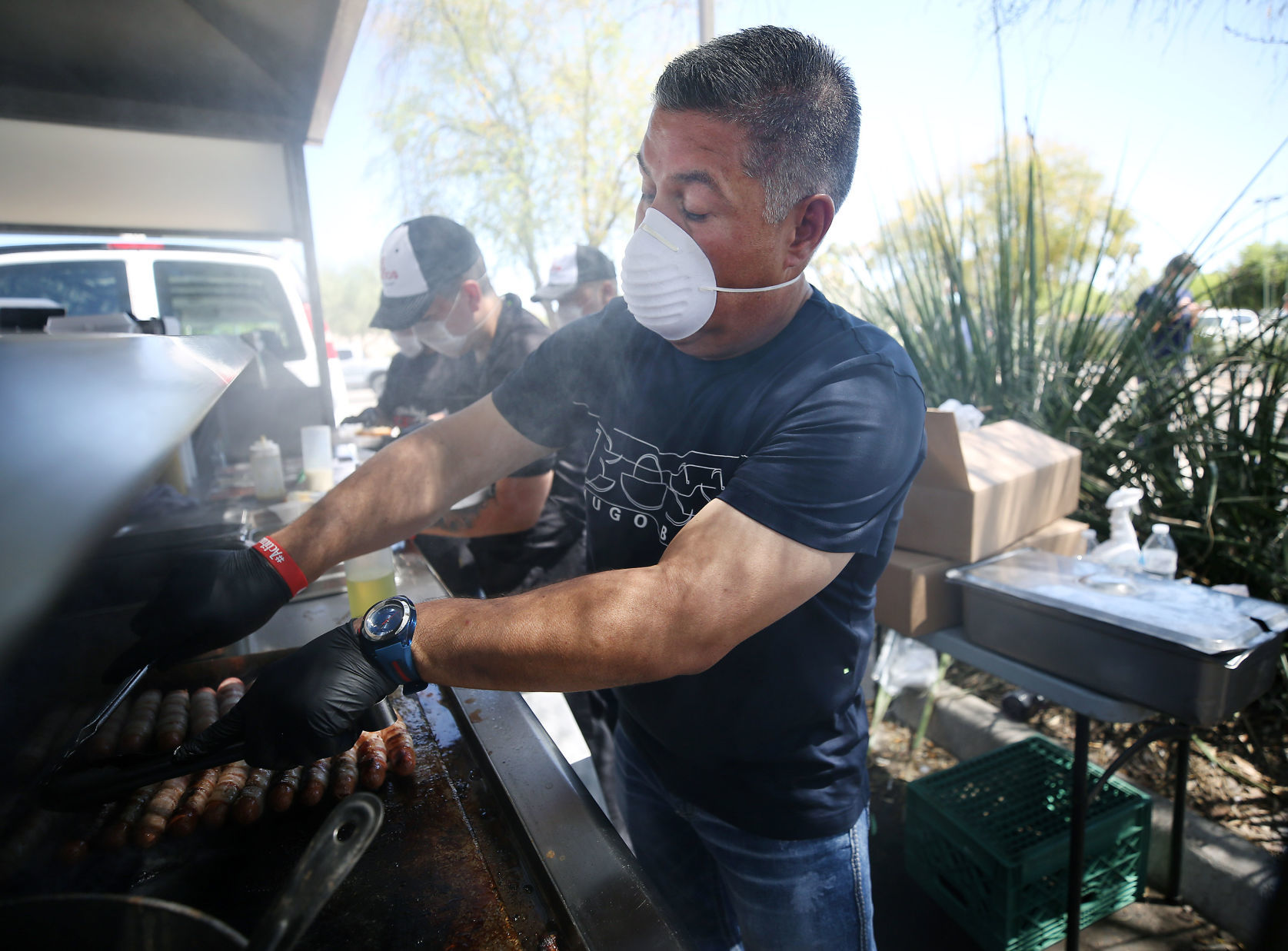
Benny Galaz, owner of BK Carne Asada & Hot Dogs, cooks up Sonoran hot dogs in the parking lot of St. Mary's Hospital on April 10, 2020. Galaz is giving free food to healthcare workers at Tucson area hospitals for the next several weeks as a way to say thank you for their hard work during the coronavirus disease (COVID-19) outbreak.
Tucson in photos, coronavirus pandemic
Updated
Healthcare workers line up for their 2 free Sonoran hot dogs and a drink from BK Carne Asada & Hot Dogs in the parking lot of St. Mary's Hospital on April 10, 2020. The owner, Benny Galaz, is giving free food to healthcare workers at Tucson area hospitals for the next several weeks as a way to say thank you for their hard work during the coronavirus disease (COVID-19) outbreak.
Tucson in photos, coronavirus pandemic
Updated
A man uses the taped off exercise station in Reid Park as an anchor for his band workout, April 8, 2020, Tucson, Ariz.
Tucson in photos, coronavirus pandemic
Updated
Alicia Roseanna, 9, fourth grader at Esperanza Elementary School, grabs a sheet of paper while listening to her teacher, Rachel Watson, and her classmates inside her home in Tucson, Ariz. during Watson's online class on April 7, 2020. Due to the Coronavirus Disease (COVID-19) closing down schools and universities, teachers and students have been forced to schedule and participate in classes online for the remainder of the school year.
Tucson in photos, coronavirus pandemic
Updated
COVID-19 survivor, Glen Reed, poses for a photo looking out from the room he's using for isolation from his family in his home, April 10, 2020, Tucson, Ariz. Reed spent nearly a month in the hospital including weeks in ICU on a ventilator.
Tucson in photos, coronavirus pandemic
Updated
ER and EMS workers run through a drill practicing how to process an incoming patient experiencing a respiratory emergency at the Tucson Medical Center's Emergency Room, on April 10, 2020.
Tucson in photos, coronavirus pandemic
Updated
Tucson Fire Paramedic personnel prepare to run a drill at the Tucson Medical Center's Emergency Room, on April 10, 2020.
Tucson in photos, coronavirus pandemic
Updated
The CDC recommends Americans wear a facial covering when out in public, part of an effort to reduce the spread of the virus that causes COVID-19. Above, shopping for spring blooms at Tucson’s Green Things Nursery.
Tucson in photos, coronavirus pandemic
Updated
Coronavirus disease (COVID-19) signs taped onto dorms at the Babcock Dorms. The rooms located at 1717 E Speedway Boulevard may be used to house hospital workers from Banner - University Medical Center if they need to be quarantined due to COVID-19.
Tucson in photos, coronavirus pandemic
Updated
Alex Swain, a member of Beloved in the Desert - Tucson's chapter of the Episcopal Service Corps, packs the trunk of his housemate's SUV in the parking lot of Fry's on 2480 N Swan Road after grocery shopping for an elderly man, on April 3, 2020. Swain and his housemates have volunteered to shop for elderly and at risk populations as people quarantine and stay at home during the Coronavirus (COVID-19) pandemic.
Tucson in photos, coronavirus pandemic
Updated
Julisa Montano, a bus driver with Sunnyside Unified School District, gathers up the last few meals to hand out to students outside of Gallego Primary School, on April 7, 2020. The school district is distributing meals and has wifi available for students to use for school.
Tucson in photos, coronavirus pandemic
Updated
A table is taped off at Fred Enke Golf Course, 8251 E. Irvington Rd., in Tucson, Ariz., on April 5, 2020 due to Coronavirus Disease (COVID-19). With a rise in the amount of people participating in golf, due to Coronavirus Disease (COVID-19), Tucson City Golf is taking extra measures to keep people safe such as sanitizing golf carts after each use and social distancing.
Tucson in photos, coronavirus pandemic
Updated
Rich DelVecchio, a Fred Enke Golf Course employee, sanitizes a golf cart. Course revenues at Tucson’s city-owned golf properties are up nearly 28% from the same period last year.
Tucson in photos, coronavirus pandemic
Updated
Golfers practice social distancing while on the driving range at Fred Enke Golf Course, 8251 E. Irvington Rd., in Tucson, Ariz., on April 5, 2020. With a rise in the amount of people participating in golf, due to Coronavirus Disease (COVID-19), Tucson City Golf is taking extra measures to keep people safe such as sanitizing golf carts after each use and social distancing.

