


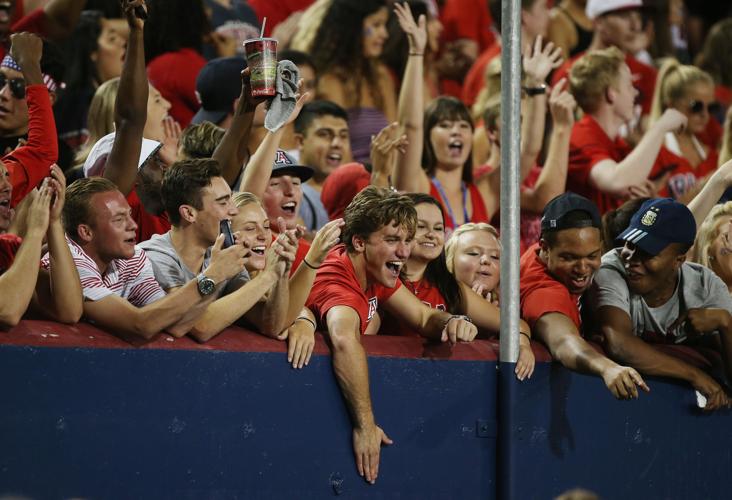

Tired of having rival fans bolt from the stands following UA basketball losses — and sometimes bumping into players — Wildcats officials lobbied hard for the Pac-12’s new court/field storming penalties.
Now the Wildcats and their fans will have to hold up their share of the bargain. Maybe even as soon as Saturday, if the UA football team upsets ninth-ranked Washington and tempts fans to race onto the Arizona Stadium turf.
The Pac-12 will fine schools $25,000 the first time their fans rush the playing surface within 60 seconds of the end of any game they host. The fine increases to $50,000 for a second offense and $100,000 for a third.
However, if opposing players, officials and staffers are able to exit safely within those 60 seconds, Pac-12 commissioner Larry Scott can waive the fine. Cal was not fined when more than 100 fans rushed the Memorial Stadium turf after a 50-43 win over Texas last week. That’s because most fans did not hit the turf until after a minute of the game’s end.
The Pac-12 also requires each school to have a security plan in place, as it did before the fine system was instituted, though an Arizona State spokesman declined comment and UA athletic director Greg Byrne offered little detail.
“I’m not going to get into the weeds there,” Byrne said. “The main point is we want to make sure we adhere to the Pac-12 policies and we want to encourage fans after big wins that they don’t rush the field in football and storm the court in basketball.”
Washington’s “Rush the Field Security Plan,” which it released to the Star, was put into place before last season. Among other things, it calls for 20 police officers and 32 contracted security officials in the student section alone, while the visiting team is assigned another 30 contracted officials, 10 of whom are stationed behind the bench, plus seven police officers, with three assigned to the head coach alone.
In addition, Washington’s plan also calls for six contracted security officials at each goal post, while staffers are instructed to follow a number of procedures as the game winds down, including prodding students back into their seats in the fourth quarter, in order to create more time before they might be able to rush the field.
At Colorado, where an improved Buffaloes football team has the potential to pull fans out of the stands this season, police and event staff routinely prepare in the fourth quarter no matter how the game is going, according to CU game day operations manager Steve Pizzi. However, the school’s Folsom Field does not have high barriers to the field in some areas.
“It’s not the easiest thing in the world to stop a few thousand people but we’re getting the message out to our fan base,” Pizzi said. “A big win here would maybe create some issues for us. … There are some facilities that have more imposing features (to get onto the field) as our stadium. But there are walls and height barriers at certain points and we put staff in appropriate places and it’s not like somebody can walk directly on to the field.”
Washington State’s Martin Stadium also has minimal barriers to the field in some areas, though WSU spokesman Bill Stevens said the school has added extra security and put forth a “heightened emphasis” on field-rushing this season.
Arizona Stadium has varying physical barriers to the field. It has narrow, controlled access points in the southwest, northwest and northeast corners, while the only wide-open access to the field is on the southeast side — where the UA band sits.
The Zona Zoo student section, along the east side, is separated from the field by a four-foot high cement wall that features the words “DO NOT CLIMB WALL” stenciled repeatedly on it.
Even if fans ignored that order, they’d face an eight-foot drop down the other side of the wall on to the field. Plus, the two breaks in the wall — two five-foot-high metal gates, near each 37-year-line — can be padlocked.
At Utah, the natural barriers are even more intimidating. Fans face a nine-foot fall onto the Rice-Eccles Stadium turf from the student section, a drop that nobody attempted on Sept. 10 even after the Utes beat in-state rival BYU by holding off a last-minute 2-point conversion attempt.
Steve Pyne, Utah’s director of event management, said several fans braved a five-foot drop on the other side of the field but that they were quickly ushered away.
Pyne said it also helps that Utah has a tradition of sending players into the student section to celebrate, instead of fans racing to join them on the field, while the school is also one of several that allows fans on the surface five minutes after the game is over.
“That’s really helped because people think ‘Why rush the field and risk getting hurt, when I can go on it later?’ ” Pyne said.
While Utah has a big natural barrier in basketball, with a student section that’s about 10 feet off the Huntsman Center floor, Colorado does not. In fact, CU students sit close to the visiting team’s bench and have no physical barriers to rush on the floor, which they did after CU edged Arizona 75-73 late last season in Boulder.
The CU postgame marked the 11th time over the previous four Pac-12 seasons that homecourt fans have rushed the court following a Wildcat loss, and it may have been a tipping point.
Pac-12 school leaders had resisted a fine structure in recent years but voted one in last May.
The SEC had been the first conference to institute fines, which now range up to $250,000, and it fined both Vanderbilt and Auburn $100,000 during the past basketball season.
During home basketball games, court-storming has long been less of an issue for Arizona, because the Wildcats are often highly ranked and expected to beat anybody who enters McKale Center.
That likely won’t change this season, with Arizona considered a Top 10 contender. The UA is hoping its fans don’t change, either.
“I think our students at basketball have done a very good job of not rushing the court and we know that we don’t want that done to us on the road for the safety of our teams,” Byrne said. “We think our students will be supportive of not rushing the floor.”

