


The Hotline mailbag publishes weekly. Send questions to wilnerhotline@bayareanewsgroup.com and include "mailbag" in the subject line. Or hit me on the social media platform X: @WilnerHotline
Some questions have been edited for clarity and brevity.
Q: What was the most significant college sports story in 2025? — @cool_brezze
A: The Hotline has a bevy of content planned in the coming weeks that casts an eye to 2026, so this feels like an appropriate time to recap the previous 12 months.
Even for an industry undergoing momentous change on a monthly basis, 2025 was a year like no other.
At the risk of ignoring a handful of issues, many of which were specific to a school or a conference (e.g., Michigan firing Sherrone Moore for his personal transgressions), let's focus on four developments that will have a lasting impact on the majority of major college football and basketball schools.
1. House v. NCAA settlement

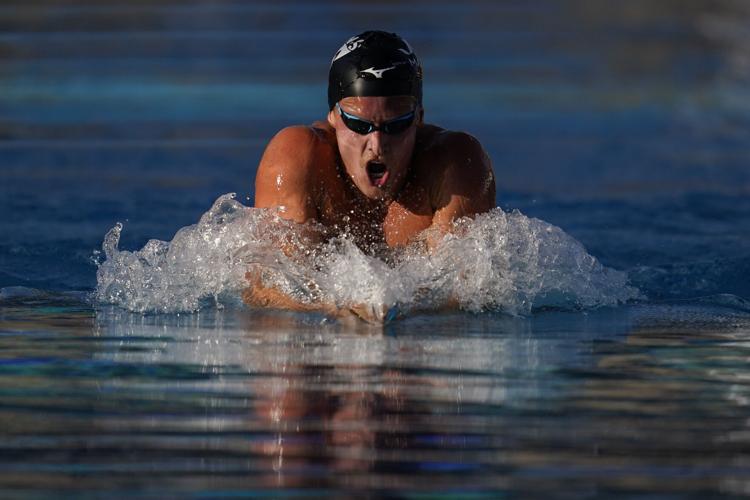
Grant House competes in the men’s 200-meter IM final at the TYR Pro Swim Series swim meet, in Mission Viejo, Calif., in this June 4, 2022, file photo.
One of the most impactful legal cases in college sports history made revenue sharing with athletes the law of the land, with all the accompanying downstream effects. (For example: Athletic departments have a $20.5 million expense on their budget that will increase over time as revenues grow.)
The settlement also created the College Sports Commission to oversee and enforce legal NIL.
But as the Hotline noted when the settlement was approved by Judge Claudia Wilken last spring, it did not mark the beginning of the end of the economic revolution in major college sports but, rather, the end of the beginning.
2. NCAA Tournament expansion
The powers-that-be in college basketball were fairly clear in 2025 that March Madness, arguably the best postseason event in American sports, eventually will expand from 68 teams to at least 76. The change could happen as soon as the spring of 2027.
The tournament has held its perfect shape since 1985, aside from the addition of the First Four (in 2011). A move to 76 teams would impact not only the format but the way we consume the event and, of course, the meaning of the regular season.
Expansion is inevitable, not because of the public's desire to watch 13-loss teams play in the first round, but because tournament participation boosts job security and triggers performance bonuses for coaches and athletic directors.
3. ACC grant-of-rights change
To settle lawsuits filed by Clemson and Florida State, the ACC agreed in March to change its revenue-distribution formula and, crucially, adjust the terms of the grant-of-rights contract that binds the schools together until 2036.
The tweak lowers the penalty for departing the conference to a manageable amount ($75 million) starting in 2031.
Put another way: Any school with an offer to join the SEC or Big Ten will be able to afford the move in five short years.
The date for the next realignment wave has been set.
4. Utah's private equity deal
The embrace of private equity came from a single school — and not one in the Big Ten or SEC. But every athletic department across the FBS was waiting for someone to become the first to welcome outside capital into its home.
Utah's move, announced in December, will undoubtedly spark a barrage of comparable deals, thus creating a new era. Within three years, dozens of schools could be linked arm-in-arm with the PE world.
The Utes assumed immense risk as the first to take the plunge but should be commended for their creativity and guts.
Anyhow, those are four developments that came immediately to mind because of their impact on budgets and talent acquisition (House), everyone's favorite event (March Madness), the next realignment wave (ACC) and the influx of private capital into college sports (Utah).
We could have mentioned 15 or 20. It was a wild year.
Q: In two years of the expanded College Football Playoff, the SEC is 3-5 against other conferences and all three wins are against automatic qualifiers (Arizona State, Clemson and Tulane). Will the selection committee finally get away from giving extra weight to middle-tier SEC wins (like when Alabama jumped in the rankings because of the victory at Auburn)? — @WorkishFromHome

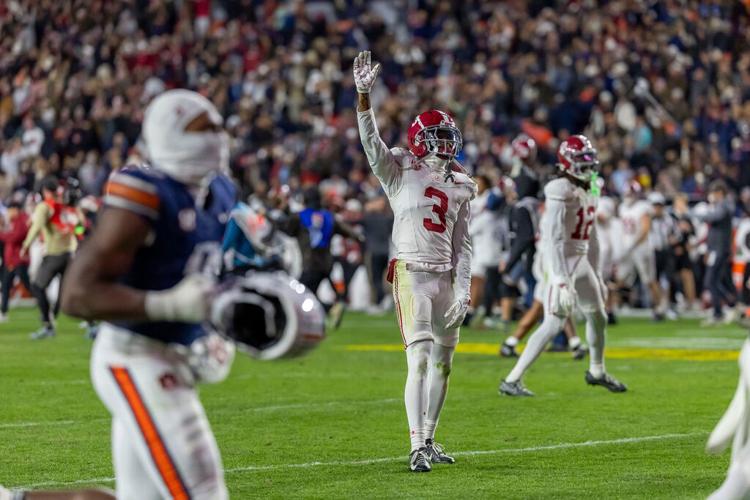
Alabama defensive back Keon Sabb (3) waves to the Auburn student section after an Alabama win, Nov. 29, 2025.
A: First, the committee's handling of Alabama after the Iron Bowl was an abject embarrassment.
Chair Hunter Yurachek, who did the CFP no favors with his stumbling and bumbling, noted the Crimson Tide "went on the road in a rivalry game, looked really good, especially in the first half, getting up 17 to nothing, ran the ball well."
Apparently, the remaining portion of the game, in which Auburn outscored the Tide 20-10, didn't count. It was comical.
The committee's treatment of the SEC as a whole was reasonable in our view, and here's why: To that point, the data suggested it was, by far, the deepest conference.
Which data? The Power Four-vs.-Power Four matchups that unfold in the first half of September and, in some cases, on rivalry weekend.
The SEC was 12-6 against the ACC, Big 12 and Big Ten. No other conference was close in total wins or winning percentage.
So, at the point in which the committee set the initial rankings (early November) and then created the CFP bracket (early December), the results suggested the SEC was, in fact, the deepest conference.
Meanwhile, the Big Ten, despite its obvious strength at the top, performed far worse in the inter-conference matchups, and the ACC was downright abysmal.
Unless and until the schedule models change — to allow more non-conference matchups later in the season — the results in the opening weeks will have outsized influence on the selection process.
Q: It seems the middle tier of the Big Ten deserves a bit more respect than it received during the regular season. Many pundits said the SEC was much stronger in the middle, but the bowl season has shown that’s not necessarily the case. — Robert T
A: The Big Ten has performed well in the postseason, both in bowl games and the CFP. But as we noted in the previous response, the regular-season results painted a different, dimmer picture of the Big Ten.
The conference had a sub-.500 record in Power Four-vs.-Power Four matchups and less than half the number of wins as the SEC in those instances.
Iowa (to Iowa State), Michigan (Oklahoma) and Minnesota (Cal) all sustained losses to power conference opponents that suggested the middle of the Big Ten was mediocre while the bottom of the conference (UCLA, Purdue, Wisconsin, Maryland, Rutgers, Northwestern) was third-rate.
For pundits and selection committee members alike, it's difficult to ignore the results.
Heck, the Hotline took a cynical view of the middle of the Big Ten because of the aforementioned results and the lack of marquee non-conference matchups.
Ohio State played Texas and Michigan faced Oklahoma. But generally speaking, Big Ten teams had fewer high-level matchups than their counterparts in the SEC, ACC and Big 12.
The end result was a bone with little meat and plenty of fat.
One final point — and this applies to all the power conferences: The disconnect between regular-season performance and bowl results is greater than ever because of opt-outs.
In our view, the former offers more insight than the latter. We assess the bowl results with a half-grain of salt.
Q: The Group of Six conferences receive only one or two CFP bids annually, meaning 66 or 67 schools are left out. Where do they go? I think they will get tired of being cannon fodder for the elite teams. — E Thompson
A: Starting next year, the Group of Six, including the rebuilt Pac-12, likely will have just one playoff berth.
The selection process is expected to change in a manner that guarantees a berth for the champions of the ACC, Big 12, Big Ten and SEC, according to Yahoo. The situation we just witnessed, with the ACC winner (Duke) failing to qualify and James Madison taking the spot, won't happen again.
Some industry observers believe the Group of Six leagues (American, MAC, Conference USA, Sun Belt, Mountain West and Pac-12) would be better served with their own playoff than by intermingling with the power conferences in both the CFP and the Bowl Season.
But that road would lead straight to the abyss for the G6.
Untethering itself from the power conferences in the current structure would be a strategic miscalculation. There's too much TV money and media exposure involved in the association.
And in some instances, the G6 comports itself quite well: In the regular season, Tulane beat Duke and Northwestern, South Florida handled Florida and Memphis beat Arkansas (to name four) while in the bowl season, Hawaii beat Cal, East Carolina beat Pittsburgh and Navy beat Cincinnati.
If the G6 removed itself from the existing postseason, there would be little separating it from the FCS.
Q: When are we going to see football games of our favorite high schools streaming live on ESPN+, Fox One or Peacock? — @TerryTerry79
A: I'm not sure about Fox One or Peacock, but ESPN has aired high school football games for years on its linear and digital platforms. Granted, only a handful are shown, mostly in August. But the content is available.
If you're wondering about full-season packages being available a la carte, well, that step could be a few years away.
The best example to illustrate the situation is the Trinity League in Southern California. Could its powerhouse schools, which include Mater Dei, St. John Bosco and Santa Margarita, cut a national broadcast deal with ESPN?
My guess is the governing body, the California Interscholastic Federation (CIF), would have to approve — and in that case, the bureaucracy and politics would be immense.
This feels like something for the 2030s.
Q: What is the threshold for USC coach Lincoln Riley to save his job next year? For me, if Riley doesn't win nine games in the regular season, it's easy to see him being let go. — @Ddwag367744
A: The victory total is only half the calculation. The cost to USC of buying out the remaining years of Riley's contract cannot be ignored if there's a decision to be made.
The details are not publicly available. But our sense is that the buyout drops each year by $10 million to $12 million, meaning it likely would hover in the $70 million range after next season.
Another consideration: USC's schedule in 2026 is brutal, even without Notre Dame.
The Trojans play Indiana and Penn State on the road and host Ohio State, Oregon and Washington. Given that gauntlet, an 8-4 record looks pretty darn good and 9-3 would put the Trojans in position for a playoff berth.
Which begs the question: Is it CFP or bust for Riley in 2026?
We don't view that as an unfair standard. After all, six teams currently in the Big Ten (Indiana, Ohio State, Oregon, Penn State, Michigan and Washington) have qualified for the playoff in the past three seasons.
The Trojans have never participated in the CFP, which is difficult to fathom. (Of the 10 winningest programs in major college history, only USC and Nebraska have failed to make the playoff since its inception in 2014.)
Riley's tenure covers four of those 12 failed seasons. In our view, USC would not be acting unreasonably if another CFP whiff prompted Riley's dismissal, as long as the Trojans can muster the cash.
Q: If Jedd Fisch had left Washington, who would the school have hired? My first choice would have been Kyle Whittingham, followed by Brian Kelly. What do you think? — @BolfMike
A: We typically don't play the hypothetical hiring game until the sitting coach has moved on. But because ex-Arizona Wildcats coach Fisch would have left on his own volition — as opposed to being fired — speculation of this sort doesn't feel disrespectful.
Whittingham would have been an interesting candidate, for sure. (Kelly, not so much.) His coaching style fits on Montlake and in the Big Ten, and Michigan was smart to grab him.
But in our view, UW's first call should have been to Jason Eck, who just finished his first season at New Mexico. Eck is the next Kalen DeBoer for whichever power conference school is smart enough to make the move.
Eck worked magic during three seasons at Idaho and just won nine games in Albuquerque. He knows the western third of the country and is a former offensive lineman who played for, and coached under, a Hall of Famer: Wisconsin's Barry Alvarez.
And from what we have seen, his personality suits the UW ethos and Pacific Northwest vibe.
The Huskies were fortunate to retain Fisch for another season. If he bolts next winter, they would be wise to pursue Eck with every resource available.
Q: Who is one college sports official you would love to interview in 2026 for your podcast, 'Canzano and Wilner', who has never been a guest? — @jimmy0726
A: Good question, and I don't have one answer. There are a handful of guests on the wish list, starting with two commissioners, the Big Ten's Tony Petitti and the ACC's Jim Phillips.
(Petitti rarely does media appearances, which is part of the reason his conference has repeatedly lost the narrative on crucial issues like CFP expansion and the transfer portal.)
Another name: Burke Magnus, ESPN's president of content and arguably the most influential person in college sports over the past 15-20 years.
There are several athletic directors and industry officials on the list for 2026 — hopefully, a few of them will agree to join us.
And my assumption is many fans would love to hear from Larry Scott and George Kliavkoff, the twin agents of Pac-12 destruction, but they are laying low for good reason.
Thanks for asking.

