



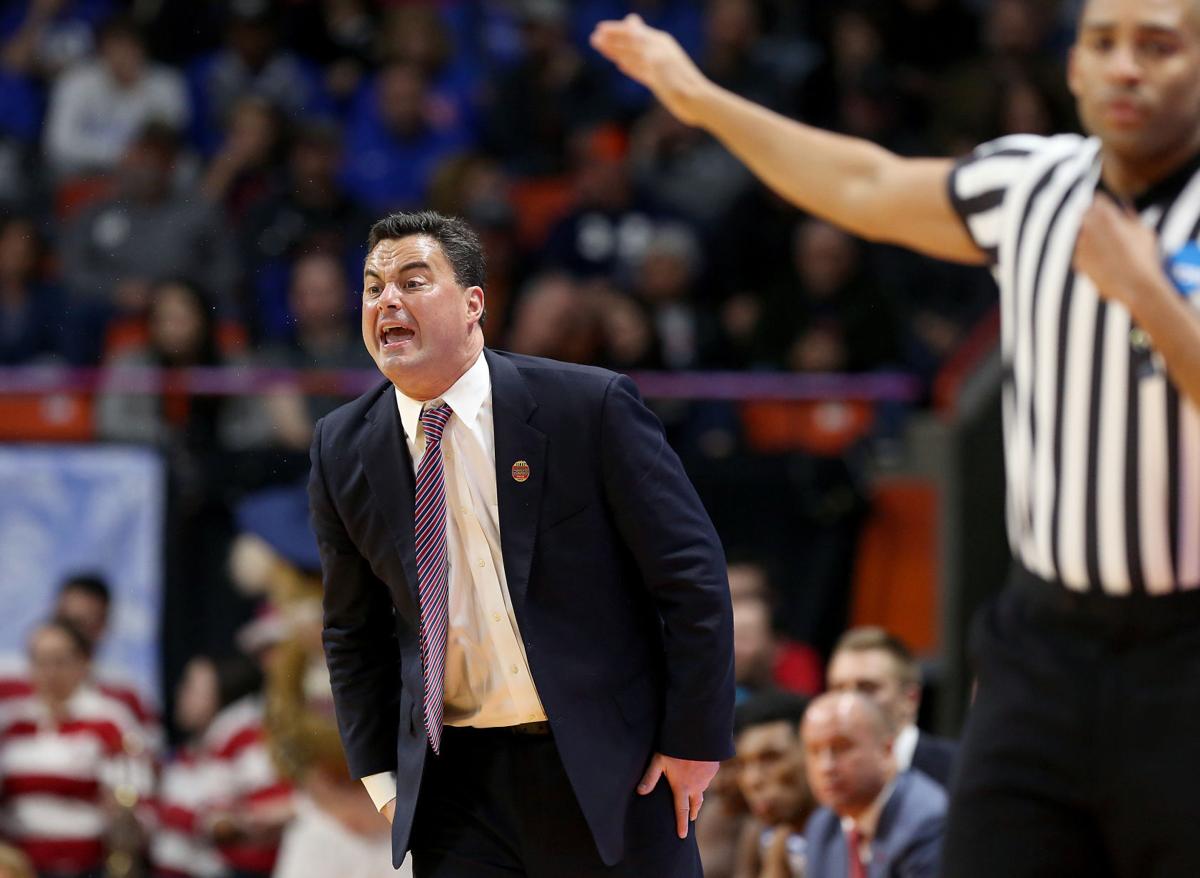
If the NCAA’s academic misconduct allegations against Arizona hold up in the Independent Accountability Resolution Process, there’s at least one possible benefit for the Wildcats.
Buffalo goes away. Forever, at least in the record books.
The Wildcats’ shocking appearance in the 2018 NCAA Tournament, an 89-68 first-round upset loss to Buffalo, could be vacated along with up to 50 regular-season wins and three other NCAA Tournament games. That’s because the NCAA enforcement staff says a player's ineligibility resulted from the misconduct, which reportedly was to get Rawle Alkins in a Wildcat uniform.
It’s not certain the IARP will make such a ruling even if the allegation holds up, since vacated games are considered an additional and not “core” penalty.
But NCAA rules and precedent suggest it’s a possibility: The player believed to be Alkins could be ruled both retroactively ineligible and improperly recruited after the NCAA’s Notice of Allegations claimed former Arizona assistant Book Richardson arranged to falsify a recruit’s academic transcript to get him into school.
Meanwhile, the NCAA claimed another former UA assistant, Mark Phelps, “arranged for a false or inaccurate academic record” involving an Arizona recruiting target in 2017. Phelps was removed from the UA staff in February 2019 after ESPN reported that he was accused of a violation regarding former recruit Shareef O’Neal’s academic transcripts.
In the case that appears to involve Alkins, the NCAA alleged that, beginning in March 2016, Richardson “engaged in pre-enrollment academic misconduct and provided a recruiting inducement” when he arranged for and/or paid $40,000 to obtain fraudulent credit to help a player meet academic eligibility requirements.
The NCAA enforcement staff wrote that the fraudulent transcript was provided to UA and subsequently sent to the NCAA Eligibility Center. As a result, it said, the player “competed while ineligible.”
In September 2019, citing an FBI recording that was not presented as evidence in the federal basketball trials, Yahoo reported that Richardson discussed paying $40,000 to a “high school coach” to help ensure Alkins’ eligibility. ESPN reported that Richardson told agents that Alkins needed one more class to become eligible at UA, and that an unidentified coach wanted $40,000 to put the class to his official transcript.
The coach “said, ‘Book, I need $40,000 to get this on his transcript. If he does not get this class, he’s gonna be a partial qualifier. He’s not gonna have 16 credits to graduate,’ Richardson said in the recording, according to ESPN. “So long story short, I said OK. You need 40 grand for that class. He said, ‘Yes, Book, because it’s not just me doing it. I gotta take care of some people.’ I said, ‘(Expletive) you I’m not doing it.’ Tried to play poker and one week turned into a month, and I said, ‘Oh s---.’”
On Aug. 1, 2015, Alkins — a rising five-star prospect — tweeted out a Top 10 list that did not include Arizona. However, he took an official visit to Arizona in January 2016, watching as Oregon snapped the UA’s 49-game homecourt winning streak, and committed to the Wildcats less than six weeks later.
“One thing really stuck out with me when I took that visit was that (at UA) winning the only option,” Alkins said.
“They lost their first (home) game in three years. That really stuck with me.”
Alkins surprised some by waiting until a week after the spring signing period opened before signing his letter-of-intent. One of his former coaches in New York told the Star after his eventual signing that Alkins was waiting until his mom was “on board” with the signing before doing so.
Atlanta-based attorney Stu Brown said if a player is ruled retroactively ineligible only due to academic issues, a team would only have to forfeit wins until he became subsequently eligible by passing enough classes at his college.
But Brown added that “if the enforcement staff’s ‘recruiting inducement’ theory is upheld in the IARP process, then vacation of all games in which the relevant player participated over the course of his UA career before any ‘student-athlete reinstatement’ occurred is a possible outcome based on NCAA precedent, though not necessarily a foregone conclusion.”
Alkins played in all 37 of the Wildcats’ games in 2016-17, when they won 32 games and appeared in three NCAA Tournament games. Because of foot issues, he played in only 18 of the Wildcats’ 27 wins in 2017-18. He played in their final 13 games ... including the loss to Buffalo.
Alkins was never ruled ineligible during his playing career. If the NCAA’s allegation holds up, it’s unclear whether the IARP would make Arizona vacate all games he played in, some of them or none.
But typically, teams must vacate all regular season wins and all appearances in the NCAA Tournament, while coaches’ records and sometimes even individual player statistics can be erased.
Arizona was forced to vacate its one-game NCAA Tournament appearance in 1999 NCAA because of benefits then-UA guard Jason Terry took from an agent, and to vacate 19 wins and an NCAA Tournament game in 2007-08 because of improper involvement with the Cactus Classic recruiting event at McKale Center.
UA’s record book reflects adjustments for both seasons. Similarly, Syracuse’s media guide lists the effects of vacated games between 2004-05 and 2006-07 due to rules violations along with a subtraction from coach Jim Boeheim’s record.
In a 2016 ruling against Southern Miss involving academic fraud, the NCAA ordered the school to vacate all wins from the time the involved players were ineligible until they were reinstated.
The NCAA also told Southern Miss it had to reflect all records from the involved games, including on the then-coach’s record, and that head coaches with vacated wins on their records may not count those vacated wins toward any specific honors or milestones.
If such a penalty were applied to Arizona, coach Sean Miller’s 302 wins could be reduced to as few as 252. The 300th win he celebrated on Feb. 20 at USC may be only his 250th.
In addition, Arizona could potentially decide to claw back up to $355,000 in performance bonuses Miller received during the 2016-17 and 2017-18 seasons, including $100,000 each year for winning both the Pac-12 regular season and tournament titles.


