


SEATTLE — With lifelong roots in the nation’s midsection, Dana Altman left as Creighton’s head coach to take over the Oregon program in 2010 and took a hard look around at his new environment.
“We looked at these programs and said, ‘We’ve got to compete with Arizona. We’ve got to compete with UCLA,’ Altman said. It was “Can we recruit at this level? Those are the programs we’ve got to beat.”

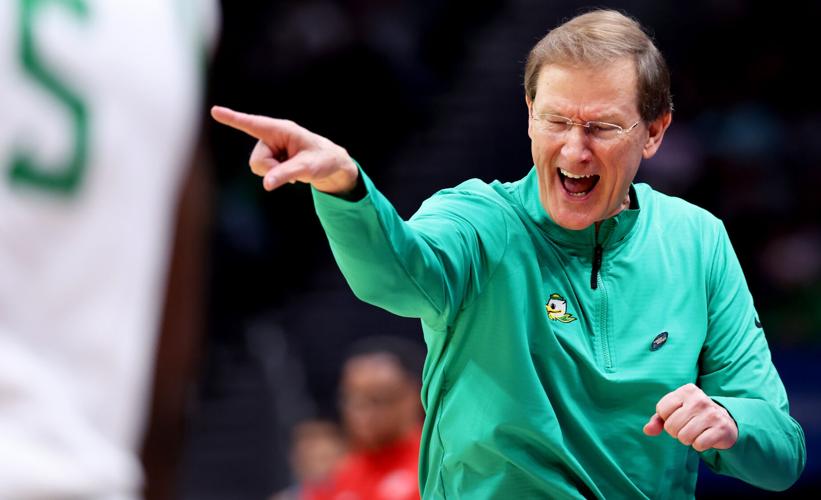
Oregon’s head coach Dana Altman tries to get the Ducks in their offensive set during a possession against Liberty during the second half of their first-round game of the NCAA Tournament in Seattle on March 21, 2025.
Could they survive the Pac-12? Could they survive and blend into West Coast college basketball?
Altman’s Ducks did, continuing one of the Pac-12’s best rivalries since the early 2000s with Arizona, a rivalry that will be renewed Sunday under far different circumstances in the second round of the NCAA Tournament.
If there’s a West Coast identity now, maybe it’s the West Coast Conference’s best teams, Gonzaga or Saint Mary’s, or Mountain West teams such as San Diego State, which made a run to the 2023 NCAA title game.
But it’s not the Pac-12, for now anyway, at least until Gonzaga and SDSU join in 2026-27 and maybe something else happens.
For now, there is no “Conference of Champions,” no conference tournament on the Las Vegas Strip, not even a tie-dyed Bill Walton around.
Thanks to a cosmic, TV-driven conference blowup in August 2023, the Wildcats became absorbed in the Big 12 this season, while Oregon bled into the Big Ten along with UCLA and, at least for now, that’s just how it is.
UA and UO are playing out West on Sunday, in old Pac-12 country, but this is not a Pac-12 game or even a West game. It’s an NCAA Tournament second-round game within the East Region that just happens to be played in Seattle and just happens to have Arizona facing Oregon.
“With these conferences spanning the country, us in the West are going to have to fight hard for our place at the table and for our identity because we don’t have a league that’s committed to a region of the country,” Arizona coach Tommy Lloyd said. “We’re going to have to fight. We’re going to have to scratch. We’re going to have to claw and let people know we’re here.
“How do you do that? You win, you’re successful, you’re competitive, and you play a national schedule. Those are the things that we’re going to do to continue to let people know that Arizona basketball is here for it. We’re here for it.”
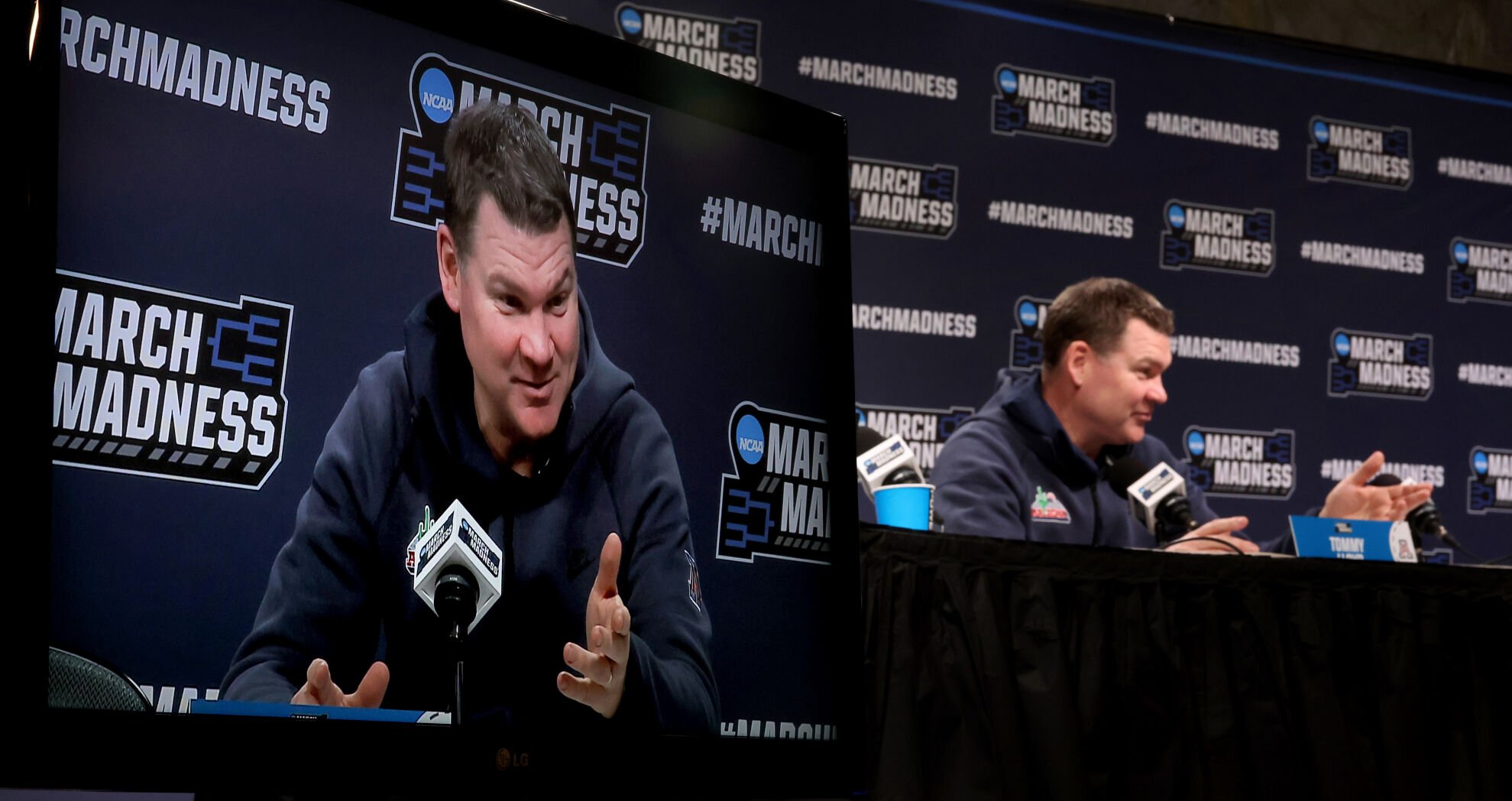
Arizona coach Tommy Lloyd fields questions at a press conference after the Wildcats finished up their practice session for their second-round game against Oregon in the men’s NCAA Tournament in Seattle on March 22, 2025.
Arizona mostly played its part, slightly beating expectations of a fifth-place finish in the Big 12 by tying for third place, playing none of its games in the Pacific time zone but most away games in the Central and even East time zones.
They had no choice.
“Just because we’re the furthest west team (in the Big 12) or one of them that goes all the way to Orlando and Morgantown and Cincinnati, we’re OK out here,” Lloyd said.
Oregon also held its own in the Midwestern-rooted but now coast-to-coast Big Ten, finishing in a seventh-place tie while winning six of 10 conference road games.
And like UA players and coaches have credited the Big 12 for toughening them up, preparing them for this day, Oregon players say the exact same things about the Big Ten.
The Big Ten “was a great experience,” said Oregon center Nate Bittle, an in-state recruit who played three years for the Ducks in the Pac-12. “It’s a different league, way different than the Pac-12. The Pac-12 is a little faster pace. The Big Ten is more physical, more gut-it-out games.
“I think that playing in that league taught us a lot this year. We’ve been in a lot of close games with a lot of good teams. We played a really good schedule. It’s prepared us for these moments.”
Also like the Wildcats, the Ducks found full or at least vocal arena environments almost everywhere they went. No 80% empty Washington State arena, no half-full Bay area gyms.
Just fans excited to see them, and harass them.
“The Big Ten fan base is a little different,” said Oregon forward Brandon Angel, a transfer from Stanford. “A lot of student sections are right behind your bench, and they have huge turnouts pretty much every game. That’s what’s fun about it.
“It’s a super fun environment. You want games like that. We all love to play in that.”
At the same time, both Bittle and Angel are West Coast kids who grew up paying attention to a league that may never be quite the same.
“I grew up watching the Pac-12, being from the West Coast, so not having the Pac-12 is a little weird,” Angel said. “Playing four years in the Pac-12, and not playing those same teams every year is obviously different.”
While Angel was able to play the four final seasons of the Pac-12’s last iteration for Stanford, another Southern Californian, Arizona forward Carter Bryant, didn’t even get the chance.
He committed to a Pac-12 school, signed with what was still a Pac-12 school and then showed up to play as a freshman for the Wildcats this season ... in the Big 12.

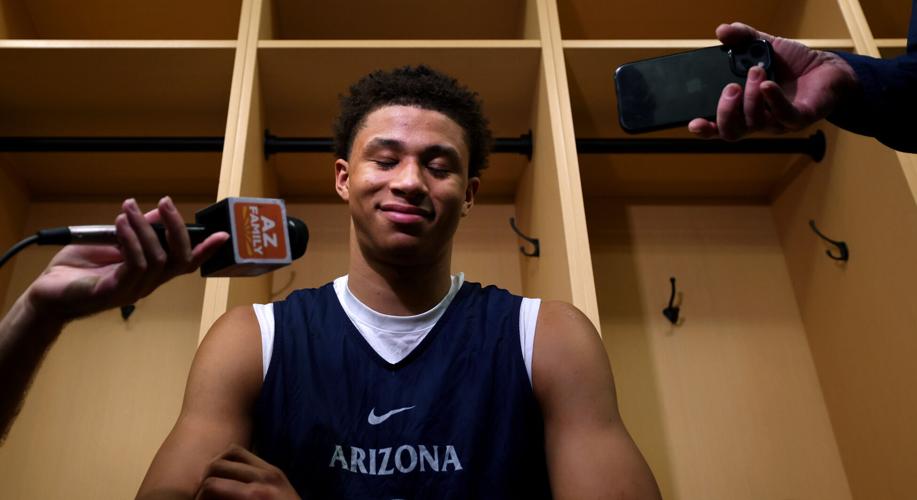
Arizona forward Carter Bryant (9) stops for a second to gather his thoughts before answering a question while meeting with reporters the day before their round of 32 game against Oregon in the men’s NCAA Tournament in Seattle on March 22, 2025.
“I grew up watching Pac-12 basketball … and obviously, from a fan perspective, it’s sad to see the Pac-12 kind of break down and just not be the same as it was before,” Bryant said. “But I think it’s a great thing for the game of basketball. I think we’re starting to see new matchups. We’re going to see a lot more rivalries form moving forward. So I think that’s just a good thing for basketball.”

