


SAN DIEGO – When the Arizona Wildcats outrebounded Utah State 54-26 on Sunday to help themselves get out of the NCAA Tournament’s second round with a 12-point win, they weren’t just crushing the Aggies on the glass.
They were also shattering the glass slipper.
For the second year in a row, the NCAA Tournament will not have a single mid-major team in the Sweet 16, not a single team that qualifies as a Cinderella, those small-budget teams that manage to dance deep into the tournament, a phenomenon that used to help push the event into cultural transcendence.
“I think America is dying for a mid-major,” Utah State coach Jerrod Calhoun said Saturday, a day before his team became the last one to exit the tournament -- and two days before reports surfaced he would become the new coach at high-major Cincinnati. “Everybody in the country roots for the underdog.”
Before the NIL era, mid- and even low-major teams annually won NCAA Tournament games, often by leaning heavily on veteran players with the savvy and determination to defeat a more talented but less experienced high-major team.
Now a lot of those guys leave mid-majors after a year or two, heading into the transfer portal to chase six- or even seven-figure money at high-major schools instead of sticking around for a potential NCAA Tournament upset or two.
Utah State standout Mason Falslev became a rare exception last spring when he turned down what Calhoun called "astronomical numbers" to play elsewhere.
But more common are the stories like the ones Arizona has: Anthony Dell'Orso joining the Wildcats before last season after leading low-major Campbell in scoring, and Trey Townsend starting for the Wildcats last season, a year after he helped Oakland (Mich.) actually pull off a Cinderella-ish win over Kentucky in the first round.

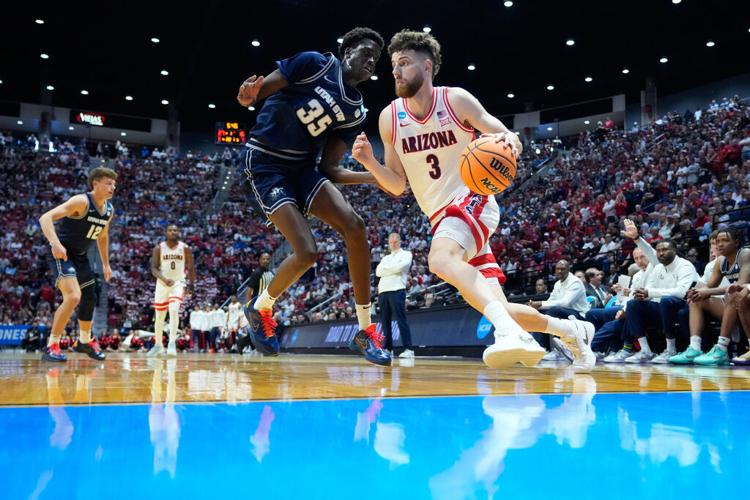
Arizona guard Anthony Dell'Orso drives against Utah State forward Adlan Elamin during the first half in the second round of the NCAA Tournament Sunday, March 22, 2026, in San Diego.
Stories like those are everywhere now, collectively draining the mid-major talent pool.
“I think once finances become part of it, there's going to be a breaking point for some of the lesser programs that just don't have the finances,” UA coach Tommy Lloyd said. “I think that's just an obvious statement.”
Colleges are allowed to pay athletes up to $20.5 million this season across all sports under the House settlement that was approved last June, “revenue sharing” payments that are typically combined with outside NIL funds to essentially create roster budgets.
While Arizona won't disclose the amount it specifically gives men’s basketball players — and while NIL contracts are shielded from public-records requests by Arizona law — UA officials have said the program is competitive.
Most coaches also decline to discuss roster budgets, but before Sunday’s game, Calhoun said it would soon be clear “what the price tag is to get to a Sweet 16,” and that “most of the power fours you talk to, they say $10 million.”
“And it’s not going down,” Calhoun added.
Calhoun said Utah State didn’t give men’s basketball any revenue-sharing money this year, yet the men's basketball team still managed to increase its budget from about $880,000 to $2.4 million this year, thanks to fundraising.
“I think it's on every coach's mind around the country,” Calhoun said. “You think about back in the day, it was, 'What's your practice facility look like? What's the arena? Are you chartering? What's the deal?'
“Now it's 'What's the budget? What's the school sharing with you? And what's the donor base like?'”

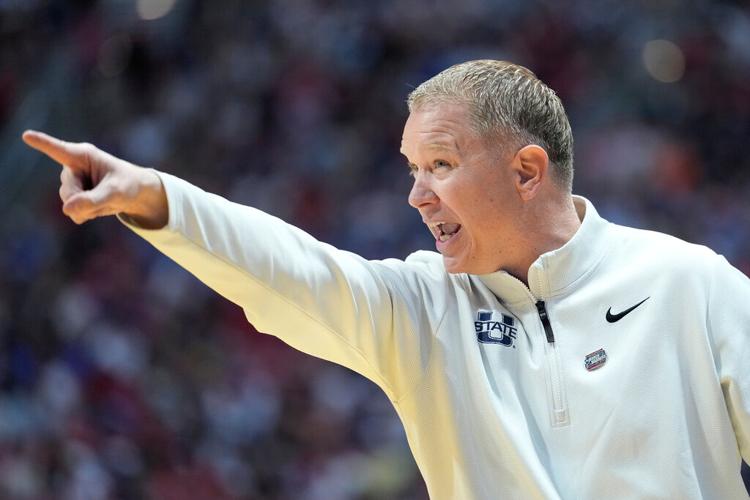
Utah State head coach Jerrod Calhoun motions towards the court during the first half against Arizona in the second round of the NCAA Tournament Sunday, March 22, 2026, in San Diego.
Calhoun said he knew his staff would need to spend 70% of its offseason time raising funds, but that Utah State had an “incredible” donor base that helped. He said USU raised $300,000 alone by hosting an event with former Aggie pros, while he and his wife also kicked in $150,000, making them the program's second-highest donors.
“It's the fight that every university has,” Calhoun said. “That's what I said (Friday) with the administrators. They've got a tough job. ADs don't have it easy either.”
Thanks, possibly to all that fundraising, Utah State managed to keep Falslev and bring in standout guard MJ Collins from Vanderbilt, two players with market values likely at least in the high six figures. The Aggies still weren’t the most well-endowed program in the Mountain West, but won the conference’s regular season and tournament titles.

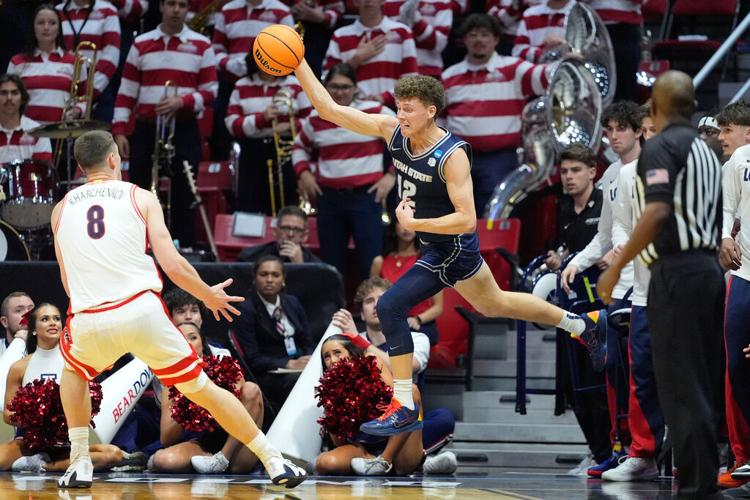
Utah State guard Mason Falslev (12) keeps the ball in bounds against Arizona forward Ivan Kharchenkov (8) during the first half in the second round of the NCAA Tournament Sunday, March 22, 2026, in San Diego.
Yet they received only a No. 9 NCAA Tournament seed and their season is over after just two tournament games.
Lloyd might have known he could have been thrown into a similar situation. So when asked after Arizona’s win Sunday what he thought about the Sweet 16 lacking a mid-major team again this season, he said it was a “good question and a deep question” before giving his answer.
“There's lots of reasons I took the Arizona job and one of them was forecasting these changes happening, because right when I was getting the job (in 2021), the NIL deal was rumored,” Lloyd said. “Then it started in July,” just three months after Lloyd took over the Wildcats.
“I figured Arizona's a place that has a pretty strong, long basketball tradition, and they're going to be excited to invest in basketball, and we have.
“So I'm thankful for where I am. But I think that's a great question. I don't have a great answer for you on how to fix it. So let's just leave it at that.”

