



Because coaches vote for Big 12 postseason awards, and because they tend to highly value conference regular-season championships, choosing the conference’s Player of the Year can be simple.
Best player on the best team. Period.
Like Houston’s Jamal Shead in 2024, or any of five Kansas players in the seven seasons before that. Even Pac-12 coaches, who also voted for the postseason honors, chose Arizona’s Caleb Love in 2024 over the conference’s leading scorer, Washington’s Keion Brooks, and ultra-efficient Colorado point guard KJ Simpson when the Wildcats won that league that season.
That’s the sort of philosophy Arizona coach Tommy Lloyd says he believes in, anyway.
“I'm pretty biased towards our guys — I've always been biased — but usually I think the league champ should get the first shot at that,” Lloyd told the Star. “But everyone gets their vote. It's their right to vote how they want, and we'll see how it plays out.”

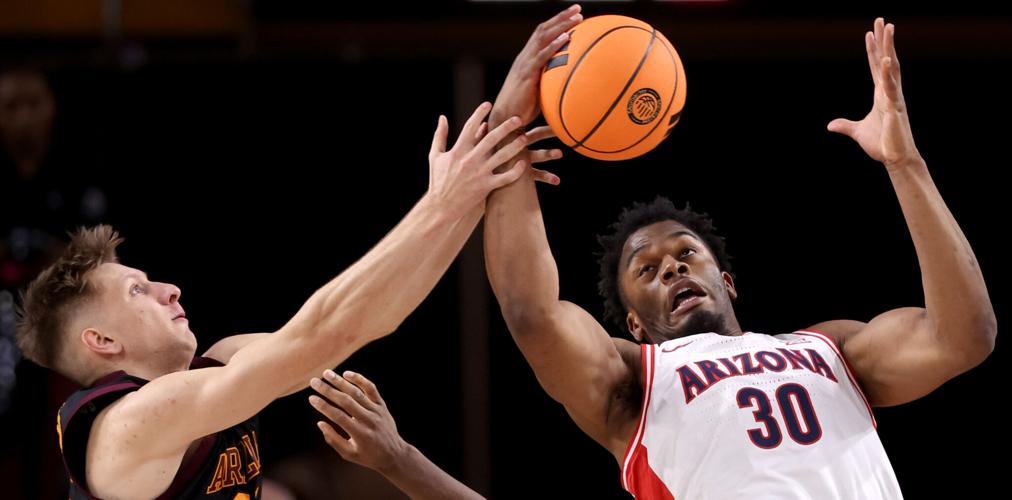
Arizona forward Tobe Awaka snares a rebound out of the hands of Arizona State guard Noah Meeusen in the second half of their Big 12 game, Jan. 31, 2026, in Tempe.
The vote totals might not play out in Arizona’s favor because, among other things, how would coaches decide? Balance helped the Wildcats win the league, but it did not produce a single statistical monster.
Could they vote for Jaden Bradley, the Wildcats’ floor leader and often most clutch player during many of their biggest wins?
Could it be Brayden Burries, who came alive in the Big 12 season to score 20 or more points in six conference games, and played game-winning roles, especially at BYU and at home against Kansas?
Or what about Motiejus Krivas, the legit 7-footer whose stats don’t fully reflect how he changes the game defensively by imposing himself around the rim? Coaches do tend to value that sort of thing.
(And we’re not even talking about Koa Peat, the potential NBA lottery pick, or Ivan Kharchenkov, who has emerged largely under the national radar as a two-way force.)
So in light of all that, the award Monday could well go instead to multiskilled BYU forward AJ Dybantsa, who leads the league in scoring average for conference games at 26.3. Or somebody like versatile, two-way Iowa State standout forward Joshua Jefferson.
Or maybe, if he isn’t judged on missing the final five games of the regular season with an ACL tear, the vote could go to Texas Tech’s JT Toppin, who left as the conference’s third-leading scorer (22.6) and leading rebounder (11.1) — and led the Red Raiders to an overtime win at Arizona on Feb. 14.
There’s also Kansas State’s PJ Haggerty, who has averaged 23.7 points a game … but has done so on one of the conference’s worst teams.
Still, there's at least two major awards that Arizona might run away with when the conference honors are announced Monday, before the Big 12 Tournament begins a day later.
One is Lloyd as Coach of the Year, considering that the Wildcats were picked fourth and will win the league outright by at least one game even if they lose at Colorado on Saturday.
The other likely call: Tobe Awaka as the league’s Sixth Man of the Year. Awaka trails only Toppin in overall rebounding during conference games (9.2), and he leads all of Division I in offensive rebounding percentage, picking up 20.8% of his teammates’ missed shots when he’s on the floor.
Arizona forward Tobe Awaka snares a rebound out of the hands of Arizona State guard Noah Meeusen in the second half of their Big 12 game, Jan. 31, 2026, in Tempe.
“Tobe is an absolute warrior,” Lloyd says. “He just plays so hard.”
The only player who appears anywhere near Awaka for sixth-man consideration is West Virginia guard Chance Moore, who averages 10.4 points and 5.4 rebounds off the bench. Iowa State’s Nate Heise hit a go-ahead 3-pointer with 1:17 left to help the Cyclones beat Houston on Feb. 17, but averages only 5.1 points a game.
“I don't even know who the other candidates are,” Lloyd said of the sixth-man award. “But Tobe's obviously had a really consistent, high impact year.”
Krivas, meanwhile, could have an argument for the Big 12’s Most Improved award, having roughly doubled his scoring (10.4) and rebounding (8.2) averages, though Texas Tech guard Christian Anderson and Iowa State forward Milan Momcilovic are among others who ballooned their production and/or efficiency.
Krivas could also have a shot at the five-player all-defensive team, having blocked an average of 1.8 shots a game and changed countless others. So could Bradley, who averages 1.4 steals a game on a team that doesn’t overly gamble for them and is among 15 players on the late-season watch list for the Naismith Defensive Player of the Year.

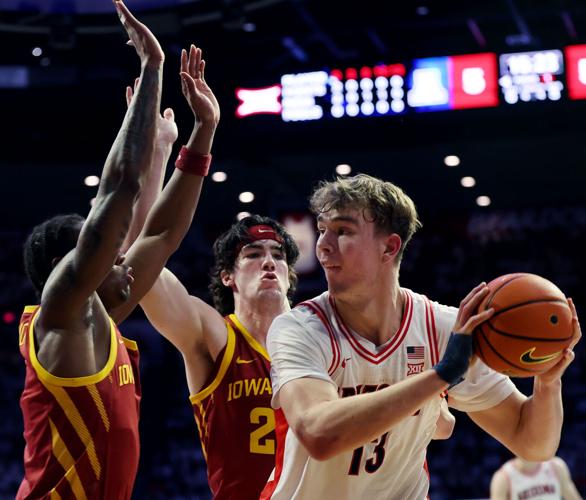
Iowa State guard Jamarion Batemon (1) and Iowa State forward Blake Buchanan (23) defend Arizona center Motiejus Krivas (13) in the first half during a game at McKale Center on March 2, 2026.
But because Dybantsa is only a freshman, he could also sweep the conference’s Freshman and Newcomer of the Year awards. And while Burries, Peat and Kharchenkov might all get consideration for the all-freshman team, that’s a group that could include Dybantsa, Houston’s Kingston Flemings, Baylor’s Tounde Yessoufou and Kansas’ Darryn Peterson, among others.
Ultimately, Arizona’s balance and success might be best reflected on the Big 12 all-conference teams. Last year, the Big 12 voted 10 players on to its first team, then five on a second and another five on a third team, for a total of 20 honorees.
All of Arizona’s top six players could get significant votes for those 20 spots.
“Sometimes that happens,” Lloyd said. “But we don't get too caught up in that stuff, preseason awards or postseason awards, because our team's still playing for something bigger.”

