

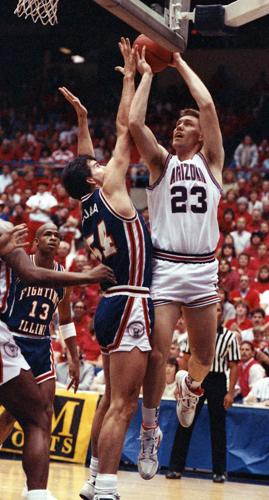

Of all the members of the Final Four-bound 1988 Arizona men’s basketball team — heck, of all the former Wildcats of any era — there may not be one as colorful as Tom Tolbert. Certainly not one brasher. Definitely none more honest.
Part of it is his job. Tolbert is going on his 22nd year as a host for KNBR sports radio in San Francisco, where he serves as one-half of the drive-time duo Tolbert and Lund.
Part of it is his hold-nothing-back personality.
Part of it is a renewed sense of vigor. Tolbert is six months removed from emergency heart surgery after a thoracic aortic dissection. For the former Arizona big man, who averaged 14 points and six rebounds per game over two seasons in Tucson after transferring from Cerritos (Calif.) College, it came as a shock.
Tolbert says he’s feeling better these days, even if he’s moving a little slower.
The Star caught up with Tolbert, 52, on the 30th anniversary of Arizona’s 1988 Final Four run:
Looking back on the Final Four run 30 years ago, what is it that stands out the most to you?
A: “It was the beginning of Arizona becoming a brand. High-level basketball, Hall of Fame coach. And it’s lasted 30 years. That was the year that put Tucson on the map.”
What was it about that team and that run that became so important to Tucson?
A: “A lot of it is just having such a successful year. That was the first really successful year Arizona had really had. And that success was due to the fact that we were compatible. I still talk to Steve (Kerr), Craig (MacMillan), Sean (Elliott) occasionally, and I see Bruce (Fraser, a Warriors assistant) at games. I still talk to Lute. I’m not sure what makes a team close or not close. We have a lot of guys who still keep in contact. It’s really just good people.”
You’ve had a career full of accomplishments, both on the court and on radio. How does the Final Four run stack up? Do you think of it often?
A: “Sometimes it pops into your mind. Really only around tourney time do I think about this run. I think I’d think about it more if we won the whole thing. The fact that it ended in disappointment. … And the story ends the same way when I think about it, every time. I’ll have flashbacks to beating North Carolina. To beating Iowa. You have a flashback of a game, think about playing another game with those guys. Until it ended up with a thud.”
Some of your ’88 teammates all singled out the life lessons they learned under Lute …
A: “I’d be lying if I told you some cliché about how I carry that with me every single day. The one thing I’ll say is Lute demanded a lot from me. Probably demanded more than I thought I could give. He was on me constantly. Halfway through my senior year, he stopped yelling at me. I guess I got it. I try to tell the kids that. I haven’t coached youth sports in a while, but you always have more to give than you thought you had to give. I thought I did until Lute reminded me over — and over, and over, and over, and over, and over — again. I just know I liked hanging around good people. Maybe the definition of good is a moving target. But I loved my teammates, I loved hanging around them.”
You’ve been doing radio almost half your life; do you still consider yourself an athlete? A member of the media? Neither?
A: “I’m a member of the media now. My athletic days are in the rear-view mirror. I’m a guy who still understands what it takes to play, what it takes to get ready to play. Being in a locker room, being on the court, how it is to play at that level. It looks really easy when you’re on the couch. Basically, I just try to entertain people. They want to listen to people talk sports for a while. It’s the candy store of life, but people are passionate about it. I try to keep it light.”
Just like print journalism, sports radio is undergoing a transformation, as well. As a radio vet in one of the best sports radio towns — San Francisco — how do you see yourself professionally and where is the industry headed?
A: “Podcasts are not the wave of the future. They’re now. People want to consume on their own time. They get on their phones, they want their highlights, and they might not want to consume a whole radio show. It’s definitely changing. I think there will always be a certain portion of the listening audience that wants local sports radio, and we have 49ers and Giants. We want people to talk about the games, people to be able to call in. But where is the future? I don’t know if that’s going to happen in my radio career. I’ll probably be around another 10 years or so if I’m lucky enough.”
Speaking of, most importantly: How are you feeling?
A: “I’m good. I’m feeling healthy. I have to get checkups every three months or so. Get my scans, take my meds. Other than that, they did a great job of fixing me up and shipping me back home.”

