


The first time Arizona played in the Battle 4 Atlantis, the Wildcats lived up to the event’s name.
They were, simply, lost.
Arizona, which will return to the prestigious Bahamian tournament this week, entered the 2017-18 event ranked No. 2 in the country. They had projected No. 1 NBA Draft pick Deandre Ayton making a return trip to his home country as a freshman, while the Wildcats also had veteran talent that included guard Allonzo Trier, center Dusan Ristic plus guards Parker Jackson-Cartwright and Rawle Alkins.
Ayton said he expected billboards to greet him in Nassau, and it wasn’t a stretch to think Ayton would lead UA to an Atlantis title, then maybe a Final Four, before entering the NBA Draft.
But while Ayton played well in the Battle 4 Atlantis and did become that No. 1 pick the next June, the Wildcats lost all three games they played in the Bahamas.

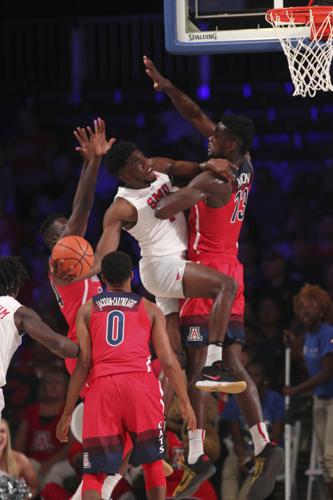
Deandre Ayton (13) averaged 22 points and 12.3 rebounds during the Wildcats’ three-game trip to his native Bahamas.
They dropped entirely out of the Associated Press Top 25 poll the following Monday and were last seen losing in the first round of the NCAA Tournament to 13th-seeded Buffalo.
They fell off the map, underwater. Gone, it seemed.
How?
According to legend, gods sank the once-prosperous island of Atlantis deep into the sea when they became angered the inhabitants of the utopian society had lost their morals.
In that sense, possibly at least in the eyes of some FBI and NCAA investigators, Arizona’s 2017 Atlantis disaster was even more fitting. But that’s another, fully debatable, story.
Whatever the case, the truth was that Sept. 26, 2017, happened.
That was the morning FBI agents showed up at the front door of Arizona assistant coach Book Richardson to arrest him, leading to his eventual firing at UA and a three-month federal prison sentence. The FBI held a news conference that same day in New York to make public its investigation into college basketball and announce that 10 people, including Richardson, had been arrested.
That left the Wildcats without an assistant who was especially popular with players, while casting dark clouds over the program that wouldn’t fully dissipate for over five years.
In December 2022, an alternative to the NCAA infractions process, the Independent Accountability Resolution Process, found the Wildcats guilty of 10 violations but cleared then-coach Sean Miller of a head coach responsibility charge and did not issue a postseason penalty on top of Arizona’s self-imposed decision not to participate in the 2020-21 Pac-12 or NCAA Tournaments.
Miller was fired in April 2021, and the IARP resolution arrived early in Tommy Lloyd’s second season at UA, when the Wildcats were cruising along in the Top 10. For them, life was good at that point.
But in the eight weeks between Sept. 26, 2017, and the Battle 4 Atlantis, the Wildcats were challenged in ways they had not been before.
Maybe even spooked. Later the same day that Richardson was arrested, Alkins broke his foot during what UA called “voluntary activities.” A month later, predictably, the Wildcats’ 2018 recruiting class began to fall apart, with five-star recruit Jahvon Quinerly decommitting.
Then, a week before the season opener, promising freshman Brandon Randolph suffered a concussion that limited him over the first few weeks of the season. And just before the opener, Arizona also suspended another assistant coach, Mark Phelps, and key reserve Keanu Pinder.
Phelps was suspended for two games, then removed from the staff in February while UA let his contract run out; the IARP later upheld a Level II violation against Phelps for trying to cover up a $500 loan he gave Pinder for a plane ticket.
A punch in the face
Still, even with all that going on, the Wildcats were ranked No. 3 in the preseason AP poll and No. 2 heading into the Atlantis event. They were paired in the opposite bracket as No. 5 Villanova, making for a potentially huge matchup in the championship game.
Then the Wildcats came out and allowed N.C. State to shoot 49.1% in the opening game, negating 27 points and 14 rebounds from Ayton, and never really recovered. Over the next two days, UA lost to SMU and Purdue, never seeing Villanova and, maybe, never wanting to see the Imperial Arena ever again.
“Everybody has horrible memories from that trip,” longtime UA trainer Justin Kokoskie said. “We lost three straight games but the biggest thing, the first thing, was we got punched in the face” against N.C. State.
The loss to N.C. State shoved the Wildcats into the consolation round, giving them less than 24 hours to prep for the slow-down style of SMU, which ran at the 336th-fastest adjusted tempo in the country.

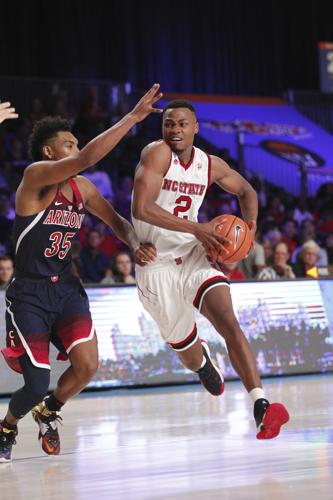
North Carolina State guard Torin Dorn (2) drives to the basket while Arizona guard Allonzo Trier (35) defends on Nov. 22, 2017, in the Battle 4 Atlantis tournament in Paradise Island, Bahamas.
Ayton and Trier combined for 39 points in that one, but the Wildcats turned the ball over 20 times and allowed SMU to collect 20 offensive rebounds, allowing the Mustangs to overcome their 31.4% shooting.
“Their second shots realty hurt us,” Miller said. “Tonight, 20 turnovers killed us.”
That loss slid the Wildcats into a booby prize game that was no joke. Purdue had entered the event ranked No. 18 but also lost its first two Atlantis games.
Nobody wanted to be embarrassed by losing a third.
“We’re not out of this yet,” Miller said after the SMU game. “Clearly there’s a lot on the line. I know, like our program, they have a lot on the line.”
But somebody had to sink to the bottom, and it was Arizona.
The last game wasn’t even close. Purdue beat Arizona 89-64 by shooting 57.4% from the field and hitting 11 of 22 3-pointers. Ayton scored 22 and Randolph emerged for 17 but Trier had eight points and four turnovers while UA hit only 3 of 17 3s.
‘Shell-shocked’
After it was over, Miller was asked if the FBI investigation had affected his team, but he declined to say.
“Our focus is just on the season right now,” Miller said.
But that season was changing, and Miller acknowledged as much. Three days later, the Wildcats dropped out of the AP Top 25, and they took two weeks to get back in, never rising past No. 9 the rest of the way.
“We’ve been ranked in the Top 25, I think, for 101 weeks in a row,” Miller said after the Purdue game. “We came here the No. 2-ranked team. Everybody knows that. But now it’s different for us. So I don’t know if everybody will look at us as the same team maybe that they looked at before.”

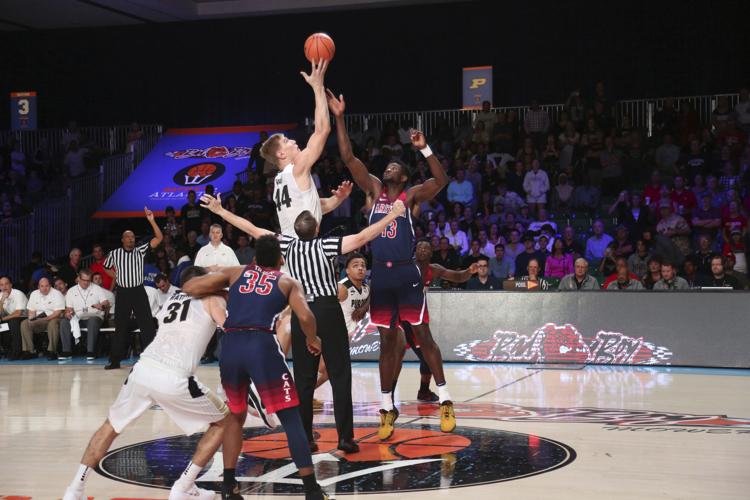
In this photo provided by Bahamas Visual Services, Purdue center Isaac Haas (44) wins the tip-off over Arizona forward Deandre Ayton (13) on Nov. 24, 2017, in the Battle 4 Atlantis tournament in Paradise Island, Bahamas.
Though the Wildcats never did rise back to their preseason expectations, they won their next nine games, then stormed into the postseason despite a late-season ESPN report that said Miller discussed paying Ayton $100,000 with an agent (an allegation that did not surface in the NCAA and IARP findings).
They captured both the Pac-12 regular season and tournament titles, while Ayton ran away with the Pac-12 Tournament MVP honor by putting up put two straight dominant performances, capped by a 32-point, 18-rebound effort in UA’s 75-61 win over USC in the final.
“It’s incredible,” Ayton said. “I’m speechless.”
Arizona went into the NCAA Tournament as a No. 4 seed but never did get a chance to play Villanova there, either. No. 13 Buffalo memorably destroyed the Wildcats 89-68 in the first round while Villanova went on to win it all, its second national championship in three seasons.
Maybe the Atlantis disaster foreshadowed the Buffalo game. Maybe the FBI investigation and ESPN report ultimately proved too much for the Wildcats to withstand over time.
Those things may never be fully known, though it is likely the Wildcats’ poor performance in the Bahamas ultimately cost them a No. 2 or 3 seed that would have avoided a matchup with Buffalo.
Either way, Kokoskie said he didn’t think the offseason drama affected the 2017-18 Wildcats as much as Alkins’ early absence and the sometimes unforgiving path playing three high-level games in three days can take you down.
“We kind of got shell shocked” against N.C. State, Kokoskie said. “Our confidence went down a little bit and we couldn’t rebound in time to practice before the second game. Then the second game, bam. And Purdue, by then, I think everybody was questioning themselves. But we obviously rebounded from there and had a good season.”
Staying in the moment
This time, for different reasons, it’s not clear what sort of season the Wildcats will have. They were ranked No. 10 entering this season, but are going into the Bahamas after losing two straight games for the first time ever under fourth-year coach Lloyd, who is still struggling to cobble together an effective rotation.
Maybe the Wildcats can use the Battle 4 Atlantis to flip things around this time, with an opening game against Davidson on Wednesday and a potential matchup against Indiana or Gonzaga in the championship game on Friday.
But Lloyd is never one to speak of anything but the immediate moment ahead, and, more than anything, the history of Wildcats’ 2017 trip to the Bahamas demands as much.
“I’ve heard a lot of stories about that” trip, Lloyd said. “But, right now? Come on. We play Davidson on Wednesday and let’s just find a way to win. We’re not looking to anything beyond that.”

