



A day after Arizona lost 57-54 to UCLA earlier this month, coach Tommy Lloyd sat down in his home workspace, trying to figure out how to solve a similarly aggressive team in Samford a few days later.
With his family out of the house with other things to do, there was even more ability to focus. Or obsess.
The Wildcats were 4-5, after all.
“A couple guys on the staff come up and we met,” Lloyd said, “and I was like, ‘Man, why do I feel good right now? Why do I have a joyful feeling? I shouldn’t be having a joyful feeling. This is hard.’”
Lloyd was in an unprecedented spot. Not only have Arizona men’s basketball teams almost never had losing records over the past four decades, but the Wildcats’ fourth-year coach had never lost a single game in November before this season, never lost more than two in a row, and never lost his fifth game before late January.

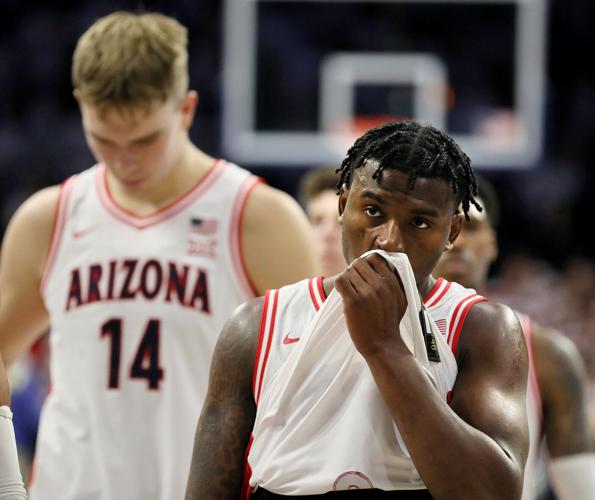
Arizona Wildcats guard Jaden Bradley walks off the court with his team after the Wildcats’ 69-55 loss to Duke at McKale Center on Nov. 22.
During a recent interview, Lloyd couldn’t even recall having a rougher early season at Gonzaga, where he spent 20 years as an assistant.
It was hard. But Lloyd embraced it, the way he explained things.
“You know what it is?” Lloyd said. “I love coaching. I love the challenge. I love figuring out hard things. I can’t just be there when the getting is good.
“What drives me and motivates me is delivering for the community, for the university, for the players. I can’t let the disappointment of a slower start than we all would have hoped for weigh me down because I feel guilty we haven’t delivered.”
After entering the season ranked No. 10 in the Associated Press Top 25, only in the first of four segments during the nonconference season did the Wildcats deliver what was expected.
Here’s how those four periods roughly broke down:
Part I: The early tease

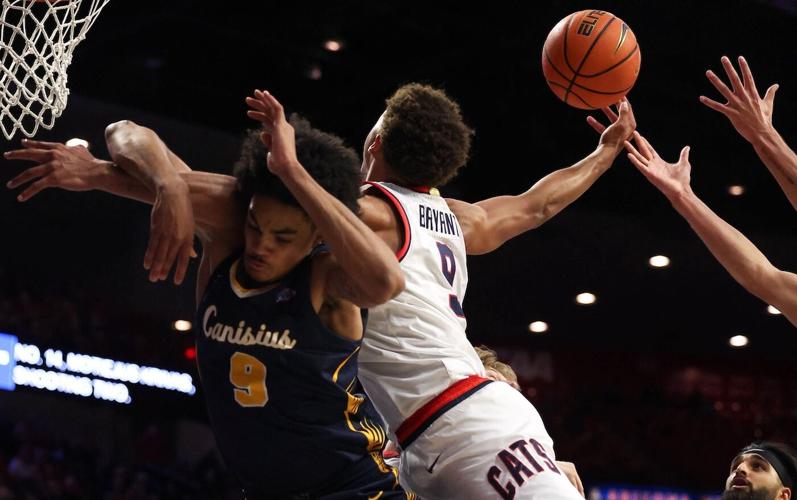
Arizona forward Carter Bryant (9) extends his arms in attempt to gain possession of the ball against Canisius guard Evan van der Plas (9) at McKale Center, Nov. 4, 2024.
During exhibition wins over Eastern New Mexico (117-54) and Point Loma (113-64), then regular-season home games with Canisius (93-64) and Old Dominion (102-44), the Wildcats played early like nearly every other Lloyd-coached team: With a dominant, free-flowing offense that can score from every possession, solid rebounding and a defense that allowed only 55 points and 37% shooting in their first two regular-season games.
The Wildcats set up 41 of their 71 field goals with assists over their first two regular season games, shot 49.7% and, when they missed, often just picked the ball off the glass and tried again.
Against Old Dominion, Arizona rebounded 24 of its 37 missed shots, for an almost absurd offensive rebounding percentage of 64.9%.
“I love offensive rebounding,” Lloyd said after that game. “Offensive rebounding is a great insurance policy for offenses. It’s always gonna be a staple of what we do. I think we have great potential with our depth inside and some of our athletic wings to be a great offensive-rebound team.”
But while the Wildcats received projected starting center Motiejus Krivas back from a foot injury in time for the opener, there were early signs that integrating Krivas and several other players into the rotation wouldn’t go as smoothly as it was during Lloyd’s first three seasons.
After the easy win over Canisius, Lloyd left his press conference fretting over what to do about it.
“I’ve got to figure out a way to mesh the lineups so they’re not so glaringly different,” Lloyd said. “I’ve got to spend some time on it and figure it out and then who we play against Old Dominion might not be who we play on the road at Wisconsin. That’s a decision I’ve got to make.”
Part II: Home-and-home damage

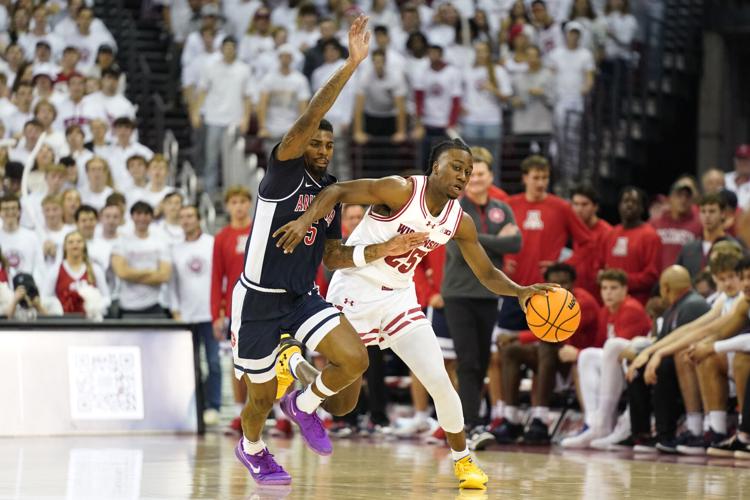
Wisconsin guard John Blackwell (25) dribbles the ball against Arizona guard KJ Lewis during the second half on Nov. 15, 2024, at the Kohl Center in Madison, Wis.
Two of Arizona’s 11 nonconference games were a result of two-year “home-and-home” contracts in which the Wildcats and a high-major opponent play a game each at each other’s campus site.
This year, UA packed them into back-to-back Fridays, a game at Wisconsin on Nov. 15 and a much-anticipated home game with Duke on Nov. 22.
The Wildcats disappointed in both. Ramping up steeply in competition and atmosphere after their blowout of Old Dominion, the Wildcats fell behind 7-0 to Wisconsin early and, after guard Caleb Love picked up a technical foul when UA trailed just 9-8, they never really recovered.
Wisconsin became the first team to fully exploit UA’s weakness in defending 3-point shots, hitting 12 of 27 3s, while the Badgers went to the line to make 41 of 47 free throws.
Forward John Tonje poured in 41 points in large part because he went to the line 22 times — and made 21 of 22 free throws.
“The dude scores 40 on you, you tip your hat to him,” Lloyd said.
But while UA’s loss that night could be partly attributed to tight officiating and a true road atmosphere at the Kohl Center, their 69-55 loss to Duke threw neither adversity at the Wildcats.
Instead, the game featured McKale Center at its best: With a supportive crowd that had long anticipated the presence of cross-country rivals who hadn’t visited in 34 years, plus a number of former UA standouts on hand near courtside.
The Wildcats led early but stayed within two possessions for only the first 25 minutes and watched Duke pull away by double-digits over the final 1:19. The Wildcats shot just 39.6% from the field, hit only 6 of 23 3-pointers, made it to the free throw line just 11 times — and were outrebounded 43-30.
Before their UCLA scoring effort set an even lower bar, their 55 points tied the lowest they had ever scored under Lloyd, equaling their output in a humbling 59-55 loss to Princeton in the first round of the 2023 NCAA Tournament.
“Great atmosphere,” Lloyd said. “Unfortunately, we didn’t play the way we’d hoped to play. A lot of credit goes to Duke. They played a great game. It was an honor to play them here, and I wish it would have went a little better for us, but that’s how it goes sometimes.”
Part III: Lost at Atlantis

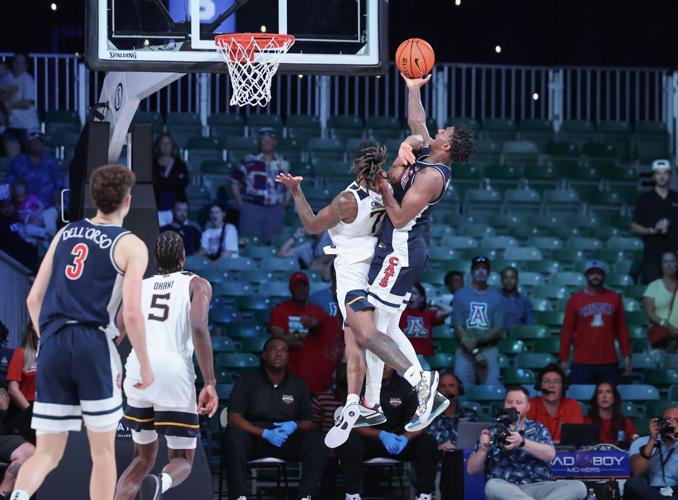
West Virginia (40-39) outrebounded Arizona despite the Wildcats’ height advantage, Nov. 29, 2024.
Arizona appeared to restore its normal offensive flow in a Battle 4 Atlantis opener against Davidson, shooting 56.5% while making 11 of 22 3-pointers. But the Wildcats stumbled backward again against better competition in their next two games in the Thanksgiving week event.
Oklahoma and its notably stiff defense prompted the Wildcats to miss their first 10 field goals and, possibly more troubling, Love missed his first five shots after scoring 20 points against Davidson.
The Sooners held off UA in the second half in part by making 8 of 14 3-pointers after halftime, including two by little-used pick-and-pop center Luke Northweather. A technical foul on UA guard KJ Lewis for pointing at the Sooners’ bench didn’t help the Wildcats, either.
UA cut Oklahoma’s lead to three points twice late in the game, but it wasn’t enough.
“They came out and put us in some tough situations, and our offense took a while to get going,” Lloyd said. “I think they were a little more physical than us, which is disappointing. We’re a team that loves to bump and grind and be physical.”
The next day, the Wildcats received 24 points from Love but again couldn’t solve their opponents’ 3-point shooting. This time, it was do-it-all forward Tucker DeVries scoring 26 points while making 8 of 12 3s, often shaking loose off a screen at the top of the key to hit his long-range shots.
Also troubling for Arizona: The Wildcats couldn’t physically shake a West Virginia team that was playing its third overtime game in as many days, that they allowed the Mountaineers to score 24 points off UA’s 14 turnovers, and that the Wildcats received only three points from their 7-footers – Henri Veesaar had two points while Krivas had just one.
“We’ve got to get our bigs playing better,” Lloyd said. “Our bigs have always been an integral part of what we do. They’ve got to be able to create advantages for us.”
The loss dropped UA to 3-4 heading into December, four losses in a month that previously had none over the past three years.
Instead of firing out of the gate, they were stumbling.
“We’re gonna get back in the gym and work. We’re gonna clean things up,” Lloyd said. “This is not the product we want to be putting out on the court right now.”
Part IV: The jury is out

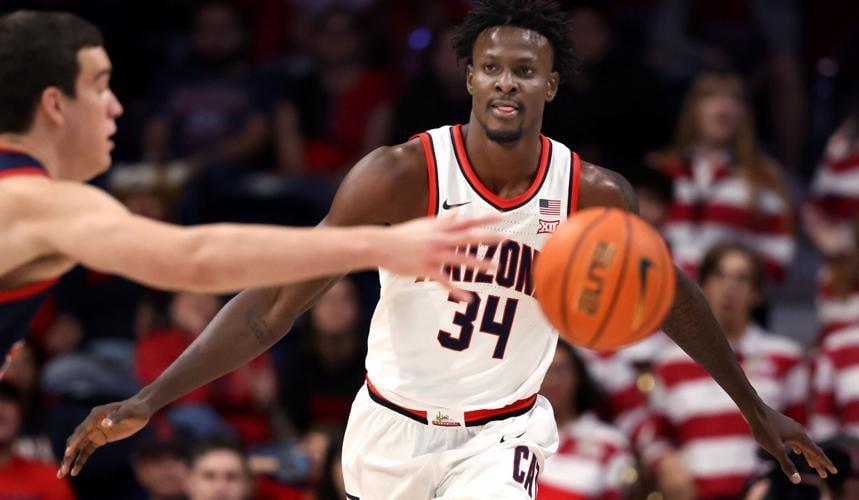
Arizona center Emmanuel Stephen (34) moves up to defend near the top of the key in the second half against Samford at McKale Center, Dec. 18, 2024.
While the Wildcats melted down during the second half of their Dec. 14 loss to UCLA, blowing a 13-point lead without a single field goal in the final 8:46, they spent the first three weeks of December attempting to rebuild chemistry and confidence while also adjusting to a setback for Krivas.
The Lithuanian 7-footer’s left foot flared up again before the UCLA game, and Lloyd braced for the possibility he would miss the rest of the season. He pulled freshman 7-footer Emmanuel Stephen out of a redshirt season, sprinkled some minutes at power forward for freshman small forward Carter Bryant, with a trickle-down effect that even opened up some minutes for sophomore Conrad Martinez at point guard.
All three had their moments while the Wildcats mowed down Southern Utah (102-66), Samford (96-64) and Central Michigan (94-41) earlier this month.
Bryant had nine rebounds and four assists against Southern Utah even though he missed both field goals he tried, Stephen debuted with an improbably athletic tip-in against Samford – then had six points and six rebounds against Central Michigan – while Martinez had nine points and five assists against the Chippewas.
The rotation remains unsettled. Lloyd has started three different players at small forward — first Lewis, then Campbell transfer Anthony Dell’Orso, then Bryant — while it isn’t entirely clear if and how Stephen and Martinez will carve out regular roles.
But there are options. All 10 of Lloyd’s healthy scholarship players logged nine minutes or more against Central Michigan, and nine of them had six points or more.
“We’re not a one-man show,” Lloyd said. “We never have been and no one’s professed that we are, but we just have to have that vibe that we want to make each other better, an eagerness to do that. I think we’re taking steps in that direction.”
They have 20 Big 12 games to keep taking them, a potentially grueling path they will be traveling for the first time this season. But the conference season ends in March, when college basketball seasons are really defined, not by wins in November or December.
“I feel like you see a lot of teams every year that blossom really early,” Bryant said, “and you look late in the season, you’re like, ‘Wow, they looked really good early, but what happened?’”
Maybe this time, Arizona flips it the other way around. If the Wildcats are going to meet their preseason expectations in 2024-25, that’s the only way it happens.

