


Arizona will receive $35.5 million from the Big 12 for 2024-25, slightly less than the amount it would have received from the Pac-12 a year earlier if not for legal costs over its departure.
Big 12 commissioner Brett Yormark said Friday the conference would distribute a total of $558 million for 2024-25 to its member schools. While that’s an average of $34.9 million per school, BYU, UCF, Cincinnati and Houston were scheduled to receive only partial media rights distributions and a smaller overall distribution.
Yormark did not break down the distributions to each school but Will Wheeler, Arizona’s associate AD for finances, confirmed through a spokesman that UA would receive $35.5 million for 2024-25.
Arizona would have received $36.6 million from the Pac-12 in 2023-24, according to the Wilner Hotline, but UA and the other nine departing Pac-12 schools paid $6.5 million each as a result of a settlement over their departure, reducing UA's share to $30.1 million.
Yormark said the Big 12’s total distribution of $558 million was a record for the conference, which expanded from 14 to 16 teams in 2024-25, while saying the conference sees more growth in commercial partnerships and sponsorships.
“I’m incredibly bullish on the future of the Big 12,”
Yormark said. “As we head into this new chapter in our industry, we will be at the forefront of innovation, and we’re going to continue to positively disrupt while competing for championships at the highest levels.”

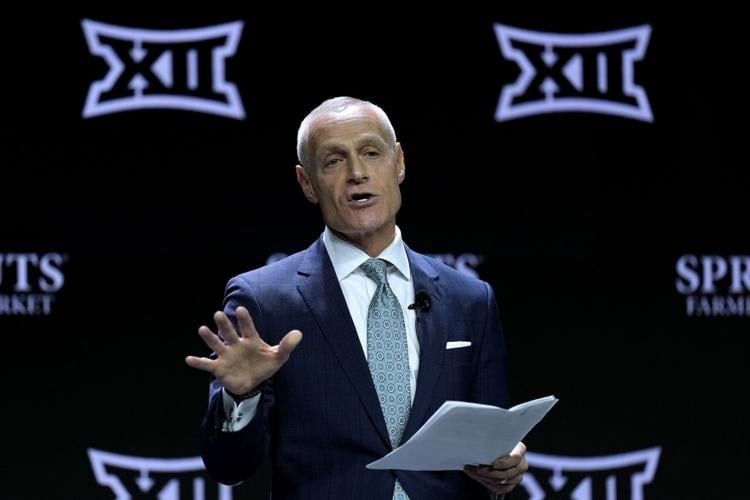
Big 12 Commissioner Brett Yormark addresses the media during the conference’s women’s basketball media day, Oct. 22, 2024, in Kansas City, Mo.
But to maximize the Big 12’s ability to do so in football, Yormark may still have some lobbying to do. The Big Ten has backed a “4-4-2-2” College Football Playoff format that would include four automatic bids to the Big Ten and SEC, but only two for the ACC and Big 12 among its 16 total spots.
Instead, Yormark said he is pushing for a “5-11” format, which guarantees five automatic bids for conference champions but 11 at-large openings — a situation that could result in more, or less, Big 12 bids than the Big Ten and SEC in any given season.
While it could be tempting to take the two guaranteed bids a 4-4-2-2 format would give the Big 12, that format would lock the Big 12 and ACC into second-tier status behind the Big Ten and SEC.
Yormark said the 5-11 format was fair and was good for college football overall, while saying the Big 12 wanted to earn its spots.
“We don’t want any gimmes,” Yormark said. “That was the direction of the key stakeholder groups, the ADs and the coaches. I feel very comfortable with that. I feel the same way, and I’ve been very outspoken about it.”
The ACC has also expressed a preference for the 5-11 format. The SEC has given off mixed signals, though Yormark said he was encouraged that SEC football coaches expressed support for it.
“There’s real momentum for 5-11,” Yormark said. “The public is voting ‘yes’ for it, which I think is critically important. Yes, the Big 10 and SEC are leading the discussions, but with that, they have a great responsibility to do what is right for college football and not to do anything that just benefits two conferences.
“I have a lot of faith in the process, and I think we’ll land in the right place.”
During a joint interview with Baylor president Linda Livingstone, chair of the Big 12 Board, Yormark also said the Big 12 was supporting the idea of a single transfer-portal window in January for football instead of the current two windows in December and April.
Yormark said this week’s Big 12 meetings were the first to combine football coaches and basketball coaches along with athletic directors — on top of it being the first involving all 16 schools as active members.
NCAA president Charlie Baker appeared at the meetings along with media partners ESPN and Fox, which will kick off a six-year media rights agreement with the Big 12 next season. Livingstone said it was probably one of the “most collaborative and integrated meetings” the conference had had.
“Obviously lots of really significant issues that we were talking about, whether it’s the House settlement or the CFP or president Baker with us talking about the options for restructuring Division I decision making,” Livingstone said. “Probably one of the more substantive meetings that we’ve had on issues that are really critical to the long term success of our conference, and also to college athletics.”
The still-pending House settlement would allow schools to pay up to $20.5 million each in revenue sharing, though schools are free to divide up percentages to individual sports as they wish.
“If the settlement is approved, it gives us long-overdue clarity and a shared cap that applies to everyone,” UA athletic director Desiree Reed-Francois said via text message. “There will be challenges — anytime you’re undergoing a transformation of this scale, that’s inevitable. But it’s progress, and it gives us a foundation to begin planning with some certainty.”

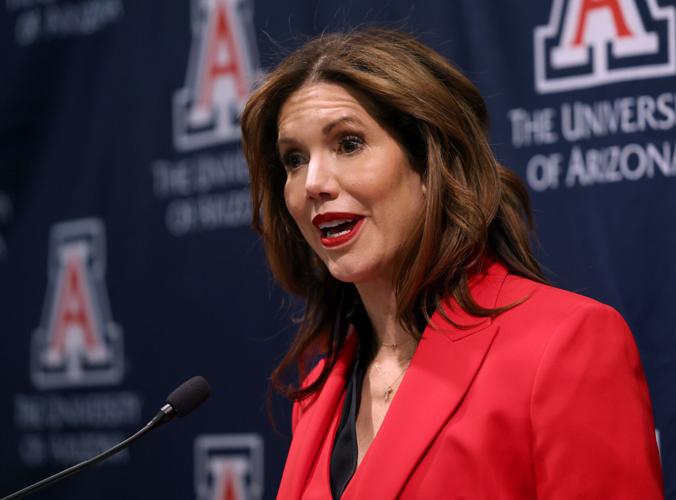
Arizona athletic director Desireé Reed-Francois talks about Becky Burke, new coach of the women’s basketball team, during a press conference at McKale Center on April 11, 2025.
The House settlement also includes a provision in which all NIL deals greater than $600 would be audited to determine if they are for “fair market value,” a potential scenario that has resulted in a frenetic spring of basketball transfers racing to sign NIL deals before it goes into effect.
The auditing could effectively end booster-provided pay-for-play — or end up pushing payments under the table — but Yormark said he felt confident in how the changes would be implemented. He said representatives from firms that would oversee NIL auditing and revenue-sharing caps met with coaches during the Big 12 meetings.
“What I’ve said to our coaches and our ADs and our board is that it’s progress over perfection,” Yormark said. “It’s not going to be perfect. It just won’t be. But there’ll be significant progress.
“And I am very confident that the College Sports Commission, which is going to be the new enforcement agency overseeing settlement, will execute at the highest levels. They understand the responsibility, and you break those rules, the repercussions will be punitive.”

