



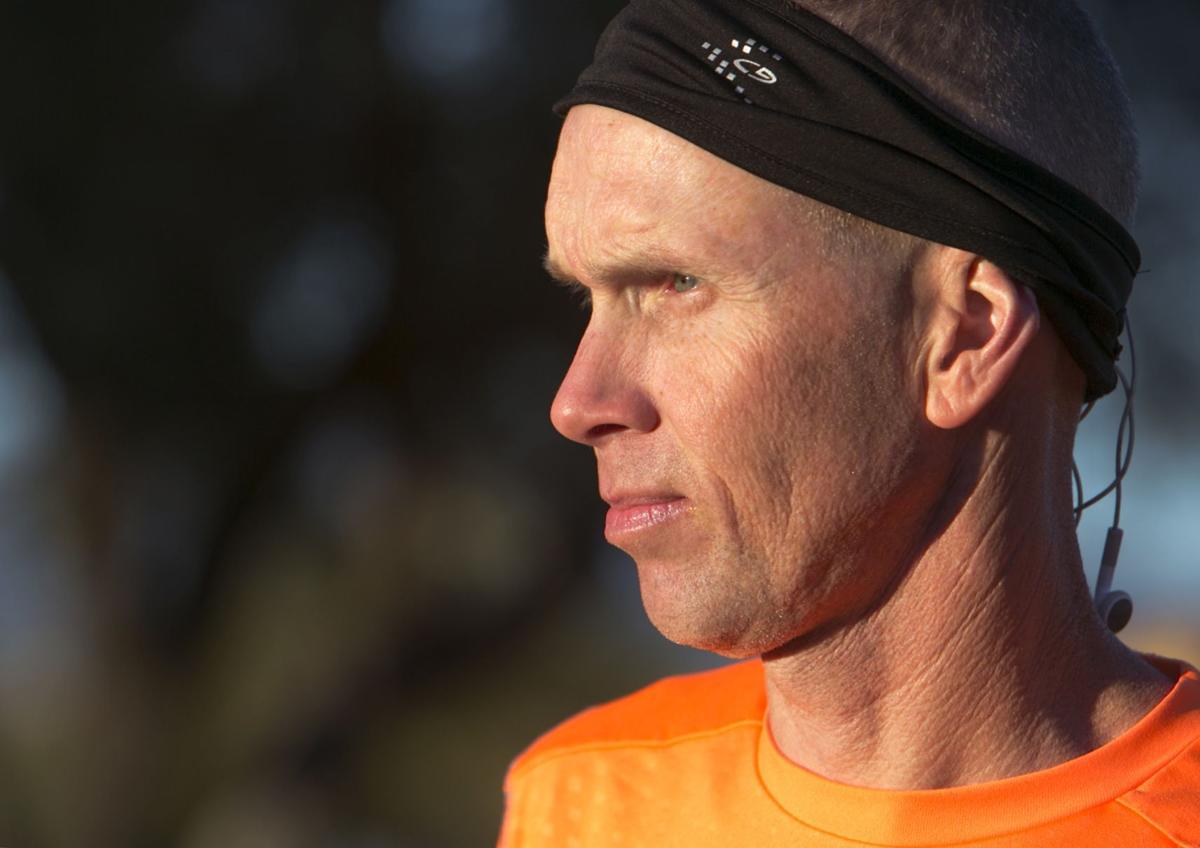
Around, say, mile 63, it will probably dawn on Dan Heston.
This is what I’m doing this for.
It will be a searing famine, sharp, then dull, then acutely sharp once more. Pangs, right in his right side, reminding him that his body may be in cruise-control, but his fuel is low. Hunger, through every inch of his body.
But is that any different than the hunger a mother feels when she’s given her child the last jelly sandwich and she has none for herself? Who can afford peanut butter these days, after all? Is there any difference, really?
Hunger is hunger, right? Longing, needing, emptiness. Hunger is hunger.
And Dan Heston is trying to end it.
In Southern Arizona, at least.
•••
A lifelong runner, albeit primarily uncompetitively, Heston picked things up a half-decade ago. He’d run Turkey Trots and half-marathons and full marathons, but he was ready to run with a purpose. For a purpose.
So in 2013, Heston ran for 12 hours straight, raising roughly $1,000 for the Marana Community Food Bank. A Marana resident, he’d heard about the plight of his neighbors, so many of whom relied on the food bank to feed entire family units. He ran 55 miles straight, and, well, he felt pretty good afterward.
The next year, Heston ran for 12 hours again, this time racking up 60 miles, raising a few thousand dollars. In 2015, he ran back-to-back marathons — 52.4 miles, to be exact — and raised a similar amount, and last year, he did it again, raising more than $8,000.
He wanted to up the stakes this year. Maybe even up the steaks, or at least the ground chuck.
So on Friday night, leading into Saturday morning, Dan Heston will run the entire 100-plus-mile El Tour de Tucson course.
The goal? Raise $15,000. More than everything he’s raised in previous years combined.
•••
We’re not talking about Meb Keflezighi here, perhaps the greatest American male long-distance runner of his generation. This isn’t Abdi Abdirahman, the Tucson High, Pima College and UA grad who has been the top-finishing American at the New York City Marathon the last two years. Heston is far, far from Shalene Flanagan, who just became the first American woman since 1977 to win the NYC Marathon.
He’s your average guy, only with an above-average desire to push himself and his body to the limits, and an above-above-average desire to help those in need.
He was not a track star in high school, nor in college. A self-proclaimed “Navy brat” who moved frequently, Heston never really got into “team” running. He tried to run cross country in high school, but was frequently felled by twisted ankles. He didn’t run much after high school, not for a dozen years. In his 30s, he picked up distance running and never put it down.
It has become, in his own words, “an obsession.”
“I absolutely love it,” said Heston, who credits his wife and kids for supporting his relatively newfound passion. “I want to see what my personal limits are. I haven’t quite found what my limits are. When I finish a long run, I feel like I can keep going.”
Yeah, OK. We’ll see if he feels that way on Saturday morning, when he plans on finishing his 106-mile journey shortly before El Tour kicks off.
Who knows? He may just turn into an ultramarathoner, those on the outer limits of sport who decide to treat their bodies like a car on a cross-country road trip. Stop for gas, man! There’s a Steak-and-Shake with your name on it. Grab a bag of sunflower seeds, something.
These people are almost fanatically dedicated to testing their boundaries, to seeing how far they can go, or, rather, how far their bodies will let them go.
•••
And speaking of bodies, here’s what happens when a child goes hungry.
Cognitive, social and emotional development can be delayed. Vitamin A deficiencies can cause vision problems, even blindness. A lack of calcium can damage gums, teeth. Immune systems become compromised.
The Community Food Bank of Southern Arizona was founded in 1975 by Barry Corey and Mark Homan to help end these issues in the community, and the organization feeds nearly 200,000 people every year. That’s 200,000 of your neighbors who look like you and talk like you and breathe like you and yet go hungry every day.
“Hunger is huge a problem in Southern Arizona and the whole state,” said food bank public relations and marketing specialist Norma Cable, who has worked extensively with Heston on this endeavor. “It affects one in four kids and one in five adults.”
The organization, which gets more than 80 percent of its funding from donations, serves five counties, providing food particularly to children and seniors, who make up more than 20 percent of the clientele. Most, Cable said, are members of the working poor.
“Hunger is all around us,” Cable said. “It’s not just an isolated problem that comes up every once in a while. We’re so impressed with how Dan has recognized that and is stepping out of his way to do his part.”
His part, Cable explains, is significant: Every $1 donated can provide four meals.
“You always hear about the parents who didn’t eat so their kids could, and I’ve never felt where I’ve gone to bed hungry,” Heston said. “I’m thankful for that. I can only imagine that. I’ve been hungry before. You’ve got kids who don’t eat until lunch, until dinner, not at all. This is what those kids feel like all the time.”
He’ll be hungry again on Friday, and most certainly on Saturday morning.
Funny thing is, he knows how hard it will be for him to eat.
“You use up all your reserves to keep going, but your body, it’s hard to choke down the food,” he said. “Your body is rejecting fuel. You feel like you need food, but you can’t even get it down, you have to force it down.”
Heston will rely on what he calls his “nectar,” Pedialyte. The electrolyte-filled children’s drink is the perfect mix of salty and sweet to replenish the body. Somebody better have a case on hand.
He knows what to expect.
“That first few miles,” he says, “you’re not comfortable at all. You’ll hear distance runners say that’s the warm-up. You get to the point where you’re kind of dazed. You shut things down. You do two miles and don’t even realize you’re doing it. It’s like shifting a car from first to fifth and you don’t even feel second, third and fourth.
“You feel like you’re gliding,” he continued. “You don’t even feel your feet hitting the ground. Until you experience it, it’s hard to explain it to someone. It can feel like an out-of-body experience.
“You come out of it, and it’s ‘Hey, this doesn’t feel that good,’ and you battle through the pain, the muscle cramps, and you get that euphoric feeling again once you get through that runner’s wall, and that will happen repeatedly through runs.
“And once you get to a point where maybe you don’t think you can go any further, you just do. Who knows? Maybe after 106 miles, I’ll feel like I can keep going. That’s what the pleasure in the pain is.”


