



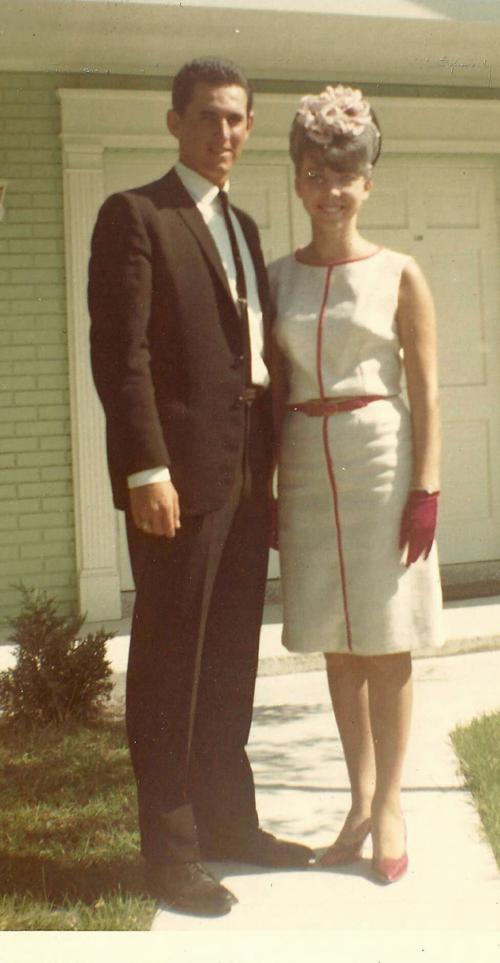
Terry and Elaine Banderas both felt it. They had settled down for some television Wednesday at their home in Lincoln, Calif., when they saw a report of how Tom Seaver had died at 75 from complications linked to Lewy body dementia and Covid-19. While the baseball world had started mourning a legend whose pitching once summoned miracles, Terry saw that kind of mastery first-hand – and not when Seaver threw for the New York Mets.
When Terry and Elaine think of Seaver, they think of Buffalo.
Terry, 80, is retired from a long career in the aerospace industry. As a young man, he was a good enough outfielder to play in 1966 for the Bisons in the International League, one step below the majors. Even now, after 54 years, Terry recalls a couple of chilly spring days in Western New York when he faced a young pitcher for the Jacksonville Suns whose potential greatness was clear every time he unleashed a pitch.
Elaine, too, was in the ballpark as a witness. They had barely started to talk about Seaver's death, Terry said, when “we get a call and it says it’s coming from Buffalo.”
More than a half-century after their last visit to this city, a columnist was asking about a game that lived on in Seaver's memory. In 1966, he was a 21-year-old right-hander with Jacksonville. Years later, on a visit to Buffalo, he said he was all but sure he hit his first professional home run in this city. Seaver mentioned that home run in a 2012 interview for Minor League Baseball while visiting what is now called Sahlen Field for the celebration of that season’s Triple A all-star game.
Seaver, as you might expect, was correct. Brian Frank, a local Bisons historian who oversees “The Herd Chronicles,” did some digging Wednesday and came up with a box score from June 17, 1966. Seaver, for the visiting Suns, was the winning pitcher in a 3-0 win against Buffalo in the first game of a doubleheader. He pitched 6 1/3 innings of shutout ball, struck out four and gave up six hits.
He also hit his only homer of his first professional season off Bisons righthander John Tsitouris. It was a solitary shot in an unfamiliar city at the minor league dawn of a Hall of Fame career filled with astounding moments, yet Seaver still remembered long after he retired from the game.
That speaks to a universal baseball truth: There is nothing quite like hitting a home run, even when one of the greatest pitchers to walk the planet did it in a battered old park in Buffalo.
Tom Seaver hit his first professional home run in #Buffalo. It was a solo shot on June 17, 1966 at the Rockpile. He pitched 6.1 innings that day in Jacksonville’s 3-0 win in the first game of a doubleheader. h/t to @seankirst pic.twitter.com/2bo7nHKVrv
— HERD Chronicles (@HERDchronicles) September 3, 2020
Frank posted that tidbit Wednesday to Twitter, where his tweet exploded. Told the tale, Terry Banderas laughed again. While he does not remember Seaver's home run, he is pretty sure he remembers the game – Terry was 0-for-1 – due mainly to exactly what you would expect: Seaver's pitching. What Terry absolutely recalls is the homely majesty of that crumbling stadium, best known in memory as “The Rockpile.”
It was a place built for football, Terry recalled, with “a left field that went forever and a centerfield that went even farther,” before cutting fast toward a big ominous wall in right field.
Terry is impressed, by the way, at how beautiful Sahlen Field looks on national television, as it serves as temporary home to the Toronto Blue Jays. But as a young guy from California in 1966, Terry had a much different feeling about the Rockpile on April days that felt so cold to him it might as well have been mid-winter. He is pretty sure the icy weather was a big part of the reason that on one occasion, while sprinting after the ball, he felt a terrible pop and “blew my hamstring out.”
Elaine said the couple met when she sold sno-cones at a ballpark in Kennewick, Wash., touching off a baseball love story going strong at 57 years. She was only 19 when she and Terry, as newlyweds, lived in a Delavan Avenue apartment right above a catcher named Tom Tischinski and his wife Marilyn, an arrangement in which the couples quickly became close friends.
Thinking of Seaver's death, Terry noted wistfully that so many of the players from those teams are gone – including Lee May, the Buffalo first baseman who went on to a standout big-league career, and Clarence “Choo Choo” Coleman, an original New York Met who caught for Jacksonville and worked with Seaver on the day of his home run.
It was not the only time Seaver faced the Bisons in a season in which his record was 12-12. Brian Frank uncovered an earlier game, for instance, where Terry was again 0-for-1 as Seaver and the Suns beat the Bisons, 12-1. Terry recalls fouling off a couple of pitches, but that was about it. Seaver, he said, had a compact delivery and a way of releasing the ball with such explosive velocity that even if you got around in time it was “just like you were hitting a rock.”
That stays in his mind far more than any image of Seaver at the plate. He remembers they talked for a moment before one game about a California city where they both spent a lot of time. Seaver grew up in Fresno and – as a baseball-loving kid – was aware of Terry, five years older, who walked onto the college team at Fresno State, then played so well in the outfield that the Angels eventually signed him.
By the time Terry and Seaver crossed paths in Buffalo, they were going in opposite directions. After Fresno, Terry played outfield for a San Diego team in 1964 that included the late Hall of Famer Tony Perez, a club good enough to capture the Pacific Coast League championship. But Terry hurt his arm and needed surgery, and he told Elaine:
If the injury eventually meant getting shipped deeper into the minors, he would do something else with his life.
“I wasn’t going to be a hanger-on,” he said.
The Cincinnati Reds, as Terry half-expected, decided before the end of the year to send him down to Knoxville. He finished the season and returned to California, where he embraced a successful career in aerospace technology, and he and Elaine raised their family.
Seaver ended up in Cooperstown. Terry’s grandchildren know the stories of many of the greats their grandpa played with or against. That includes his at-bats against a guy who was a pitching dynamo as the 1969 New York Mets – a team that had been a national joke for its losing ways – broke out of years in or near the game's basement to win the National League, earning a chance to face the powerful Baltimore Orioles in the World Series.
That was the era when the nation stopped to watch daytime series games on television. While the Mets had tremendous sentimental appeal, the Orioles were heavy favorites to win it all. Instead, the Mets took the series in five games, a shock of beautiful magnitude. One of the team's outfielders was Art Shamsky, who had been Terry’s roommate in San Diego. As for Seaver, he went on to win 311 games while striking out 3,640 batters and rose into the pantheon of all-time greats.
Today, Terry Banderas is a passionate water color artist who also teaches painting. It has been a long time since he and Elaine were in Buffalo, and while Terry knows millions of baseball fans mourn deep connections to a pitcher they revered, he offers a tribute that only someone who batted against Seaver can fully understand.
On a spring day 54 years ago in Buffalo, in a game Seaver himself did not forget, Terry dug in to face the kind of stuff that left the old outfielder, at 80, to make the same sound of wordless awe over the phone that thousands of other batters shared on their way back to the bench.

