


It was a big deal when Mike Bibby chose Arizona out of high school.
Bigger than the rise in Tucson of Sean Elliott — that was a local kid who didn’t blow up nationally until he was a senior.
Bigger than Jason Terry or Khalid Reeves.
It was even bigger than all of Sean Miller’s top-level recruits he’s signed since coming to Arizona: Aaron Gordon, Stanley Johnson and the like.
Coming out of Phoenix Sunrise Mountain in 1996, Bibby was considered quite possibly the best Arizona high school basketball player of all time. He was the No. 1 point guard in the nation, drawing comparisons to Jason Kidd.
As a sophomore, UCLA, Duke and Arizona were among the schools already scouting him.
No pressure.
In college, while he might not have become a superstar — which might be because of the talent surrounding him at Arizona — he was still a resounding success.
That’s what it’s called when a freshman point guard leads a team to the national title.
No biggie.
His two-year career at Arizona helped him be picked the highest in the draft in Arizona history — matched only by Derrick Williams 13 years later.
Here’s a look back at Mike Bibby’s path to the NBA draft.
At Arizona: As a high school sophomore, Bibby was already being called the state’s best prospect since Elliott in 1984.
As a junior, he averaged 34.6 points, eight assists, six rebounds and four steals per game.
As a senior, he became the state of Arizona’s all-time scoring leader with 3,002 points.
For college, with his dad, Henry, having had a rich history at UCLA, the Bruins were thought to be a leader for recruiting Bibby, but he and his father never really got along, and Bibby committed to the Wildcats as a junior.
“At this stage, he’s the best we ever recruited,” Olson told the Star in 1996. “Some believe he is not only the best point guard in the nation, but the best player, period.”
With his level of talent, the expectation was that he wouldn’t last long at Arizona. One year, maybe two if the Wildcats were lucky.
“It’s the furthest thing in my mind how long I’m going to last at the UA,” Bibby said. “I’m just going to try to go in every year and play one year at a time.”
The Wildcats were lucky — he lasted two years. None — in program history — have been better than his first season.
In his first-ever game, Bibby scored 22 points in an upset win over No. 7-North Carolina, a game that set the stage for the rest of the season.
With the help of Bibby — along with Michael Dickerson, Jason Terry, Miles Simon and others — the Wildcats were a No. 4 seed in the NCAA tournament.
Miraculously, Arizona stormed through the tournament, upsetting three different No. 1 seeds on the way to winning the title against Kentucky.
In the Sweet 16 against overall No. 1 Kansas, Bibby almost single-handedly won the game for the UA, scoring 11 points in the last nine minutes of a 3-point win. He averaged 18.0 points per game for the tournament.
“He amazes me,” Terry said at the time. “That man has ice water in his veins.”
As a sophomore, Bibby developed more into the prodigious talent everyone expected, leading the team with 5.7 assists per game to go with 17.2 points. He was a consensus All-American and the Pac-10 Player of the Year.
The Wildcats went on to be upset by Utah in the Elite Eight that season, and Bibby, unsurprisingly, declared for the NBA draft.
The draft: The hype surrounding Bibby continued into the pros, as he was considered a lock from the get-go for the top five.
After the Los Angeles Clippers won the NBA draft lottery for the No. 1 pick, early rumors surfaced that Bibby was their target at the top spot. And this was a draft that included future All-Stars like Vince Carter, Paul Pierce and Antwan Jamison.
Bibby’s agent, David Falk, believed this to be so true that he didn’t let Bibby work out for anyone else besides the Clippers.
“It’s pretty obvious where we need to improve our team,” said Clippers executive Elgin Baylor. “It’s no secret we need to get stronger in the backcourt. Bibby is a player we like. The player that we would want, we know will be there.”
As the draft drew near, though, rumors started swirling that the Cliippers were looking at Pacific 7-footer Michael Olowakandi for the top pick.
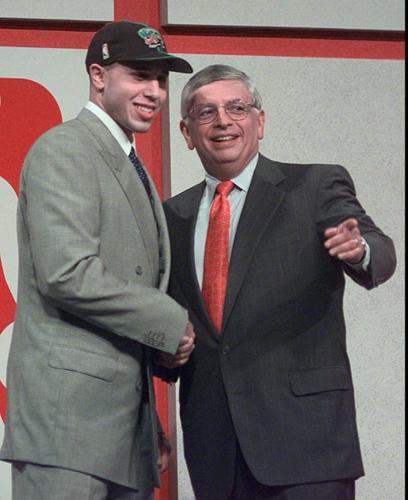
And in the end, that’s what happened — Los Angeles picked Olowakandi, now considered one of the biggest draft busts of all-time, and Bibby was swooped up at No. 2 by the Vancouver Grizzlies.
“We feel he brings leadership to our team, he’s an excellent shooter, and he’s very unselfish; he’s infectious that way,” said Vancouver general manager Stu Jackson. “He’s a workaholic, and he’s very committed to the game, and he has a great feel for the game.
“Above all, though, Mike Bibby wins. Whether it’s high school, pickup games, Nike camp, or his first season at Arizona, he’s a winner.”
From the archives: “I’m not having hard feelings right now. I’m just happy to be drafted. I’ve been waiting for this my whole life. ... I’m so relieved right now.” — Bibby after the draft.
As a pro: To emphasize just how much the Grizzlies were ready to head the reins over to Bibby, they traded away point guard Antonio Daniels, their top pick the year before, to clear space for Bibby.
For Bibby, a proven winner, he had solid NBA players like Shareef Abdur-Rahim and Bryant Reeves to pass to, but the Grizzlies were still rebuilding and struggled to win even with Bibby in the fold. He spent three years in Vancouver before he was traded to the Sacramento Kings in 2001.
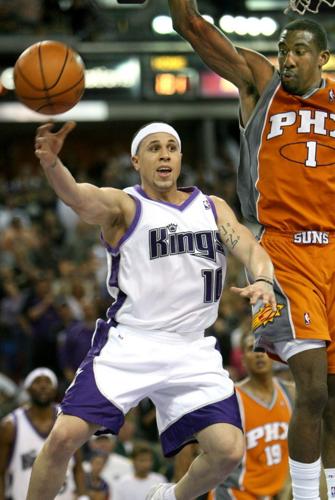
In Sacramento, Bibby formed one of the league’s best pick-and-roll duos with Chris Webber, and together they helped the Kings make it to the Western Conference finals in Bibby’s first year there.
“He’s very cerebral,” Webber said. “He’s a winner. He can do so many things. He’s a great scorer, too.”
Bibby’s best year in Sacramento came in 2005-06, when he averaged 21.1 points and 5.4 assists per game.
He would spend 6ƒ seasons with the Kings before he was traded to the Atlanta Hawks in 2008, where he stayed until 2011 when he was traded to the Washington Wizards, who eventually waived him. Bibby closed out the 2011 season with the Miami Heat and then signed with the New York Knicks, where he spent his final NBA season in 2011-12.
Now Bibby is an assistant coach at his alma mater, Shadow Mountain High, where his son, Michael Jr,. currently plays.

