



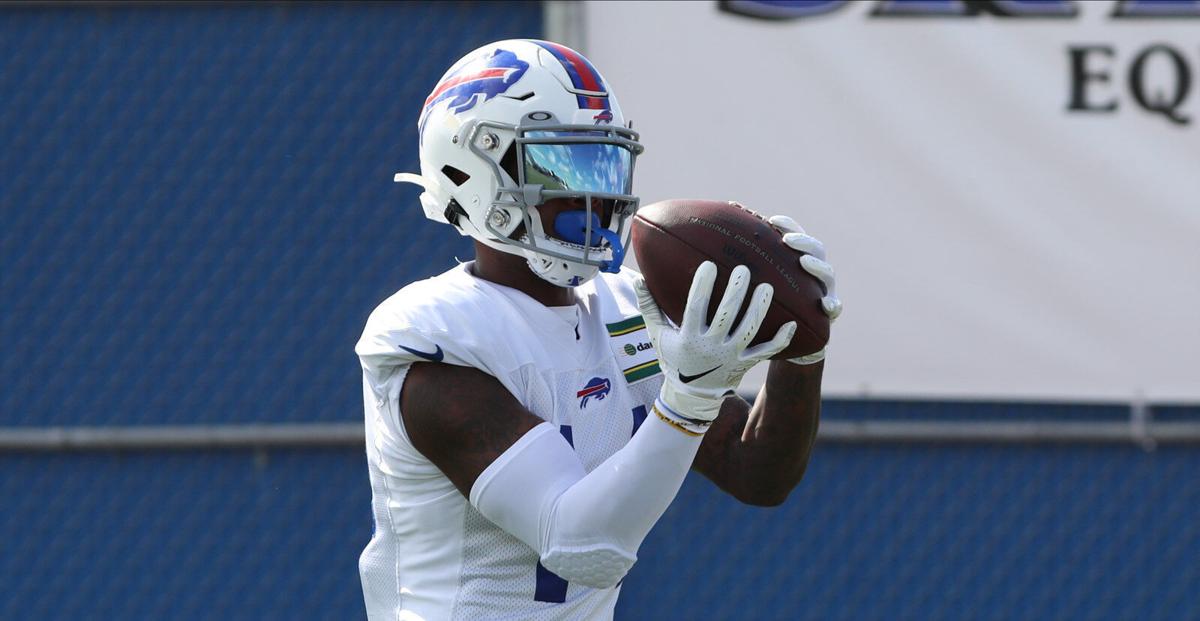
Buffalo Bills’ offensive coordinator Brian Daboll has a favorite saying: It’s all about the matchups.
Enter Stefon Diggs. The new No. 1 receiving weapon in the Bills’ offense should give Daboll the ability to dictate matchup advantages all across the field.
“His versatility is one thing that makes him so good,” said former Minnesota linebacker Ben Leber, now a radio analyst for the Vikings. “He can play the X and the Z and the slot. ... He’s a hard guy to grasp because he’s not just an outside receiver. He’s got the quickness to beat the nickel corner, as well.”
In the 26-year-old Diggs, the Bills have a receiver who can win against No. 1 cornerbacks. That’s whether he’s lined up as the X receiver (wide to the weak side of the formation), the Z receiver (off the line of scrimmage to the strength of the formation) or in the slot.
Here’s a look at various ways Diggs should help the Bills’ scheme:
Go deep: Diggs averaged 17.3 yards per catch last season, fourth best in the NFL among starting wideouts. He tied for the NFL lead in 40-plus yard receptions (eight) and tied for sixth in 20-plus yard catches (20).
“He’s been such a big-play guy for them, and that’s what we missed last year,” Bills general manager Brandon Beane said. “We kept having to go down the field 10 plays, 11 plays, 12 plays. We weren’t getting that two-play, 65-yard touchdown drive. Those take some pressure off. It’s hard to go 10, 12 plays every time."
“Again, that’s what happened to us in Houston,” Beane said, referring to the playoff loss. “We had some penalties or a sack or a lost-yardage play, something like that to get us behind the sticks. It’s tough to recover, and we settled for field goals. Hopefully, Stefon will bring that big-play element and also free up John Brown a little bit.”
Diggs scored a 54-yard TD against Denver last year on a deep post when the middle safety hesitated on his assignment. Diggs ranked No. 1 in the NFL on post routes, according to NFL NextGen Stats. He was No. 3 in the NFL on go routes (deep down the sideline) behind Miami’s DeVante Parker and Jacksonville’s D.J. Chark.
He’s also known for making contested catches, important in making plays downfield and in going against top cornerbacks who have tight coverage. Diggs had the No. 1 success rate in the NFL last year (61%) on contested catches, according to Pro Football Focus.
Quarterback Josh Allen should benefit, because last year the Bills did not deploy a receiver who was adept at contested catches. While the speedy Brown is good at getting separation, his slight frame doesn’t allow him to be open when he’s not open.
“Up close, he’s not a big guy,” Leber said of Diggs. “He’s not overly thick. I think even with pads on, people get this idea, ‘Oh, I can chuck him at the line of scrimmage or I can manhandle him through the route,' and they come to find out, no, this guy is fast and he’s quick and he’s strong.”
Man coverage: Diggs excels at getting great releases off the line of scrimmage and getting quick separation with his quickness in and out of his breaks at the top of his routes.
Statistics back it up. He ranked in the top 7% of NFL receivers in success against man coverage each of the past three years, according to Yahoo Sports.
Allen and the Bills’ passing game struggled mightily last season against elite defenses that specialized in man-to-man coverage. New England, Baltimore and Pittsburgh were the biggest examples.
Diggs is a man beater. We should get an early look at how much the Bills have improved against man coverage when they travel in Week 2 to Miami, which has bolstered its defensive backfield.
Three-wide set: The Bills’ offense looked its best last season out of 11 personnel (one running back, one tight end, three receivers) in the second half of the season. The Bills ranked seventh in use of 11 personnel last season at 70.1%. As long as Daboll is reasonably confident in his pass protection (maybe not in the game at Denver), expect the Bills to be a heavy three-wide team.
Who do defenses want to double cover? Diggs? Fine. Brown and Cole Beasley should see favorable matchups. Do they want to protect deep on both sides of the field in Cover 2? Then the run game should prosper.
“If they play heavy guys outside, then that usually opens up stuff inside,” Daboll said. “If they play heavy inside, that usually opens up stuff outside. You try not to make more of it than it really is. Those guys are good players. They've been good players in the league in terms of Smoke and Diggs, and we’re very confident in Cole with what he can do.”
Slot receiving: Minnesota used 11 personnel the least in the NFL last season (26%), according to Sharp Football. That meant fewer opportunities for Diggs in the slot. He lined up just 15.8% in the slot last season, according to Pro Football Focus, down from about 25% the previous two seasons. He’s not going to be higher than 25% in the slot in Buffalo, because Beasley is elite from the slot and runs 80% of his routes from an inside position.
Nevertheless, it will be interesting to see how much Daboll moves Diggs around. In 11 personnel, the Bills often employ 3-by-1 formations, with three receivers to one side and a lone receiver (sometimes tight end Dawson Knox) to the other. Slot cornerbacks tend to be smaller than outside corners. Some weeks, running Diggs against a slot corner will be a favorable matchup.
Teams may opt to bracket Diggs from the slot with a linebacker and a defensive back. But that should open up someone on the outside.
The Vikings face two 3-4 teams in the NFC North in Green Bay and Detroit, so Diggs has seen a lot of bracket coverage underneath.
“I feel like a lot of the 3-4 defenses gave our passing offense problems,” Leber said. “The passing offense was so predicated on the short passing game. A lot of the 3-4 defenses can manipulate where they are and it is a little like looking at spaghetti on a plate, not knowing who’s rushing and who’s dropping in coverage.
“The Packers in particular did a good job of frustrating him. I think everybody knows he plays with a hot, competitive mentality. He can kind of boil over. There’s some obvious frustration that when he’s double teamed and not getting the opportunity to catch the ball, he gets mad about it. But you can’t bracket everybody.”
Diggs seems sure to put up good numbers in a Daboll offense that likes to control the ball with a precision passing game. How good his numbers will be obviously will depend a lot on Allen.
“It’s going to come down to Allen’s accuracy,” Leber said. “Can he be accurate even in double-cover situations where sometimes you have to throw caution to the wind and say 'I’m going to trust my receiver, I’ve got to trust my arm, I’ve got to throw it to a spot and he’s going to make the play?' Diggs is really good at that.”
Watch now: How Bills can exploit matchups with Stefon Diggs as No. 1 WR

