


Jim Kubiak has been analyzing the play of Buffalo Bills quarterbacks for BNBlitz.com. Kubiak is the all-time leading passer at Navy, has played in the NFL, NFL Europe and the Arena Football League, and has been a coach and executive in the AFL. He spent eight years as the radio analyst for the University at Buffalo and runs the Western New York Quarterback Academy to help develop the next generation of quarterbacks. He recently was named head coach at Hilbert College.
Overview
On the biggest stage, the Buffalo Bills and Josh Allen exacted their vengeance on the New England Patriots in a showdown that might have decided the AFC East. Allen played the best, and certainly the most complete, football game of his career, making plays that defied logic, and, in some cases, the unwritten laws of quarterbacking. His performance was highlighted by his presence of mind in protecting the football like a man with his life on the line. He completed 30 passes of 47 attempts (63.8% completion percentage) for 314 yards and three touchdowns while accounting for more than half of the Bills’ 114 yards rushing on 12 carries. He was not sacked and he didn’t turn the ball over. His overall performance grade was 96%.
The Patriots’ defensive pressure, man-to-man coverage, stunts, and zone coverage could not slow down a Bills’ offense that would not be denied. It was the mindset of the Bills organization, led by coach Sean McDermott. The Bills brought a fierce and confident swagger and overtook the Patriots, who just three weeks ago embarrassed the Bills, manhandling them by running the football 46 times on 49 plays.
This game in Foxborough had the feeling of retribution.
Consider the Bills had only one win in five games against opponents with records over .500, losing games they should have won throughout the season, including a poor outing against the two-win Jacksonville. With integral players such as Gabriel Davis, Cole Beasley and Star Lotulelei out against the Patriots, this game could have been the last straw for a team that was riding sky-high expectations coming into the season.
The Bills scored points on seven of eight offensive drives and converted 3 of 4 on fourth down with a more physical approach driving the Bills’ offense wherever it wanted to go, regardless of circumstance, not punting the football at all.
FIRST QUARTER
Play selection: 13 plays – nine passes, four runs.
Allen: 6 for 9 passing for 49 yards, one touchdown. Two carries for 6 yards.
Performance grade: 92%.
Score: Bills, 7-0.
The Bills only drive of the quarter began with 13:34 on the clock following a three-and-out by New England. Buffalo took over on their own 39-yard line, and offensive coordinator Brian Daboll called nine passes to four runs on the drive. The big play that set the tone for the drive was a smart one by receiver Jake Kumerow as Allen was being flushed to his right.
Here, the Patriots checked to Cover 2 zone as Allen was flushed to his right. Kumerow recognized the hole between linebackers, and instead of trying to come across the field, he kept himself in the hole between the two zone linebackers. The key to success against the Patriots’ zone defense is taking the completions between the zone defenders. The play set up the Bills on the Patriots’ 11-yard line.
Part of the formula for success against the Patriots is getting off to a good start and taking a lead. McDermott sensed this need as well, and the Bills went for a fourth-and-2, rather than settle for the field goal.
The gamble paid off as Isaiah McKenzie did a fantastic job of adjusting and recognizing the coverage. The Bills were in an empty formation with McKenzie and Stefon Diggs split wide to the right and tight end Dawson Knox as the most inside receiver. Knox ran a corner and both McKenzie and Diggs ran slants. McKenzie was supposed to get the ball right away, but when he didn’t, he adjusted his route behind Adrian Philips. Allen read McKenzie and found him for the touchdown. This was a great, out-of-system adjustment by McKenzie and Allen as the Bills took a lead that they would maintain for the duration of the game.
McDermott’s decision to go for this touchdown set the tone, forcing a run-oriented New England offense to have to play from behind. The decision also set in place a sense of desperation by both teams as they went for a total of 10 fourth downs.
SECOND QUARTER
Play selection: 25 plays – 16 passes, nine runs.
Allen: 10 for 16 passing for 95 yards, one touchdown. Three carries for 35 yards.
Performance grade: 92%.
Score: Bills, 17-7.
The Patriots converted two fourth downs on their own scoring drive and tied the game at 7-7. On the Bills’ next possession, this incredible scramble set up another Buffalo score, this time with a 25-yard field goal by Tyler Bass.
The Patriots brought pressure, forcing Allen to step up into the pocket, but could not account for him up the middle as all the New England defenders were in man-to-man coverage. Allen knew this from the moment he dropped back. This recognition resulted in his decision to attack and take off down the field.
The Patriots committed the only turnover of the game on a deflected slant pattern by AJ Klein.
The Bills’ offense, however, was unable to convert on a fourth-and-goal, as Emmanuel Sanders dropped a well-thrown ball in the end zone. This was the only drive without points for the Bills and their only failed fourth- down conversion attempt.
However, with 3:10 remaining in the second quarter, Allen would get another opportunity.
The key play that set up this game-altering touchdown pass was a fourth-and-7 play in which the Bills utilized a silent count. Center Mitch Morse had his head down looking behind him for Allen’s cue. When he raised his head, Patriots defender Christian Barmore jumped into the neutral zone. Morse didn’t have a chance to snap the football as Barmore was already in the backfield. A fourth-and-7 turned into a fourth-and-2 that the Bills converted with a slant to Diggs.
Here, Diggs was in a tight split to Allen’s left and ran a seam route into an area of the field left uncovered by the Patriots. Allen’s recognition of man-to-man coverage and no safety help allowed him to decisively take this first read. Allen delivered a strike and put the Bills into a commanding 17-7 lead. This lead again dictated the terms of how the Patriots had to play offense to stay in the game, and this played to the Bills’ defensive strength of stopping the pass.
THIRD QUARTER
Play selection: 16 plays – 13 passes, three runs.
Allen: 8 for 13 passing for 80 yards. One carry for 3 yards.
Performance grade: 100%.
Score: Bills, 20-14.
As good as Allen played in the first half, he performed better in the second half with a quarterback performance grade of 100%. The incredible plays he made, along with his wise throwaways and timely checkdowns kept the Bills’ offense on the move and on the field for sustained drives.
Allen went to work from his own 25-yard line and ran 13 players to set up the Bills up for a field goal that elevated the score to 20-7.
Two plays on this possession that made the difference. On first-and-10 Allen made this unbelievable throw to McKenzie.
This might look like an easy throw, but Allen had pressure from Barmore and was moving backward as he threw it. The other important aspect was the Patriots were in man-to-man coverage and Myles Bryant was positioned with outside leverage on McKenzie. Allen had to trust that McKenzie was going to take Bryant to the inside first and then break out of his route flat and toward the sideline. Allen released the ball early due to the pressure, anticipating where McKenzie was going to be. This was perfect execution as Allen and McKenzie were on the same page.
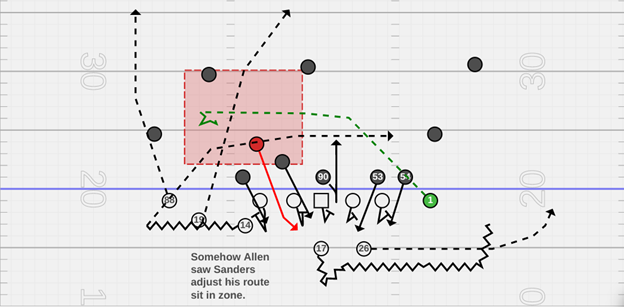
Four plays later, on third-and-10, the Patriots did a fantastic job of making their scheme look like a blitz and then dropping defensive lineman Barmore into coverage. Allen was flushed and contained as he moved to his right. The Bills had three receivers to his left and Sanders as the single receiver to his right. Sanders’ job was to run a drag from right to left. As both Sanders and Allen recognized the zone coverage, Sanders stopped his route and found an open space to sit down into. I don’t believe that this was a planned or coached event, but simply a heads-up adjustment by Sanders that Allen reacted to as he was scanning the field. This type of throw – back across the body and into the middle of the field – is the type of throw that every quarterback coach teaches not to make, and yet in the biggest game to date, on third-and-10, Allen defies quarterback convention and finds Sanders for this third-down conversion.
This demoralized the Patriots’ defense. A penalty on an illegal man downfield nullified a touchdown by Knox; a holding penalty backed up the Bills; and on third-and-14, Allen threw the football away to preserve a field goal that elevated the score to 20-7.
Although Allen did not throw a touchdown in the third quarter, his quick decisions, his ability to recognize coverage, his knack for avoiding the rush, and his patience in checking down underneath the Patriots’ coverage kept drives alive, which kept the Bills in front.
FOURTH QUARTER
Play selection: 21 plays – nine passes, 12 runs.
Allen: 6 for 9 passing for 90 yards, one touchdown. Six carries for 20 yards.
Performance grade: 100%
Score: Bills, 33-21
Allen saved the best for last, igniting the Bills’ offense again with an amazing throw to McKenzie.
Here, the Patriots were in a Cover 3 zone defense and they forced Allen to move to his left. McKenzie, who was lined up in the slot to Allen’s right, again continued to work into an open area after the play design broke down. It was the touch and trajectory of this throw that was so impressive. Allen was moving to his left, which is difficult for all righthanded quarterbacks, and he lofted the ball over Kyle Duggar, who couldn’t have played his position better. The result was a 28-yard completion. This was another example of outperforming the defensive structure, overcoming the design with ad-libbing movements into open areas in the zone, again out of system. This smart reaction by McKenzie, combined with another magical throw by Allen, resulted in a huge offensive play.
This completion was the catalyst of the scoring drive capped by a rushing touchdown by Devin Singletary. Following a failed two-point conversion, the Bills were on top 26-14.
The Patriots closed the gap to five points with a rushing touchdown and Allen and the offense had the football back for their eighth possession of the game with 7:37 remaining to play. It was at this moment that a hiccup, a penalty, or anything but high-level execution could have resulted in an opportunity for the Patriots to win.
The Bills would have had to punt, or perhaps go for it on fourth-and-10, had McKenzie not made this timely catch on this critical third-and-long play.
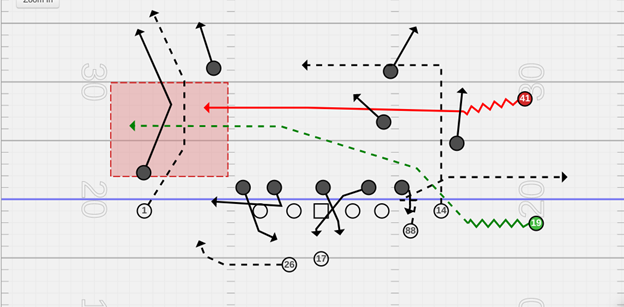
Daboll was expecting man-to-man coverage from the defense in this situation but also had to have a concept that would be viable against a zone. He created this for Allen with a drag by McKenzie and a dig route by Diggs. The beauty of this play design is that the small pre-snap motion by McKenzie tells Allen the Patriots were in man-to-man coverage because Bryant (No. 41) had to move inside with McKenzie and chase him across the field. By putting McKenzie on the outside and using his speed across the field, Daboll put the New England defense, as well as Bryant, in an almost impossible situation. In man coverage, Allen would have McKenzie on the drag. If they had played zone, Diggs would have sat in a defensive hole in the middle of the field. This was an excellent play call and a smart decision by Allen, who recognized the coverage and decisively exploited the weakness.
Four plays later, Allen made another huge play on this fourth-and-1 conversion, a simple quarterback naked boot. Daboll used heavy personnel, extra tight ends and linemen, to project that the play was going to Singletary to the right. Usually, on a naked boot like this, the offense would not block the backside containment defensive end, but in this case Dion Dawkins blocked Jamie Collins while Diggs was supposed to block defensive back JC Jackson.
This was a huge gamble for Daboll, putting the game on the line using Allen’s running ability in space against a containment defensive end and a great cornerback in Jackson. Allen again made an incredible play, getting outside of Collins and then eluding Jackson, who surged into the backfield as Diggs missed his block. This could have been the play that turned the ball back to the Patriots, who could have taken the lead with a score. But Allen’s exceptional athleticism, strength and desire proved to be more than the unblocked players of the Patriots could handle.
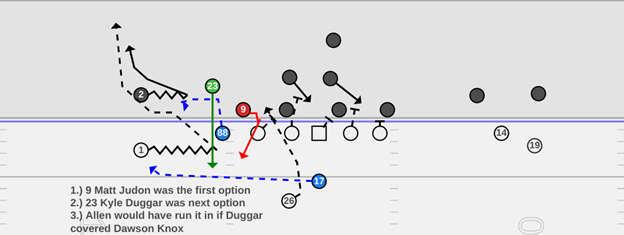
The final nail in the coffin was another incredibly designed play by Daboll. On second-and-goal, with 2:34 to play, the Bills put the game out of reach with another score. This was a play that either Daboll created this week, or he has had in the Bills’ arsenal but had yet to use. In either case, it was the perfect play call at the perfect time.
The diagram demonstrates the options that Daboll provided for Allen. First, if the unblocked defensive end Matt Judon would have taken a wide rush, Allen could have given the ball to Singletary for the touchdown. Second, as Allen ran to his left, he was looking at Bryant. As Bryant attacked him, he flipped the ball to Knox in the space Bryant had vacated. Had Bryant covered Knox, there wouldn’t have been another defender to stop Allen. This was a Daboll triple option concept in which he utilized Allen’s running and reading ability to attack three Patriots defenders with four offensive players – a Singletary run, a Knox sit route, a Sanders outside release fade and an Allen run.
Now take a look at the video to appreciate this play’s inventive properties.
In the triple-option concept, the offense typically accounts for nine of the 11 defensive players, leaving two players for the quarterback to decide off of. In this upside-down triple option idea, Allen was reading Judon and then Bryant, knowing they could not cover all the possibilities. This was the dagger that foiled the Patriots’ hopes of a comeback.
Conclusion
Allen made all the plays necessary against a defense specifically designed to stop him. Allen’s poise, his ability to make quick and correct decisions, and his clutch throws on critical downs were the difference.
The Buffalo offense had only eight drives in the game and possessed the football for more than 10 minutes longer than the Patriots, at 35:09 to 24:51. That directly speaks to Allen’s level of efficiency. The Bills also ran 75 total plays to just 60 plays for the Patriots.
Without Allen’s abilities and his willingness to take the checkdowns, the crossing routes and his incredible plays that few could make, the Patriots might very well have won.
Much of the credit must go to McDermott, who created the mindset the Bills needed to have to win this season-defining game. His ferocity and belief in the physicality of his football team showed through as the Bills manhandled New England in many ways, but it was the resilient tone from McDermott that dictated the terms in this game. McDermott’s leadership called McKenzie, Sanders, Diggs, Knox, Singletary and Kumerow to step up and make plays despite being without Beasley and Davis.
It was a winner-take-all, no-tomorrow type of mentality that changed the complexion of every decision in the game and brought the very best out of every Buffalo Bill, particularly their franchise quarterback Allen, whose performance to date has been unparalleled. He was really that good.

