


This is the 11th in a series previewing each position in the April 29-May 1 NFL draft. Today's installment looks at safeties.
Safeties and tight ends share something in common in today’s NFL.
They both require diverse skill sets that aren’t always easy to find. On offense, teams often struggle to find tight ends equally adept at blocking and receiving. Rob Gronkowski is the best example, but he’s an exceptionally rare talent.
At safety, it’s difficult to find a player who can both cover and hold up in run support. That explains why there is a good chance that for the second straight year, there will be no safeties drafted in the first round of the NFL draft.
“With safety, it’s important to remember that scheme fit is a necessity,” wrote Pro Football Focus analyst Michael Renner in his positional rankings. “The ‘safety’ moniker is a catchall for more roles these days than any other position in the NFL.”
Because of that, it’s quite possible that any ranking of safety prospects will look quite different than how they actually come off the board, because each team will be drafting with its specific scheme in mind, and some players will fit that better than others who may be projected to be taken higher.
While there were no safeties taken in the first round last year, there were players taken in the second round who had big impacts for their respective teams. Antoine Winfield Jr. played a key role on the Buccaneers’ Super Bowl-championship defense, while Jeremy Chinn started 15 games for the Panthers and stuffed the stat sheet (117 tackles, two forced fumbles, two fumble recoveries, two touchdowns).
While the first round may come and go without a safety being taken, there are prospects with impressive college production in this year’s class.
Overall position ranking: 4 of 10.
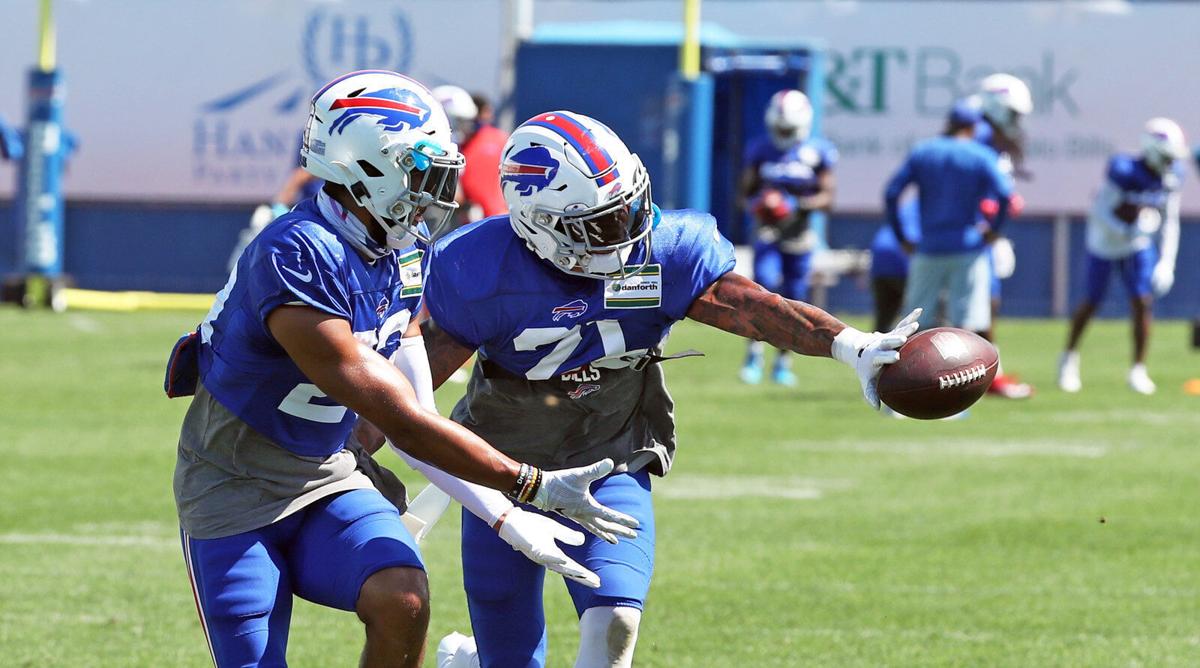
Bills view: The team has mostly ignored safety in the past three drafts, which is understandable given how durable and reliable starters Micah Hyde and Jordan Poyer have been. The only pick used on a safety under General Manager Brandon Beane came in the sixth round of the 2019 draft, on Jaquan Johnson from Miami (Fla.). He’ll go into the 2021 season as the top backup to Poyer and Hyde after the departure of Dean Marlowe in free agency to Detroit.
Because Marlowe left, safety could be viewed as a bigger need for the Bills this offseason. Typically, the team has taken at least seven safeties to training camp. They currently have just four on the roster, so adding depth to that position seems like it will be a top priority at the draft – or immediately after it with undrafted rookie free agents.
Both Poyer and Hyde have inked contract extensions in the past year, so neither of them is going anywhere any time soon. That means if a safety is drafted, special teams will play a big part in his chances of getting on the field barring injury.
Bills need ranking: 4 of 10.
The best: Trevon Moehrig, TCU.
Moehrig is one of those coveted safeties who can cover and defend the run. Here’s how he was described by Bucky Brooks, the former Bills receiver and current NFL Network analyst: “Moehrig is a dynamic safety with cornerlike skills. He capably matches up with slot receivers in space while also flashing outstanding range as a deep-half player. Most importantly, the TCU standout is an exceptional open-field tackler with an aggressive read-and-reaction approach that enables him to blow up WR screens at the line of scrimmage.”
It's possible that Moehrig sneaks into the first round after he was named an Associated Press second-team All-American, won the Jim Thorpe Award (which is given annually to the top defensive back in the country) and was a first-team all-Big 12 pick as a junior (47 tackles, two interceptions, team-high nine passes defensed).
Names to know: Jevon Holland, Oregon; Jamar Johnson, Indiana; Hamsah Nasirildeen, Florida State.
Holland’s NFL comparison on his nfl.com scouting profile is Poyer. Holland opted out of the 2020 season, but showed good ball skills in 2019 with four interceptions. He’s a second-round prospect. The same goes for Johnson, who likewise had four interceptions during the 2020 season and is praised for his versatility. … Nasirildeen is a big hitter who is strong in run support. He overcame a torn ACL suffered in 2019 and would be a good fit in the Bills’ locker room. His leadership with the Seminoles drew high praise.
Ball magnet: Syracuse safety Andre Cisco’s draft stock will be one to watch. Cisco had 13 interceptions in just 24 career games at the college level. That alone makes him an enticing prospect. He’s also got good size, at 6-0, 203 pounds, and is a good athlete. However, he’s coming off a leg injury suffered in September that ended his season and blew a fair share of coverages looking to make the big play. As mentioned previously, one team’s grade on Cisco may be much higher than that of another.
Top 10
Player, School Ht. Wt.
1. Trevon Moehrig*, TCU 6-1 208
2. Jevon Holland*, Oregon 6-1 196
3. Jamar Johnson*, Indiana 6-1 197
4. Richie Grant, Central Florida 6-0 194
5. Caden Sterns*, Texas 6-0 202
6. Hamsah Nasirildeen, Florida St. 6-3 213
7. Andre Cisco*, Syracuse 6-0 203
8. James Wiggins, Cincinnati 6-0 205
9. Joshuah Bledsoe, Missouri 5-11 201
10. Talanoa Hufanga*, Southern Cal 6-1 215
* – Underclassman
Read the full story from News Business Reporter Matt Glynn

