


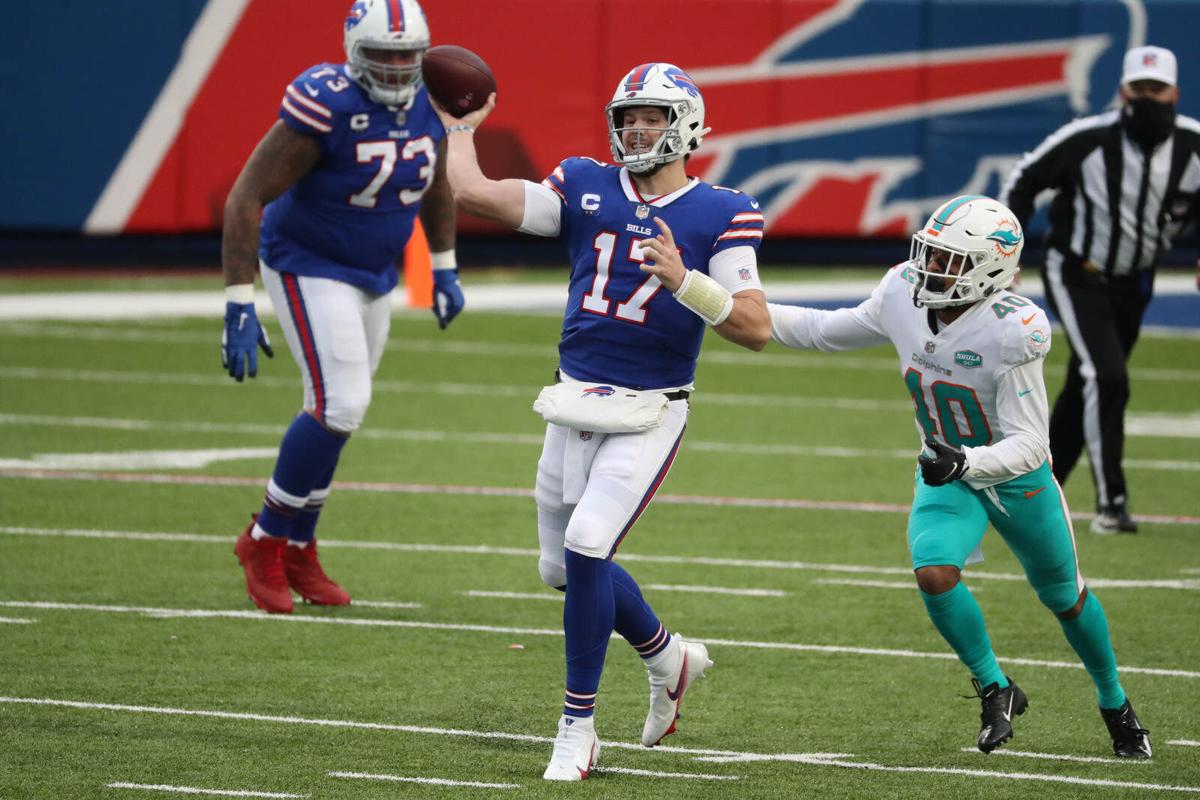
Accurate passing can’t be coached. Either you have it or you don’t. And if you weren’t an accurate passer in college, you aren’t going to become one in the NFL.
How often have we heard that since the runup to the 2018 NFL draft?
Josh Allen’s detractors put it at the top of the reasons that he wasn’t worthy of the seventh overall choice the Buffalo Bills used to select him. It was spoken with such authority and conviction, as if it were gospel handed down from the football gods.
There’s just one problem. In the case of Allen, it has proved false.
A 13-3 Bills season highlighted by the team’s first AFC East championship in 25 years, its most victories in a season since 1991 and a No. 2 playoff seed doesn’t happen without the dynamic play of Allen. He has set single-season franchise records for passing yards (4,544), touchdown passes (37), completions (396), 300-yard passing games (eight) and total yards (4,987, including 12 receiving).
But those achievements wouldn’t be possible without the most defining stat of Allen’s rise to elite status: His career-high completion percentage of 69.2, which ranks fourth in the NFL.
The Bills captured their first divisional crown since 1995 with a Week 15 win over the Denver Broncos. See a game-by-game look at how Buffalo stole AFC East royalties from perennial champs New England. Josh Allen, Cole Beasley, Stefon Diggs, Tre White and Jerry Hughes all star in this slideshow.
Allen’s adjusted completion percentage, which takes into account spikes, throwaways and throws impacted by hits, rose from 71.2% in 2019 to 79.2%, according to Pro Football Focus.
Coming three seasons after a career at Wyoming, where he completed 56.2% of his throws, it makes a solid argument that a quarterback can, in fact, become significantly more accurate as a pro.
“I have seen a real improvement in his accuracy,” Troy Aikman, Hall of Fame quarterback and lead NFL game analyst for Fox Sports, told The Buffalo News by phone. “And it’s a real credit to his work ethic. I mean, he has clearly worked really hard at it. … My years as a player and now as a broadcaster, he is one of the few that I can think of that has shown noticeable improvement in that area.”
Aikman readily acknowledges he was an Allen detractor in 2018. While he’s willing to make an exception for Allen, Aikman unapologetically subscribes to the logic that inaccurate passers in college tend to stay that way in the NFL. Aikman’s completion percentage in college was 63.3, helped greatly by his transfer from Oklahoma and its Wishbone offense, and he had a completion percentage of 61.5 in a Hall of Fame career.
“I was accurate as a passer and I just I feel you either have an ability to put a ball where you want to or you don't,” Aikman said. “And that was a real concern, I guess, of Josh coming out. Heck, I saw him miss 10-yard throws. And not even close. And you'd say, ‘Wow!’ When I was at his pro day, I was standing right behind him and I happened to be next to Mike Shula (when he was offensive coordinator of the New York Giants). He threw a ball, it had to be 85 yards in the air. I've never seen a ball travel like that. He overthrew the receiver and it was the darndest thing I've ever seen.
“When people start talking about strong arms and this and that, I saw Brett Favre launch one about 78 yards one time. I’ve never seen anyone with an arm like Josh Allen's. Now, where does that get you? Well, not very far. I mean, it helps you with a Hail Mary if you're on your own 20-yard line, but other than that ...
“I’m asked a lot, ‘Hey, what do you think the most important quality is for a quarterback?' I have always said it’s accuracy, because you can have all of the other things – great leadership, great toughness, arm strength, smart – and it just doesn't matter. If you can't throw a football where you want to throw it, then what good are you?”
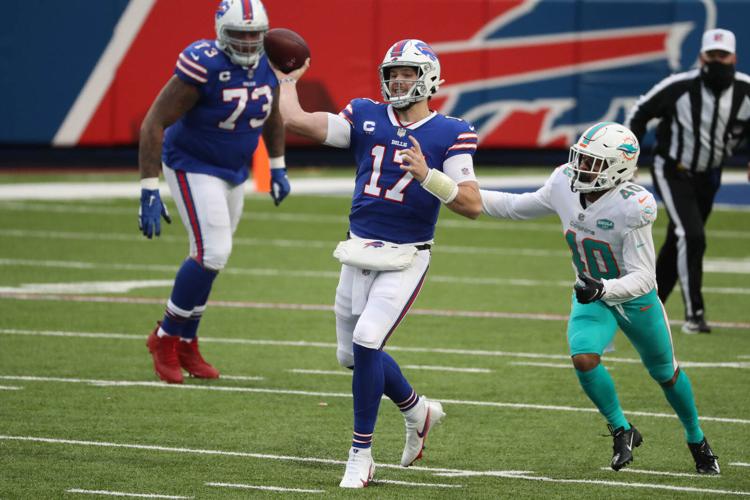
After throwing for 417 yards and four touchdowns – with three passes of 46 or more yards and seven completions in eight attempts of 20-plus yards – in a 31-28 victory at Miami on Sept. 20, Allen was asked if all the talk about his lack of long-ball accuracy could be put to rest.
"I'm asking you," said Allen, who was among the worst in the league in 2019 in 20-plus-yard throws with a 30.9% completion rate, per Pro Football Focus.
He would provide an answer to that question as he put together an MVP-caliber season. That deep-ball figure has mushroomed to 47.9% this year on almost the same number of attempts, and Allen's improvement hasn't just come on longer throws.
“It seems like Josh is a little bit more composed and comfortable in stepping up in the pocket," said Broncos safety Justin Simmons before Allen completed 70% of his passes for 359 yards in a December win against Denver. “He's making accurate throws all across the field."
'Worked his butt off'
When Allen’s completion percentage dipped from 56.2% in college to 52.8% in his rookie year, a chorus of "I told you so" rang out. It didn’t get all that much quieter when the number climbed to a modest 58.8% in 2019.
After completing only 52.2% of his passes in a forgettable performance in the Bills’ wild-card playoff loss at Houston, Allen and his coaches knew there was plenty of work to be done. Even in an offseason when the pandemic wiped out practices at team facilities, he managed to invest enough time on his own, including his annual sessions in Southern California with personal quarterback coach Jordan Palmer, to sufficiently address his throwing mechanics.
One component of his work with Palmer was having his mechanics digitally mapped, a process that allowed Allen to better understand how throwing motion correlates to accuracy and power. As he explained early last month while appearing on "The Pat McAfee Show," the mapping showed “what was firing … (it is supposed to be) my hips, then my torso, then your elbow and your hand firing. But my hand and elbow were firing near before my hips were. I wasn’t really incorporating any part of my legs in my motion.”
“Being able to add my hips and make that as consistent as possible and try to slow everything else down up top and use my hand as the leverage for the speed and the accuracy has changed a lot of things,” Allen said. “The accuracy has gone up, but it’s actually added some mph to my throwing power, too. It’s been a pretty cool process. … It was like a wake-up call. It was like, ‘OK, maybe I should try to incorporate a few clubs into my bag and try to hit that 60 degrees.’ It’s funny that I use golf as that metaphor because I’ve actually learned a lot of my throwing from my swing in golf.”
Additionally, in focusing on deep-ball accuracy, Palmer put Allen and his other clients through drills that had them throwing to receivers at the top of a hill or stadium bleachers. They had to get the ball to rotate and drop down, despite the target being 15 to 20 yards above them.
“What it does is it exaggerates the shoulder tilt and your spine tilting back,” Palmer told The News in January. “And then we bring them down the stands. You do that over a period of a month or so and it's kind of like you develop both sides of the spectrum, both extremes. Too high and not high enough.”
Passing from the bottom of an incline “kind of forces you to throw the ball with arc over the top and drop it in instead of trying to drive it,” Bills quarterbacks coach Ken Dorsey told The News. “It just forces you to get elevation on the throw, and it gives you a little bit more margin of error when you do that.”
The Buffalo Bills started their run of four-straight Super Bowl appearances with a clash against the New York Giants. Thirty years later, here's a look back at the heartbreaking defeat in the game's final seconds. From Leon Seals' bone-crunching hit of Jeff Hostetler to Thurman Thomas' key fourth-quarter TD run, several memorable scenes appear in this slideshow.
Allen also followed the guidance he received via video calls with Dorsey and offensive coordinator Brian Daboll. Their instruction continued in-person once the NFL allowed training camps to open.
Aikman and others who know what it takes to excel as a quarterback admire the amount of time and effort Allen invested to improve his passing skills.
“I think he worked his butt off,” former NFL quarterback and CBS game analyst Rich Gannon told The News. “The feet are a big thing. I know he's talked a lot about being in balance in the throws, not overstriding. He’s worked a lot on that. I think he's worked on his release mechanics. I think he's done a lot of technical work and fundamental work on that.
“I just think the fact that he’s taken it to another level where, in the offseason he's going out to California, spending his own money to work on some of those core fundamentals and techniques, all of that shows. He’s worked on core strength. I think he's also worked a lot on a whole routine to get himself warmed up before he throws every day and cool down, taking care of his arm, which guys didn't do 15 years ago.
“I think a lot of the credit has to go to Brian Daboll and the coaching staff; they’ve done a really good job with him. But I think a lot of credit goes to the kid. I had a conversation with him in one of our production meetings and believe me, he is well aware, as are all quarterbacks, what the talk on the street is about him. He’s heard the criticism.”
The addition of Stefon Diggs has done wonders to boost Allen’s production in all areas. Besides Diggs’ ability to separate from defenders, his presence has helped allow other receivers to have more room to operate. And when they have more room, Allen has a greater chance of getting them the ball consistently.
The Bills have thrown more passes this season, with Allen's percentage of deep attempts decreasing as the intermediate passing game has opened up. Cole Beasley, who generally operates on underneath routes, is having a career year with personal bests in targets (107), receptions (82) and yards (967).

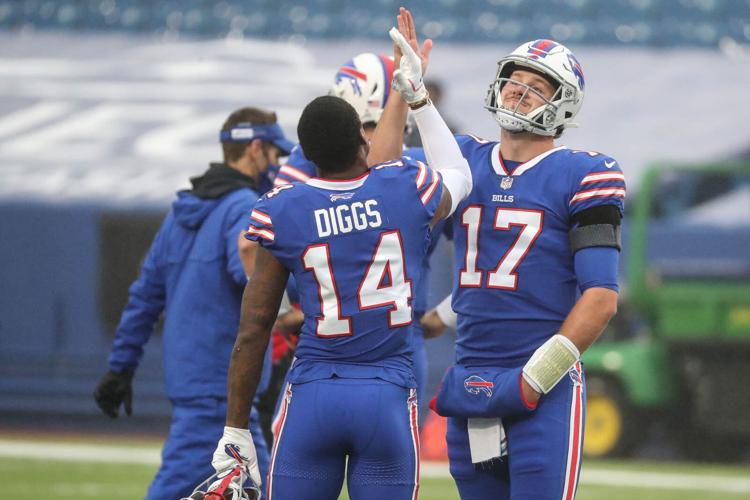
Buffalo Bills wide receiver Stefon Diggs (14) and quarterback Josh Allen (17) loosen up before the game at Bills Stadium in Orchard Park on Monday, Oct. 19, 2020.
In passes that travel to 10 to 20 yards, Allen has upped his completion percentage from 61.7% to 64.2%, moving from 58 of 94 last year to 79 of 123 this year.
“Everyone knows he has the arm," the Broncos' Simmons said, "not to mention the additional weapon they got with Diggs, he’s an elite receiver.”
Allen’s game experience has also paid large dividends.
“When he walked to the line of scrimmage against the Ravens that first game of his rookie year, there was a million things coming at him,” Gannon said. “And it all happened so fast. Now, all of a sudden, he's seeing the corner's heels at 10 yards on one side; the other guy's at eight. He's seeing the safety, who's usually three yards outside the numbers and now and he's down in the box area. He starts seeing the Will linebacker who's bossed a little bit (sliding to the strong side).
“Not only that, but he's starting to see things on the offensive side of the ball. Cole Beasley's split is supposed to be three yards from the tackle; now he's five yards. Little tips and reminders. Now you're an air traffic controller. He's still not quite there yet, but, man, he's made big progress. I think he's the most improved player in the league this year. And that's saying a lot because, in my opinion, he was trending in the right direction last year.”
'Understanding everything'
Gannon calls himself a “great example” of a QB who elevated his completion percentage during the course of his career. He went from 33.3 in 1987, as a rookie with the Minnesota Vikings, to 59.6 by his fifth season. Gannon improved to 63.6 in 1995, his first year with the Kansas City Chiefs, and hit a career-high 67.6 in 2002 with the Oakland Raiders, winning NFL MVP honors and leading his team to the Super Bowl.
He believes the reason for his improvement applies to Allen and all quarterbacks.
“One is a better understanding of everything, and it starts with protections,” Gannon said. “When you start understanding the protections, you start understanding the strength of the protection, the weakness, where you're vulnerable, who's hot, who's not, where you have to change the protection, where you have to speed up the drop, all those type of things help you. The second thing is understanding coverages and fronts. If it's an under front, and the safety's in a strike position, there's a good chance there's going to be some kind of blitz. Now I've got some answers in my toolbox for that. I can audible the protection, I can sight-adjust, I can hand-signal the receiver, I can do all these different things.
“I think he's got a better understanding of the why. Why is Daboll calling this particular play in this situation in the game, the down and distance and score? Because he's expecting blitz or he's expecting two-deep coverage or he's expecting man-to-man. All those things begin to factor into your ability to be more accurate, because you're more decisive, you have better anticipation.

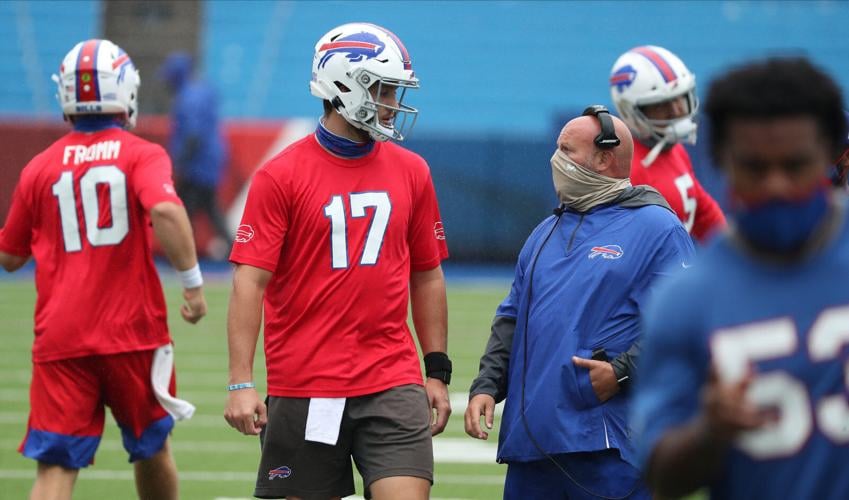
Quarterback Josh Allen (17) talks to offensive coordinator Brian Daboll during warmups.
“You watched him early in his career, he has such a strong arm, but he had to see the guy clearly coming out of the break, he had to see the guy clearly have some separation. Now you watch him, and he's throwing the ball before these guys are out of the break a lot of times because he trusts the receivers. He understands the importance of timing and rhythm in the passing game. His feet have gotten better in the pocket. You watch him, whether he's in the gun or he's working under the center, he's become a much better play-action passer.”
It’s fair to say that at least some of Allen’s accuracy issues have been circumstantial. He grew up in Firebaugh, Calif., which is hardly a hotbed for quarterbacks. Allen wasn’t building up his resume for college recruiters by attending prestigious passing camps. He wasn’t on anyone’s recruiting hot list.
As a member of the Firebaugh junior varsity team in 2011, Allen had a completion percentage of 59.5. It was 50.8% and 57.4% in his two seasons on the varsity.
“It was really just him and his high school coach probably working on it,” Dorsey said. “Then he goes to junior college for a couple years (Reedley, where his completion percentage dipped to 49). And then he goes to Wyoming for a couple years. So, it's not like he was in one place for like four or five years with the same coaching staff in college, to where they could really home in on things or anything like that.”
There are other examples, though not many, of top-level NFL quarterbacks improving completion percentage from the beginning of their careers.
Steve Young went from 52.2% in 1985, his first year with the San Francisco 49ers when he made five starts while backing up fellow Hall of Famer Joe Montana, to 69.6% in 1989 when he made three starts to 66.7% in 1992 when he went 12-2 as a starter.
The Saints’ Drew Brees jumped from 57.6% in 2003, his third NFL season with the San Diego Chargers, to 65.5% a year later, his next-to-last season with the Chargers.
The common thread is an exceptional work ethic.
“I think, number one, it starts with the individual and the type of guy you're dealing with,” Dorsey said. “Is he willing to put in extra time? Is he willing to basically sacrifice a lot of stuff to really focus on his job, his profession? And Josh is really willing to do that in the offseason and in-season, whether it's drill work, whether it's extra throwing, whether it's watching tape. I think the most important thing is you've got a guy who is hungry to improve and eager to learn and work on his craft. A part of that is just really focusing on the mechanics, building a great base of fundamentals.”
Strong base
Allen likes to see his throwing motion through the lens of golf.
For Dorsey, the closer sporting comparison is boxing.
“I equate it a lot with a boxer,” he said. “If a boxer is standing straight up and he's not moving his feet, he's going to get knocked out. The fight isn't going to last very long. Whereas, if he's playing with a great base and has a solid lower body, generally he's going to give himself a chance. I think it's the same thing with quarterback play. We focus a lot on the lower body and the base mechanics, because very rarely do you play in an NFL football game where you just drop back and you could just sit in the pocket all day and you're throwing seven-on-seven. You're going to have to slide and adjust, you're going to have to move in the pocket and kind of stress yourself and then you have to get back into a throwing position or have to throw a little off-balance.
“When you watch the most successful guys around the league, they have very good lower-body mechanics in their base and that's where you generate a lot of power from and that's where you generate a lot of accuracy from. But we try, as best we can, to replicate that through drill work."
It starts with a good, strong base with good knee-bend and foot movement. "Not letting your feet go dead is the main thing," the coach said.
After that, it's about keeping the shoulders level, with the front shoulder (the left in the case of a right-handed thrower like Allen) tight to the body to prevent it from rising.
“When you throw an intermediate or short ball, if your front shoulder’s raised, in order to throw it accurately, you've got to bring it back down to level so the ball doesn't sail on you. Obviously, that's something he worked on as well," Dorsey said. “Naturally, there’s going to be some throws where it elevates because you're putting arc on the ball and throwing it over the top. So sometimes there are those throws where you elevate the shoulder, but for the most part, you want good level and staying tight.”
Allen came to recognize how vital good footwork was to his game when he began training with Palmer before the 2018 draft.
"I had a problem with a long front step and that was causing my elbow to drop, and it was throwing off the entire sequence within the hip and the shoulder and the arm coming through," Allen told The News during his rookie training camp. "So when I keep that steady and I can take a small front stride and get (the left foot) down, my lead step, as fast as possible, the ball comes out quicker, it comes out cleaner, my throwing motion is less violent and that equals more accurate balls."
Step one of the Palmer method is having his clients jump as high as possible multiple times, land and look down.
"And I'll say, 'OK, that is your base. We're going to operate within a couple inches inside or outside of that base,'" Palmer said. "From there, I got to the root of the problem: his feet. He's overstriding. And I go, 'Well, why are you overstriding? Because your base is too narrow. You're putting yourself in a position where you have to overstride. So let's not fix the overstride, let's fix the base.'"
Among the tactics Palmer employed was having Allen wear a resistance band around his ankles while he went through drills. The purpose was twofold: 1. It helped strengthen Allen's base; 2. It reminded him of the proper distance to maintain between his feet.
"The outside of your butt, your posterior glute, is weak," Palmer said. "So if I put a band around your ankles and have you move around, it's going to burn right away. No matter how big and buff you are, if that's a muscle group that's not being addressed, it's going to burn. They're very thin, light bands, but putting them on, it fires that glute and it strengthens it to where you're strong enough to keep your base right there."
That’s the mechanical part of Allen's growth and development.
There’s a psychological part, as well, and it hasn’t been lost on Allen’s teammates.
“It’s hard when the keys to the franchise are given to you. That can be daunting, both mentally and physically,” center Mitch Morse told reporters after the Bills’ 56-26 victory against the Dolphins Sunday. “Josh has just been such a poised competitor this year. He really picked us up when we weren’t feeling great and kind of marched us forward.
“When a quarterback walks into the huddle and you can feel his confidence even when things aren’t going right, that permeates to the rest of the guys and he does an exceptional job of that and the great quarterbacks do, so we’re very fortunate to have him.”
As the Bills enter the postseason, they know they have a quarterback who is playing the best football of his life. Nowhere is that more evident than with his elevated accuracy.
It hasn’t happened by accident.
“Obviously, we’re very happy with the direction we’re in and the strides that Josh has made,” Dorsey said. “And a lot of that, and I can’t reiterate enough, is just the work that he’s put into it.”