


Three months ago, nobody knew if a college football season was going to happen. There was little hope, too, that the University at Buffalo would play this season as the Covid-19 pandemic showed no signs of slowing down during the summer.
Yet the conference announced in September that a six-game schedule would begin this week after it initially postponed the season to the spring. Advances in Covid-19 testing and stronger protocols for playing and practicing helped the MAC decide to jump-start a shortened season.
Now, the Bulls are scheduled to kick off the regular season at 7 p.m. Wednesday at Northern Illinois. In the path to returning to play, UB players found they had to change how they practiced, trained and lived.
The News spoke with four UB players about their preparation for an uncharacteristic season. Each expressed his relief to play football, the anxieties they faced, how they coped and the changes they made as their lifestyle was impacted by the Covid-19 pandemic.
The players offered a plea for help, not just at a football level but at a community and a societal level: Help diminish the spread of Covid-19, a disease that has impacted how we live, work, engage and operate.
‘Everybody is going through this’
Jaret Patterson’s family reminds him that this is not a normal time.
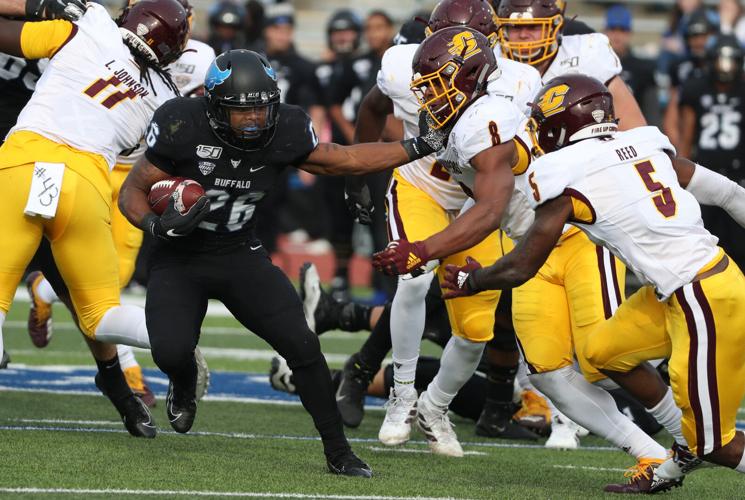
Patterson, a junior running back, has prepared since February to follow up on a record-setting 2019 season. There were moments in the last few months, however, that he wondered when the season would come. Or if it would come.
The pandemic shut down UB’s classes in March, and prematurely ended spring football practices.
Patterson and his twin brother, James, spent the spring semester at home in Maryland, where their parents, Janine and Leroy, were working from home. The UB students took their spring semester classes online, sometimes in the same part of the house where Janine Patterson would be in an online meeting with the staff of a school in Baltimore, where she is an administrator.
“It was kind of crazy, and kind of hectic, but we got used to it,” Jaret Patterson said. “We learned how to have everyone at home and made the best of that time with each other.”
The Patterson twins returned to UB in June, and haven’t been home since the start of the summer. Video calls with his family have provided a lifeline of sorts.
“I couldn’t physically be there with my family but those pep talks, not just from my family but from the staff we have here at UB, those really helped me, and my mentality,” Patterson said. “That we’re all in this together, and that we’re going to do the right things to keep safe. That I’m not alone, and that helped us get to where we are now, preparing for our first game.”
But there were moments where Patterson’s patience wore thin. In those FaceTime conversations with his parents, they gave him a valuable piece of advice.
“Stay patient,” Patterson said. “Everybody is going through this, in the world. I had to have that mindset and bring that mindset to my life, that patience is key and you really have to take things one day at a time, and good things will come to those that are really patient.”
The Bulls returned to practice Oct. 5, and Patterson said the extra time off benefited him after a season in which he led the MAC in rushing (1,799 yards).
“I took a lot of snaps and had a lot of carries last year, and that beats up the body,” Patterson said. “It was like a blessing in disguise for me because I really feel fresh, more than ever. That time off really helped get my body back to feeling good.”
But Patterson and his teammates also had to learn a new set of routines and guidelines.
“Everything was kind of new,” Patterson said. “But we have to adjust more than ever. You have to be more focused than ever with Covid, being smart outside of the facilities and wearing your mask. It’s adjusting to a new normal, staying safe and staying in the protocols that our athletic trainers and coaches give us.”

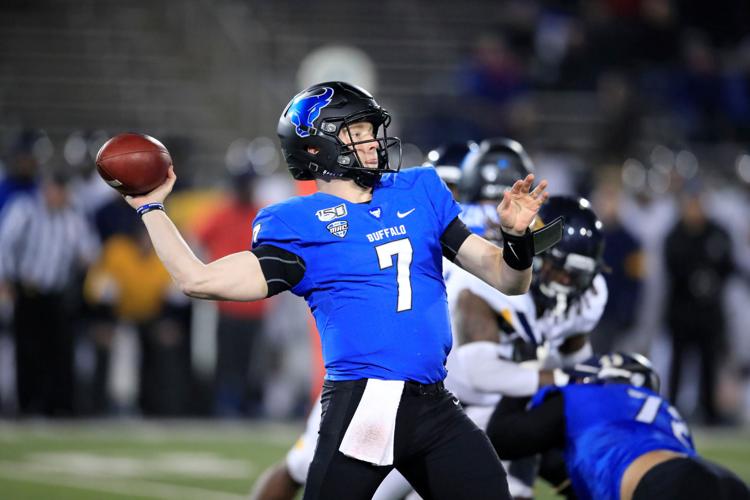
UB quarterback Kyle Vantrease.
‘Wash your clothes immediately’
Kyle Vantrease made a habit of checking the New York State travel advisory list during the summer.
Vantrease, a quarterback and a redshirt junior, carefully planned his trips home to Stow, Ohio, so he could visit his family. If Ohio was on the state’s travel advisory list, he would stay put.
If Ohio wasn’t on the list, Vantrease went home for infrequent visits. When he arrived at the door of the home he grew up in, his mother wouldn’t immediately let him in the door.
Patti Vantrease works in cardiac rehabilitation, but was assigned to work in a Covid-19 unit at a local hospital in northeast Ohio.
“She was being tested multiple times, and even when I got home, she told me, ‘You have to wash your clothes immediately, take a shower,’ just to be cautious,” Vantrease said.
When UB’s offseason workouts began in June, everything was different, including the training regimens.
Vantrease woke up earlier for Covid-19 testing. He worked with smaller groups at assigned times in the weight room. He made appointments to go into UB’s training room, as the flow of traffic in and out of the facility is constantly monitored. Even communication with teammates, whether it was discussing plays or workouts, was done by phone or by video chat.
As classes began Aug. 31, Vantrease found he missed the rhythms of each school day, whether it was walking to class or eating lunch with friends. Like many of his teammates, he is taking classes remotely this semester.
“Not being able to walk around campus and seeing all the people? To be able to see all the other students, and being a part of a college atmosphere, it’s something you’re so used to,” Vantrease said. “To not have that, it’s different.”
Vantrease celebrated his birthday on Aug. 20. However, for the first time since he’s been playing football, he spent his birthday doing something other than practicing.
Even as the season approaches, Vantrease harbors some worries given the continuous nature of Covid-19.
“The biggest part for me was the uncertainty of when we were going to play this fall, or this spring,” Vantrease said. “Even still, now, it’s health. Am I going to test positive? Is someone I’ve been with going to test positive? How is the quarantine going to have to work?
“All of the unknowns, that’s probably the biggest and most stressful part of it. In my life, I’ve always been a go-with-the-flow kind of guy, and I react, but when you don’t know what’s coming and have no way to prepare, it’s difficult. That was probably the hardest part.”
‘Try to stay safe’
Matt Myers was ready to return to the football field. He began last season as UB’s starting quarterback, but a neck injury and subsequent surgery ended the West Seneca West graduate’s first season.
Spring football was supposed to be Myers’ chance to compete again to become the starting quarterback. Instead, the shutdown of spring practices and the UB campus altered Myers’ plans. He went from training every day to trying to find ways to stay focused.
The pause, though, gave Myers more time. More time to recover from the neck injury. More time to watch film, to correct the mistakes he made during an up-and-down five games as UB’s starting quarterback. More time to watch opponents.
“Hours and hours each day, each week,” Myers said. “Once they canceled the season (in August), I kind of laid back a little bit, but then as soon as it was announced the season would happen this fall, it was right back to hours each week.”
In the downtime, Myers applied himself to his schoolwork, part of navigating through a new way of life.
“Try to stay safe,” he said. “And don’t get Covid.”
Myers understands that the disease transcends anything about football. No one in his family, he said, tested positive for Covid during the offseason. But being away from campus and from football, and being in a form of survival mode, gave him a better sense of appreciation for being able to go to school, to play football and to be with his family and friends.
The change of plans was a stark reminder that everything had been upended because of the pandemic.
“No one has been through this,” Myers said. “It was definitely challenging, for every one of us. It got to that point around May, a little before we reported back (for offseason workouts), where it was like, ‘This Zoom stuff, can we just get back to the normal way we were living?’ But once we got back to campus in early June, everything started to become a little more routine, it was good.”
Myers also drew a sense of relief from his teammates, who were going through similar feelings of isolation and uncertainty.
“We stayed connected and I knew I wasn’t in this alone,” Myers said. “There were other guys going through it, just like me. Keeping everyone involved and keeping them driven was a big goal for us in the offseason.”
‘Right now, it’s not the same’
When it came to offseason training, Taylor Riggins had to improvise. He and his teammates had no access to the Bulls’ training facilities after the school shut down, and while Riggins stayed on campus, he couldn't go to local gyms, which also were shut down due to state mandates.
He and his teammates trained in another teammate’s home gym, set up in a garage, operating in shifts and in small groups. They did conditioning drills at Kunz Field on campus.
“But it’s so much different than working out with your teammates and being in a weight room, full of energy,” said Riggins, a defensive end. “Me and my teammates, we were all apart, but we put our heads down and continued to work, and we knew that this was more adversity we had to overcome, and we had to do all the right things to make sure we’d have a season.”
He admits that not having the routines of spring practices, the structure of training and interactions with others sapped some of his motivation. But he kept faith that there would be a season. He wasn’t sure when that would happen, though.
Riggins found other outlets. He visited his family in Rochester on free weekends, and spent more time watching game film and footage of NFL players. He trained on his own and played golf with several teammates, including Vantrease.
“He’s good,” Riggins said of Vantrease. “Probably the best golfer on the team.”
UB’s first practice brought Riggins a sense of relief.
“When you’re able to see your guys and be back in the facilities and be on the field, it’s a great feeling,” Riggins said. “It gives you hope that things are moving in the right direction and that we can have a season.”
But Riggins notices the differences. Like Vantrease, he misses the energy that comes with having his teammates around him.
“You need a room full of energy,” Riggins said. “Right now, it’s not the same.”
Read the full story from News Staff Reporter Sandra Tan
What it will take to make a season happen
UB’s players agree that the season opener Wednesday is a light at the end of the tunnel. They want a season to happen.
Through last weekend, 37 games have been canceled or postponed because of Covid-19 issues, including positive tests, quarantine, isolation and contact tracing. The Bulls had a wake-up call in September, as 19 players tested positive for the virus, one of a rash of outbreaks among college football programs in the last six weeks.
Additionally, 115 Football Bowl Subdivision athletic programs have registered or have had positive Covid-19 tests reported, according to a Buffalo News database that is tracking cases in college athletics.
Playing an entire season involves teamwork on a greater scale, outside of football – the cooperation of others to mitigate the spread of the disease and to create a healthier community.
Riggins relays a message that he sends to his teammates, and that coaches and other players circulate on a daily basis.
“The biggest thing is doing the right things,” Riggins said. “Putting yourself in the best position to ensure there is a season.
“Especially with testing multiple times a week, guys see that this is serious and that we’ve got to put ourselves in the right position, because one guy can affect the whole team.”
The Bulls are motivated to get others to understand the value of personal responsibility amid the severity of the pandemic. Some, Vantrese said, understand because they have been directly impacted.
“The hardest part is trying to get everyone else to understand what they have gone through, and understand how real this situation is and how important it is to be accountable and to make sure you’re doing the right things," he said.
"Be smart. Make sure you’re with the right people. Be healthy. Keep people in your prayers that are going through a tough time. This is going to affect people. You cannot control the virus, but you can control what you can control.”

