


Helping athletes find college scholarships has never been easy, but in some ways at least it was predictable. There have always been players vying for a reasonably well-defined number of roster spots, some that include scholarships, others that don't.
This year, all that math has been thrown away, part of the fallout from the pending $2.8 billion NCAA antitrust settlement.
Liam Barrett, the managing director of the U.S. Sports Scholarships recruiting service, said it was no surprise when a soccer player called last week to say his spot on the roster at an Atlantic 10 Conference school was gone.
That player will enter a transfer portal that is likely to double in size to as many as 1,600 soccer players, many like him who are being cut from teams by coaches dealing with shrinking roster sizes and uncertainty about the future.
“It's just going to make it so much more difficult for someone who's not even in the college system yet to break through,” Barrett said in explaining the cascading impact new college roster limits are having on high school prospects.
Many schools were busy right up to Wednesday's deadline for the revamped National Signing Day for “non-revenue” sports — everything outside of football and basketball — trying to determine how many roster spots they will have to offer for the 2025-26 school year.
This is happening because the settlement that clears the way for schools to pay their players also dictates new roster limits, forcing athletic departments to reimagine the way teams — from the biggest (football) to the smallest (golf) — are built.
“I’m hearing about walk-ons and future recruits ... who haven’t signed yet getting that hard phone call,” said Minnesota women's volleyball coach Keegan Cook. “That’s brutal. It’s really hard, because now a roster spot is really a limited commodity, for lack of a better word, where it didn’t used to be.”

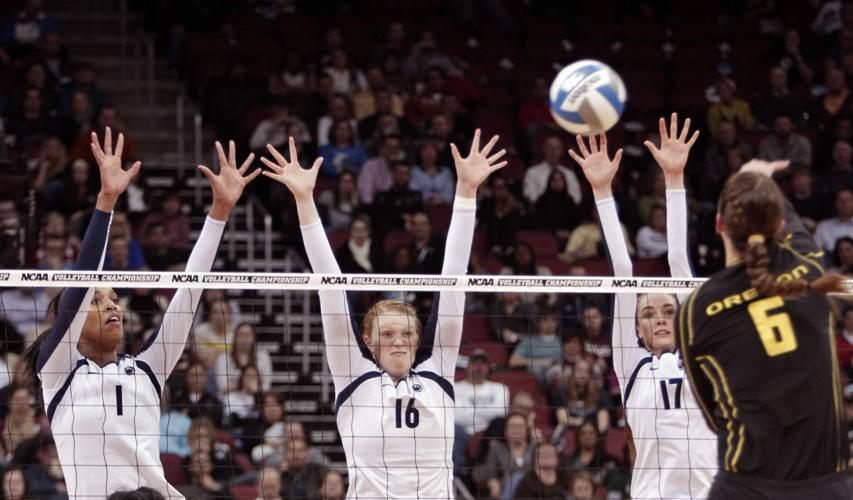
Oregon's Liz Brenner (6) hits over the triple block attempt by Penn State's Ariel Scott (1), Katie Slay (16) and Megan Courtney (17) during the national semifinals of the 2012 NCAA college women's volleyball tournament in Louisville, Ky.
Higher roster limits doesn't mean more
At first glance, the terms of the House settlement — the agreement between plaintiffs, the NCAA and college's biggest conferences that is reshaping college sports —look like a bonanza for college athletes.
Scholarship limits (for instance, 85 for football and exactly 9.9 for men's wrestling) have been eliminated and replaced by roster limits (105 for football and 30 for wrestling). If a school wants to, it can offer scholarships to every player on a team.
Doing so, however, will cost an exorbitant amount. Michigan athletic director Warde Manuel suggested if his athletic department decided to fund scholarships for every available spot, educational costs under the new rules would add $29 million to annual expenses that are already slated to grow by around $21 million to pay for the new athlete revenue-sharing provisions in the settlement.
So, choices will have to be made. Will schools give scholarships to all 105 players on their football team? If so, will they make cuts elsewhere? Or will they continue to ask boosters and fans for more money to backfill the growing costs?

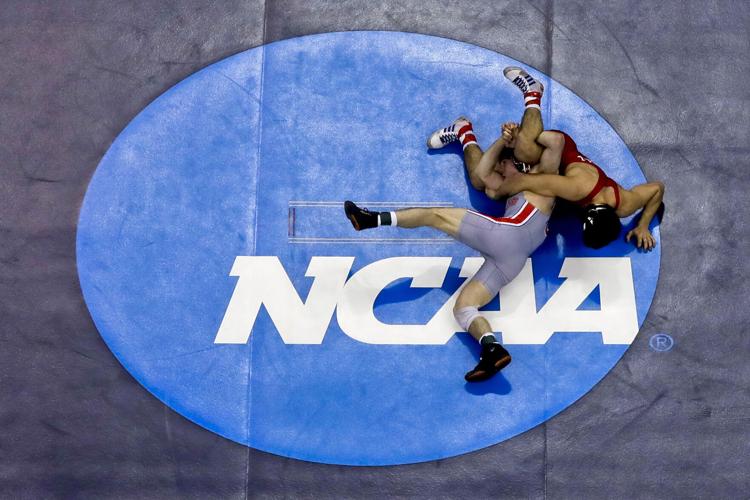
Cornell's Yianni Diakomihalis, right, controls Ohio State's Joey McKenna in their 141-pound match in the finals of the 2019 NCAA wrestling championships in Pittsburgh.
Small-sports model changing
Most of the smaller, so-called Olympic sports have long operated in a different world. For instance, some divide their 9.9 scholarships and distribute partial aid to, say, 20 players. They then add depth with walk-on athletes, some hoping to land scholarship help in the future.
Under the new system, some schools might choose to eliminate a sport or two altogether. Others will pare roster sizes, whether by choice or because the new roster limits actually make them get smaller.
In wrestling, for instance, the settlement calls for a limit of 30 athletes. Some of the nation's top programs have up to 35 wrestlers on their team, many of whom pay their own way.
“Wrestling can provide access to college for so many young men and women who otherwise wouldn't have that opportunity,” said Mike Moyer, the executive director of the National Wrestling Coaches Association. “Whenever you start limiting opportunities, it's always unfortunate."
Wisconsin athletic director Chris McIntosh estimated sports across his campus will lose between 80 and 100 athletes by the time changes come into play for the 2025-26 school year.
Nebraska's AD, Troy Dannen, told Huskeronline he's determined not to cut scholarships or sports, which is a $200 million operation at Nebraska. He is asking coaches and other administrators to start thinking outside the box.
“Is there a better way to allocate?” he said.
Minnesota eliminated three men's sports — indoor track, tennis and gymnastics — during the pandemic, easing the pain now.
“That decision, in hindsight, looks really strategic right now," Gophers AD Mark Coyle said.

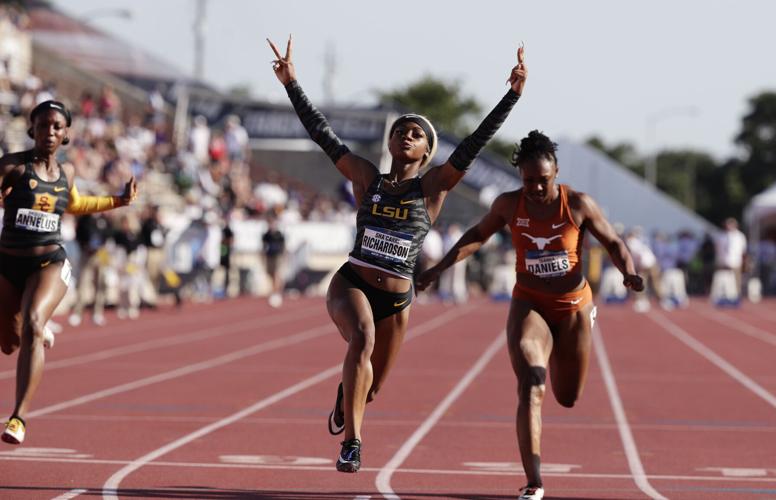
LSU's Sha'Carri Richardson, center, celebrates as she wins the women's 100 meter dash during the 2019 NCAA outdoor track and field championships in Austin, Texas.
Football gets special treatment
Underlying the entire college sports model is the reality that football, with help from men's basketball, produces the millions in revenue that fund every other sport on a typical campus.
The SEC helped its 16 schools answer some questions this fall by announcing it would keep the 85-scholarship limit intact for 2025, while allowing teams to fill the other 20 spots with walk-ons. The 105 roster spots would actually be a net loss, since the average roster size of big-school football teams tops 120.
Last spring, there were reports that the SEC would cap swimming rosters at 22, which is eight fewer than the new limit. Because women’s swimming teams are currently limited to 14 scholarships and men’s to 9.9, the new cap, if true, could dramatically increase the number of scholarships for those teams but also slash roster sizes that topped 40 swimmers in some cases.
All these choices bring about the possibility that the age of the walk-on athlete — the scrappy grinders who do it for the love of the game, school or both — could be nearing an end. Chances to develop diamond-in-the-rough athletes could be lost, as well.
“It's like, we don't care if you're a walk-on, there isn't a spot for you on the roster,” said Steve Roush, executive director of the Southern California's grassroots local swimming committee. “That could have some devastating effects for our numbers at the collegiate level.”

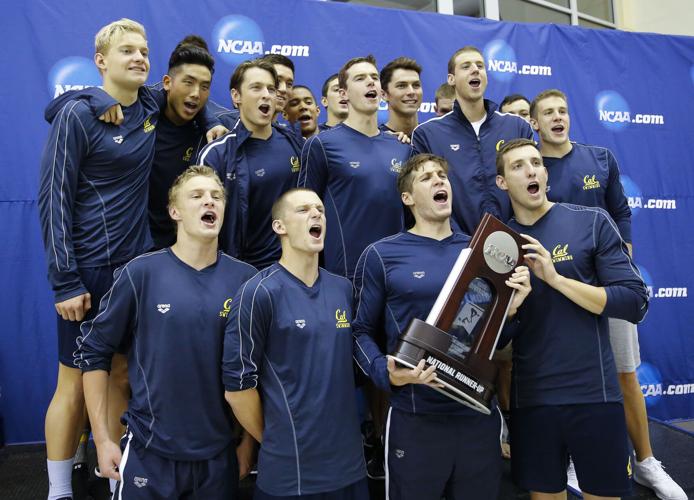
The California men's swim team poses with the trophy after finishing second at the 2016 NCAA swimming and diving championships at Georgia Tech in Atlanta.
Waiting for the fallout
One of the least-understood dynamics in American sports is the outsized impact college athletics have on the number of medals the U.S. wins every four years at the Summer Olympics.
The world's most dominant Olympic team (the U.S. led the medals in Paris with 126) got 67% of its athletes from the NCAA pipeline.
Shrinking the number of players in collegiate Olympic sports programs could eventually harm U.S. prospects, along with the overall quality of the Olympic movement itself (about 8.5% of athletes not representing the U.S. also competed in NCAA sports).
“There's a lot of anxiety around what impact this is going to have on Olympic sports,” said Rich Bender, the executive director of USA Wrestling, who is also on the board of the U.S. Olympic and Paralympic Committee. “You don't have to have too big an imagination to think that if the pool of resources is being drastically reduced, the athletic department is probably not thinking of cutting expenses around football and basketball. So where do you go?"
Massive shift, not fewer spots
Even with some of the grim predictions, it's not all doom and gloom among the experts. Some see lost opportunities for fringe athletes at bigger schools as a chance for them to catch on at smaller programs and actually get some playing time.
Others believe colleges feel the deep connection to Olympic sports.
“The good news is, there’s been a lot of awareness around, ‘Hey, it’s not cool to cut programs,'" Bender said.
Most see more stability coming in 2026 or 2027, after the House settlement is finalized and schools, conferences and the NCAA have locked in on the numbers.
For the upcoming school year, though, uncertainty reigns. As Dannen, the Nebraska athletic director, put it: “There are 100 questions I don’t have the answers for."
Sports Week in Photos: NFL takes center stage, NHL and NBA in full swing

Montreal Alouettes wide receiver Austin Mack (81) stands on his head as he celebrates his touchdown against the Toronto Argonauts during the fourth quarter of a CFL eastern conference final football game, Saturday, Nov. 9, 2024 in Montreal. (Christinne Muschi/The Canadian Press via AP)

Japan's Tomoki Osada tries to pull back France's Louis Bielle-Biarrey during the Autumn Nations series rugby union match between France and Japan at the Stade de France in Saint-Denis, outside Paris, Saturday, Nov. 9, 2024. (AP Photo/Christophe Ena)

Tyler Reddick, right, and Ryan Blaney race during a NASCAR Cup Series Championship auto race at Phoenix Raceway, Sunday, Nov. 10, 2024, in Avondale, Ariz. (AP Photo/John Locher)

Brentford's goalkeeper Mark Flekken reacts after conceding a goal scored by Fulham's Harry Wilson, his sides first goal, during the English Premier League soccer match between Fulham and Brentford at Craven Cottage stadium in London, Monday, Nov. 4, 2024. (AP Photo/Frank Augstein)

Britain's Mark Cavendish of Astana Qazaqstan, centre, sprints to win the Prudential Singapore Tour De France Criterium, Sunday, November 10th, 2024. (AP Photo/Danial Hakim)

Sturm's Otar Kiteishvili, left, challenges Dortmund's Felix Nmecha during to the Champions League opening phase soccer match between Borussia Dortmund and Sturm Graz in Dortmund, Germany, Tuesday, Nov. 5, 2024. (AP Photo/Martin Meissner)

Coco Gauff of the U.S. reacts after winning against China's Qinwen Zheng in their women's singles final match of the WTA finals at the King Saud University Indoor Arena, in Riyadh, Saudi Arabia, Saturday, Nov. 9, 2024. (AP Photo)

New Zealand's Mark Tele'a, is tackled by Ireland's Garry Ringrose, during the the Autumn Nations series rugby union match between Ireland and New Zealand at the Aviva Stadium in Dublin, Ireland, Friday, Nov. 8, 2024. (AP Photo/Peter Morrison)

Rory McIlroy of Northern Ireland tees off on 15th hole during the second round of Abu Dhabi Golf Championship in Abu Dhabi, United Arab Emirates, Friday, Nov. 8, 2024. (AP Photo/Altaf Qadri)

Charalampos Pitsolis of Greece crosses the finish line to win the 41st Athens Marathon, in Athens, Greece, Sunday, Nov. 10, 2024. (AP Photo/Yorgos Karahalis)

England's captain Jos Buttler throws his bat as he walks off the field, caught by West Indies' captain Rovman Powell for 83 runs, during the second T20 cricket match at Kensington Oval in Bridgetown, Barbados, Sunday, Nov. 10, 2024. (AP Photo/Ricardo Mazalan)

Los Angeles Clippers guard Terance Mann, right, shoots as San Antonio Spurs center Victor Wembanyama, top, defends and center Ivica Zubac watches during the first half of an NBA basketball game, Monday, Nov. 4, 2024, in Inglewood, Calif. (AP Photo/Mark J. Terrill)

Manchester City's head coach Pep Guardiola reacts during the UEFA Champions League opening phase soccer match between Sporting and Manchester City in Lisbon, Portugal, Tuesday, Nov. 5, 2024. (AP Photo/Armando Franca)

Zaquin Moses, left connects with a punch against Michael Ruiz, right, during the fourth round of a Super-Featherweight bout Saturday, Nov. 9, 2024, in Philadelphia. Zaquin Moses win by unanimous decision. (AP Photo/Chris Szagola)

San Antonio Spurs center Victor Wembanyama, right, drives against Los Angeles Clippers center Ivica Zubac during the first half of an NBA basketball game, Monday, Nov. 4, 2024, in Inglewood, Calif. (AP Photo/Mark J. Terrill)

Real Madrid's Kylian Mbappe is challenged by Osasuna's Lucas Torro during the Spanish La Liga soccer match between Real Madrid and Osasuna at the Santiago Bernabeu stadium in Madrid, Spain, Saturday, Nov. 9, 2024. (AP Photo/Jose Breton)

Niklas Hojgaard of Denmark plays his third shot on the 18th hole during the third round of Abu Dhabi Golf Championship in Abu Dhabi, United Arab Emirates, Saturday, Nov. 9, 2024. (AP Photo/Altaf Qadri)

Washington Capitals center Dylan Strome (17) trips over Capitals goaltender Charlie Lindgren (79) during the third period of an NHL hockey game against the Pittsburgh Penguins, Friday, Nov. 8, 2024, in Washington. (AP Photo/Nick Wass)

PSG's Bradley Barcola, left, and Atletico Madrid's Giuliano Simeone, right, fight for the ball during the Champions League opening phase soccer match between Paris Saint Germain and Atletico Madrid, at the Parc des Princes stadium, in Paris, Wednesday, Nov. 6, 2024. (AP Photo/Michel Euler)

West Indies' Matthew Forde celebrates taking the wicket of England's Will Jacks during the third ODI cricket match at Kensington Oval in Bridgetown, Barbados, Wednesday, Nov. 6, 2024. (AP Photo/Ricardo Mazalan)

Pittsburgh Steelers wide receiver George Pickens (14), defended by Washington Commanders cornerback Noah Igbinoghene, catches a 16-yard pass for a touchdown during the first half of an NFL football game, Sunday, Nov. 10, 2024, in Landover, Md. (AP Photo/Nick Wass)

Inter Milan's fans cheer for their team prior to a Serie A soccer match between Inter Milan and Napoli at the San Siro stadium in Milan, Italy, Sunday, Nov. 10, 2024. (AP Photo/Luca Bruno)

Charlotte Hornets' Brandon Miller, center, dunks between Philadelphia 76ers' Kelly Oubre Jr., left, and Jeff Dowtin Jr. during the second half of an NBA basketball game, Sunday, Nov. 10, 2024, in Philadelphia. (AP Photo/Matt Slocum)

Madison Chock and Evan Bates of the U.S. compete in the ice dance rhythm dance program at the Grand Prix of Figure Skating series competition in Tokyo, Japan, Friday, Nov. 8, 2024. (AP Photo/Hiro Komae)

