



The transfer portal has complicated many aspects of college sports, including a seemingly unrelated event: the deadline for college players to withdraw from the NBA Draft.
With the portal option available, several high-level players who pulled out of the draft won’t return to the school for which they played last season.
In other cases, players who opted to remain in the draft will have their roster spots taken not by inexperienced reserves but by veterans from different schools.
It all heaps layers of complexity onto our assessment below.
And one caveat: Although decisions were formalized Wednesday night, news of players returning to college could trickle out over the next few days.
Here we go …
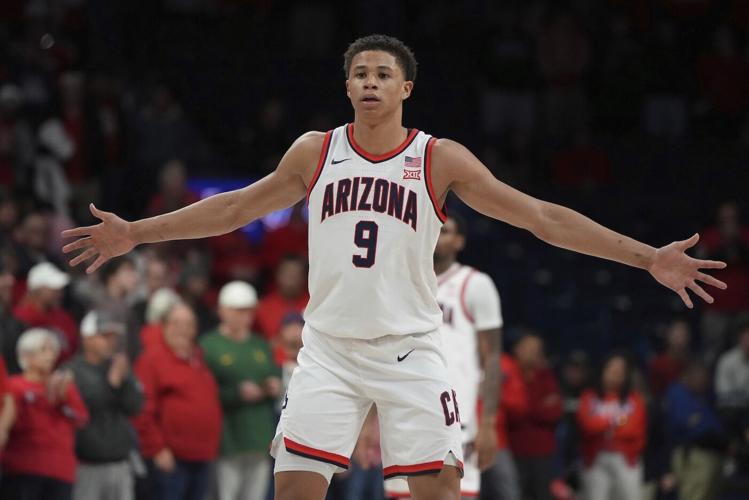
Loser: Arizona. Guard Jaden Bradley, a marginal prospect, withdrew from the draft; forward Carter Bryant, a likely lottery selection, did not. (Bradley’s decision became official Friday morning when the NBA released the list of players who removed their names.)
The impact of Bryant’s decision rises exponentially when combined with other departures: KJ Lewis and Henri Veesaar transferred (to Georgetown and North Carolina, respectively), while Caleb Love and Trey Townsend exhausted their eligibility.
All in all, the Wildcats lost four of their top five scorers and their most gifted player (Bryant).

Arizona forward Carter Bryant (9) during the first half of an NCAA college basketball game against Baylor, Tuesday, Jan. 14, 2025, in Tucson.
Coach Tommy Lloyd has replacements ready, in the form of a highly ranked recruiting class. But Arizona’s nonconference schedule is brutal, featuring showdowns with Florida, UConn, Auburn and Alabama — four powerhouses that, in contrast to the Wildcats, received indisputably positive news on the draft withdrawal front. (See below.)
The NBA decisions weakened Arizona’s outlook for 2025-26 while seemingly brightening the forecast for its early-season opponents.
The result is a dastardly double whammy that transforms a difficult early-season schedule into something approaching treacherous. And those early-season games are vital in shaping seeds for the NCAA Tournament.
The Wildcats will have little time to assimilate their new players and even less margin for error when facing a nonconference lineup stocked with top-10 opponents.
Winner: Houston. With the return of point guard Milos Uzan, whose value declined in the pre-draft workouts, the NCAA Tournament runner-up should claim a top-five position in the AP preseason poll. Kelvin Sampson’s system relies as heavily on the point guard as any in the country because of the defensive responsibilities. With Uzan, he will have one of the best.
Loser: SEC haters. If you were hoping the conference’s success in 2024-25 would not be repeated, the stay-or-go deadline brought bad news. Florida retained big man Alex Condon, an all-conference honoree; Auburn managed to keep guard Tahaad Pettiford, a double-digit scorer; and Alabama got one more season out of wing Labaron Philon, who stands as one of the nation’s top underclassmen. Additionally, Otega Oweh is returning to Kentucky, and Arkansas guard Boogie Fland will join Florida’s loaded roster after removing his name from the draft.

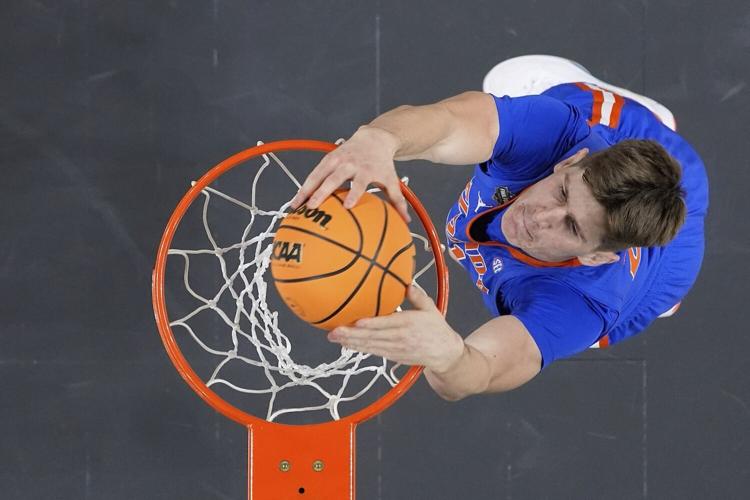
Florida's Alex Condon dunks the ball against Houston during the second half in the national championship at the Final Four of the NCAA college basketball tournament, Monday, April 7, 2025, in San Antonio.
Winner: San Diego State. Clarity came to the Mountain West race on Wednesday, when guard Miles Byrd opted to return for his junior season. Instantly, the Aztecs became the clear frontrunners for the conference title while Byrd staked claim to being the best all-around player in the MW. (All he did last season was average 12.3 points, 4.4 rebounds, 2.7 assists and 2.1 steals.) This time next year, Byrd could be one of the few West Coast players projected for the first round of the 2026 draft.
Loser: Duke. The Blue Devils knew they would lose Cooper Flagg, Kon Knueppel and Khaman Maluach — all three are slotted for the lottery portion of the draft. But they hoped to retain Cedric Coward. The 6-foot-6 wing played just six games for Washington State last season before an injury and was set to join the Blue Devils’ roster. He proceeded to generate intense interest from NBA scouts after reporting a 7-2 wingspan, with a deft shooting touch and high-level athleticism. Not surprisingly, Coward elected to remain in the draft.
Winner: Oregon. It feels like Nate Bittle should have churned through his eligibility by now. After all, he committed to the Ducks in the fall of 2020. But the 7-footer has one season remaining and decided to use it following his experience with the pre-draft process. He averaged 14.2 points and 7.6 rebounds for the Ducks last season and will enter the fall as one of the top players in the Big Ten.
Loser: North Carolina. The Tar Heels lost talented freshman Drake Powell to the draft and suffered collateral damage when a certain team down the street — not that one! — substantially upgraded its roster. Texas Tech star Darrion Williams withdrew from the draft last week, but instead of returning to Lubbock, he transferred to NC State and will help new coach Will Wade cause havoc in the ACC.
Winner: St. John’s. Fresh off their breakthrough season, the Red Storm received a dose of good news when point guard Joson Sanon removed his name from the early-entry list. Sanon averaged 11.9 points for Arizona State as a freshman but will play for St. John’s next season and add another valuable piece to coach Rick Pitino’s lineup. Expect to see the Red Storm near the top of the AP preseason poll in November.

