



The Hotline mailbag publishes weekly. Send questions to wilnerhotline@bayareanewsgroup.com and include “mailbag” in the subject line. Or hit me on the social media platform X: @WilnerHotline. Some questions have been edited for clarity and brevity.
On the 1-to-10 scale, how likely is it that the Mountain West and West Coast Conference become one-bid conferences in future NCAA Tournaments? — @Seattleite206
A: Our answer is whatever number (8, 10, 17) reflects an extreme likelihood. But this issue isn't limited to the Mountain West and WCC. It encompasses the Pac-12, as well, and even the entire region.
The state of college basketball, at least on the men's side, is deeply concerning across the Mountain and Pacific Time Zones.
Just four teams reached the second round, Arizona, Gonzaga, Utah State and UCLA, and only the Wildcats made the Sweet 16.
Last year, only Arizona and BYU advanced to the regional semifinals.
As many readers are undoubtedly aware, no team from the western third of the country has won the NCAA title since Arizona in 1997.
Add realignment to the cauldron, and the situation grows more desperate on two fronts.
— Every conference in the region is, or will be, a lesser version of itself.
The new Pac-12 won't have Arizona or UCLA, which moved to the Big 12 and Big Ten, respectively.
The rebuilt Mountain West won't have San Diego State, Boise State, Colorado State, Fresno State or Utah State, which moved to the Pac-12.

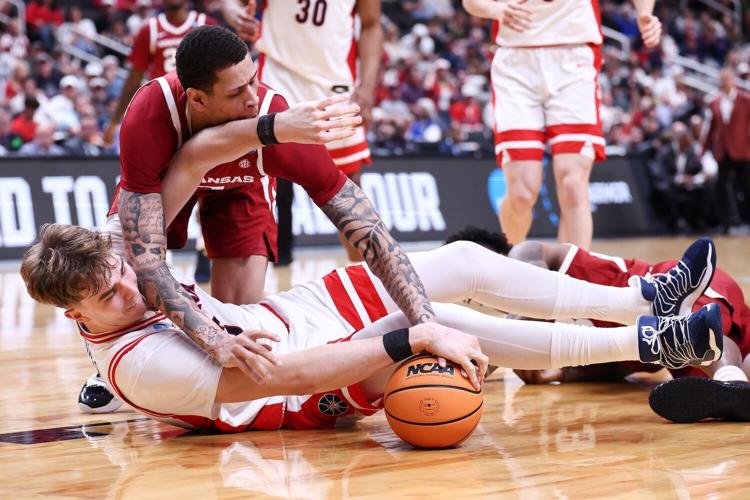
Arizona center Motiejus Krivas, bottom, vies for a loose ball against Arkansas forward Trevon Brazile during the second half in the Sweet 16 of the NCAA college basketball tournament, Thursday, March 26, 2026, in San Jose, Calif.
The West Coast Conference won't have Gonzaga, which did the same.
Even the Big West will be depleted in the future without Hawaii and UC Davis, which are joining the Mountain West, and UC San Diego, which is headed to the WCC.
The realignment wave that began in July 2021, when Texas and Oklahoma announced they were leaving the Big 12 for the SEC, has impacted conferences in every region and far down the Division I food chain.
— Access to March Madness is shrinking as the engorged power leagues swallow more at-large spots.
Two years ago, eight teams from outside the Power Five basketball conferences (ACC, Big East, Big 12, Big Ten and SEC) collected at-large bids.
Last year, that number was trimmed to four.
This year, only four qualified, as well.
No single development explains the trend. NIL and the transfer portal are major contributors, of course. But so are realignment and the increasingly difficult process of scheduling nonconference games that can strengthen résumés and NET rankings.
It's not one thing, folks. It's many things conspiring to impact every conference in the West, and there is limited justification to believe the circumstances will become more favorable in the future.
After all, the at-large field, currently at 37 teams, will be trimmed to 36 next season when the Pac-12 becomes officially recognized and receives an automatic bid for its champion.
With Gonzaga, San Diego State and Utah State, the rebuilt Pac-12 should receive at least one at-large berth every season and perhaps two. But the Mountain West and WCC will be hard-pressed to corral even one — not unless the competitive dynamics change and someone becomes the new Utah State or the new Saint Mary's.
There is a caveat to our admittedly bleak forecast: NCAA Tournament expansion.
We expect a decision next month and suspect the powers-that-be will approve a 76-team tournament with eight additional at-large berths.
Make no mistake: The power conferences will gobble most of those spots, but there could be two or three available for the Pac-12, WCC and Mountain West, along with the likes of the American and Atlantic 10. Maybe the WCC benefits one year, the Mountain West the next. There is no way to predict the allocation.
The Hotline is generally opposed to expansion: The sport doesn't need more 14-loss SEC and 12-loss Big Ten teams in the tournament.
If we thought the change would materially improve access for the leagues outside the Power Five — if we thought there would be more access for Utah State and Santa Clara and Grand Canyon — our view might change.
But we are skeptical the selection process for a 76-team field will play out in any manner that doesn't greatly benefit the heavyweights. For many of the conferences in the western third of the country, a one-bid future awaits.
With Gonzaga entering the Pac-12 and Saint Mary’s coach Randy Bennett headed to Arizona State, is Santa Clara prepared to become the premier team in the WCC? Does Herb Sendek have it in him to elevate the Broncos to the top consistently in a depleted conference? — Richard E
A: A gigantic opportunity exists for the Broncos — and for USF and Pacific and all the WCC schools now that Gonzaga no longer lords over the conference and Bennett is off to Tempe.
To be clear: We aren't dismissing Saint Mary's as a potential contender under new coach Mickey McConnell, but consider it unlikely the Gaels will maintain their level of success.
Santa Clara has the foundation in place to fill the void atop the league thanks to a high-caliber coach, Sendek, who has sound financial backing for the talent acquisition process. (Sendek is also developing an impressive NBA pipeline with first-round picks in 2022-23: Brandin Podziemski and Jalen Williams.)

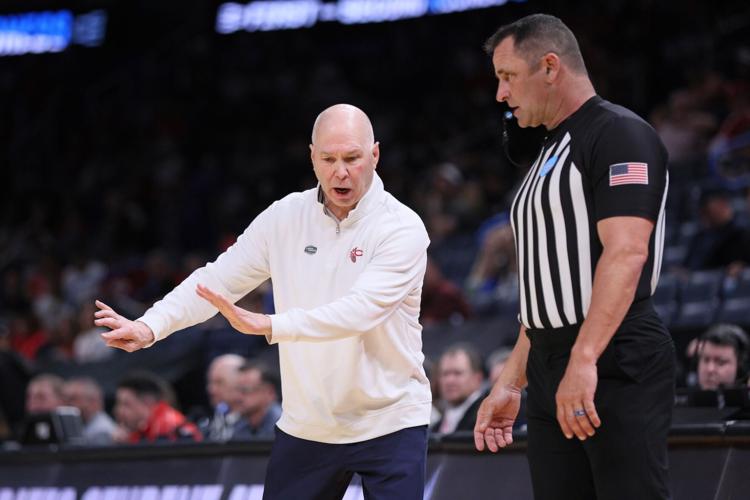
Saint Mary's head coach Randy Bennett, left, talks to a referee during the first half in the first round of the NCAA Tournament, Thursday, March 19, 2026, in Oklahoma City.
Exactly how much the Broncos spent on NIL this season is not known, but we believe the outlay was near the top in the WCC. The donor community has plenty of money that can be put to optimal use if key stakeholders sense an opportunity to build on Sendek's success.
It would not take much for the Broncos to become the biggest spender in the conference in the post-Gonzaga world.
They could have company — not from Saint Mary's necessarily but from Pacific or Pepperdine, which is completing a new arena as part of a larger capital project for a mere $250 million.
Not in 30 years has the WCC been as wide open as it will be next season.
The future looks bleak for non-power conferences and uncertain for the Big East, Big 12 and ACC, too. If the SEC and Big Ten wanted, they could negotiate their own TV deal and make their own rules. Survival of the mid-major programs depends on breaking out and forming their own conglomeration. — Larry E
A: We aren't convinced that's the best approach, at least under the present circumstances. The conferences outside the Power Four in football and Power Five in men's basketball receive immense benefits (financial and otherwise) from their association with the top-tier programs.
In some regards, that association is baked into the underlying value of their media rights agreements. Certainly, postseason revenue is tied to competing in the same events, the College Football Playoff and the NCAA Tournament, as the biggest brands in the sports.
That said, it's not difficult to envision a rupture in six or eight years in which either the Big Ten and SEC create their own competitive entity or all the power conferences partner on something new.
A football-specific breakaway — it could take the form of a super league — seems more likely because of its unique existence and because the NCAA, for all its faults, does a superb job running championship events for basketball and the Olympic sports. (For that service alone, it's worth preserving.)
Until they have no choice, or until they are left behind by a big-brand breakaway, the medium and small conferences should remain tethered to the blue bloods for as long as possible.
The Washington State regents directed $20 million of campus funding to the athletic department. So what happened with that Pac-12 "war chest"? Is it all spent or did it never really exist? — @NateJones2009
A: Oh, it exists. It definitely exists.
Some is being used to acquire new members and likely tied up in litigation with the Mountain West.
Approximately $50 million hasn't been collected yet because the NCAA Tournament payment system unfolds over the course of years.
And a good chunk was used to help Washington State and Oregon State fund their athletic operations in the 2025-26 fiscal years, when the schools effectively had zero media rights revenue. (The football broadcast agreements with The CW generated a pittance.)
The two-pronged strategy with the so-called war chest was 1) to allow the Beavers and Cougars to remain afloat during their two years in purgatory and 2) to rebuild the conference.
Those tasks have been accomplished.
The one-time injection of $20 million in Pullman is for the 2026-27 competition year to cover a shortfall in the Cougars' operating budget caused, in part, by the onset of revenue sharing — an issue that did not exist in the fall of 2023 when WSU and OSU took the departing schools to court.
What’s the media landscape going to look like for college athletics in 2026? Are big changes ahead, or will it be a stable year? — @MrEd315
A: We do not envision major material changes in the college sports media ecosystem. Because of existing contracts that run into the 2030s, there simply isn't an opportunity.
Granted, the NCAA could decide next month to expand the tournament to 76 teams for next spring, and the CFP could decide by the end of the year to expand the playoff for the 2027 season. But those are not for this calendar year.
The most significant media-related issue over the coming nine months is the NFL's decision to restructure its broadcast agreements.
The Hotline addressed this topic in our college sports forecast for 2026 — it was the No. 1 issue — and we continue to believe the outcome will have monumental implications for all major sports, including college football and basketball.
If the NFL successfully renegotiates 50% increases in rights fees from Fox, CBS, ESPN, NBC and Amazon, there will be roughly $6 billion annually removed from the pot of cash for everyone else.
That could cause conferences to change the timing of, and strategy behind, the next round of realignment.
The Mountain West was set to get a new media deal worth $7 million to $8 million per school per year before the five members left for the Pac-12. Now, the conference is getting around $3 million per school. How can the departing schools and Pac-12 believe the conference didn't suffer real exit fees damages? — @bresee_k
A: First, your projected dollar figures for an intact Mountain West are on the (very) high side based on what we have been told.
Second, the Pac-12's argument in the poaching penalty case is based on the free market. Sure, the Mountain West was damaged by realignment, but so, too, have the Pac-12 and other conferences been damaged in the recent history of college sports. Market conditions impact companies, for better or worse, all the time.
Approximately $150 million is at stake in the poaching penalty and exit fee lawsuits — the former filed by the Pac-12 against the Mountain West, the latter by Utah State, Boise State and Colorado State against the Mountain West.
Our view hasn't changed: We believe the Pac-12 has the stronger case in the poaching penalty suit and the Mountain West has the stronger case in the exit fee suit.
And we are convinced both will be resolved before a trial.
If you presume any settlement would result in the disputed amount being split, that would leave the Mountain West with about $75 million.
Admittedly, that's a barely-educated guess. Everything the Hotline knows about the law we learned from Jackie Chiles on 'Seinfeld.'
As you know, there have been several attempts to get certain Division I athletes to unionize. In your opinion, after all these years, why hasn't this materialized nationally? — @NILnotNLI
A: Two reasons come immediately to mind, one legal and one philosophical.
Under current labor law, state employees cannot unionize. Athletes at public universities would, presumably, be considered state employees.
That's why the two highest-profile unionization movements in college sports have taken place at private schools, Northwestern and Dartmouth.
But even if that was not a limiting factor for athletes across Division I, there's another consideration: They have it damn good right now.
The NCAA screwed up so badly over so many years that the court system has essentially conferred onto athletes unlimited opportunity. They receive scholarships; they get paid through revenue sharing and outside NIL; some continue to get paid under the table (i.e., unreported); and they can transfer as often as they want without sitting out.
That's a pretty good situation.
If they unionize and bargain with the schools, restrictions could be placed on both compensation and movement.
The only thing they really cannot do, thankfully, is compete in college, play professionally, then return to college.
Today's athletes have strength and conditioning coaches and nutritionists. Why do we see all of these injuries today in pro and college sports? They live in the lap of luxury and seem to be either injured or whining. Has the sports world gone paper mache? — Jon J
A: We are hesitant to judge pain tolerance or the mental and physical toughness of any particular athlete or subset of athlete. But UConn coach Danny Hurley made a relevant point this week when asked why the media sees "hard coaching" as problematic.
"Society has gotten soft in a lot of ways with trying to develop young people ... You remember that English teacher that made you do the work and the tests were hard and you had to study hard. And I just think the same thing applies to coaching," Hurley said.
"I have a responsibility. I coach 18-, 19-, 20-year-old men. There's a lot that I have got to instill in them. There's a lot of discipline, a lot of accountability, a lot of commitment to prepare them for the real world. The real would is tough. It's cruel. You have to be equipped."
Instilling those traits through hard coaching doesn't connect directly to how players respond to injuries or how those injuries are treated by training and medical staffs. But we found Hurley's comments insightful at a broad level.
Will you ever write a book about the best advice offered by your guests on the ‘Canzano and Wilner’ podcast. — @jimmy0726
A: For those unfamiliar, we end conversations with first-time guests by asking them to recount the best advice they have ever received, personally or professionally.
There have been some terrific responses. I'm not sure the collection is worthy of a book, but perhaps it could form the basis of an article at some point.
Appreciate the question.

