



Arizona defensive coordinator Duane Akina has a different approach when it comes to managing the plethora of injuries in the UA defense.
It’s easy to dwell on the misfortune, especially when eight of the 11 starters in Arizona’s season-opening defense have been impacted by injuries this season — some of which are season-ending.
In recent weeks, those season-ending injuries include preseason All-Big 12 linebacker Jacob Manu, who suffered a leg injury celebrating a third-down stop against Colorado last week; they also include nickel back Treydan Stukes and most likely safety Gunner Maldonado, who still needs to undergo surgery, UA head coach Brent Brennan said Monday.
The UA coaches, Akina included, have preached “next man up,” but the Arizona defensive coordinator likens the defense to a household. With impactful starters unavailable, the Wildcats are depending on veteran defensive back Dalton Johnson, sophomore safety Genesis Smith, senior defensive back Owen Goss, redshirt freshman safety Jack Luttrell, who had two interceptions against Colorado, along with second-year linebackers Taye Brown and Kamuela Ka’aihue, among others. Second-year linebacker Leviticus Su’a and Justin Flowe, a former highly-touted recruit, have been “nicked up.” Brown, Ka’aihue and Tulane transfer Jared Small are the Wildcats’ options at linebacker.

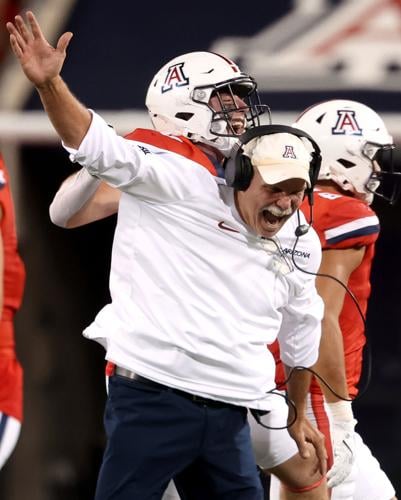
Arizona defensive coordinator Duane Akina celebrates with defensive back Owen Goss after the Wildcats made a fourth-down stand against Northern Arizona in the fourth quarter of their game at Arizona Stadium on Sept. 7.
“They gotta emerge,” Akina said. “Genesis, he was the little brother behind Stukes and Gunner. Now he’s gotta emerge. They went off to college, (Smith) is the big brother in the house now. Taye has taken more of a leadership role and now he’s helping the younger linebackers in there.
“That’s just part of it. That’s life. That’s football. Things just happen to you. He’s done a great job with it all.”
Akina didn’t sugarcoat the loss of Manu, who led the Pac-12 in tackles (116) last season and was named to the All-Pac-12 First Team and Associated Press All-Pac-12 First Team. Manu currently leads the Wildcats with 47 tackles.
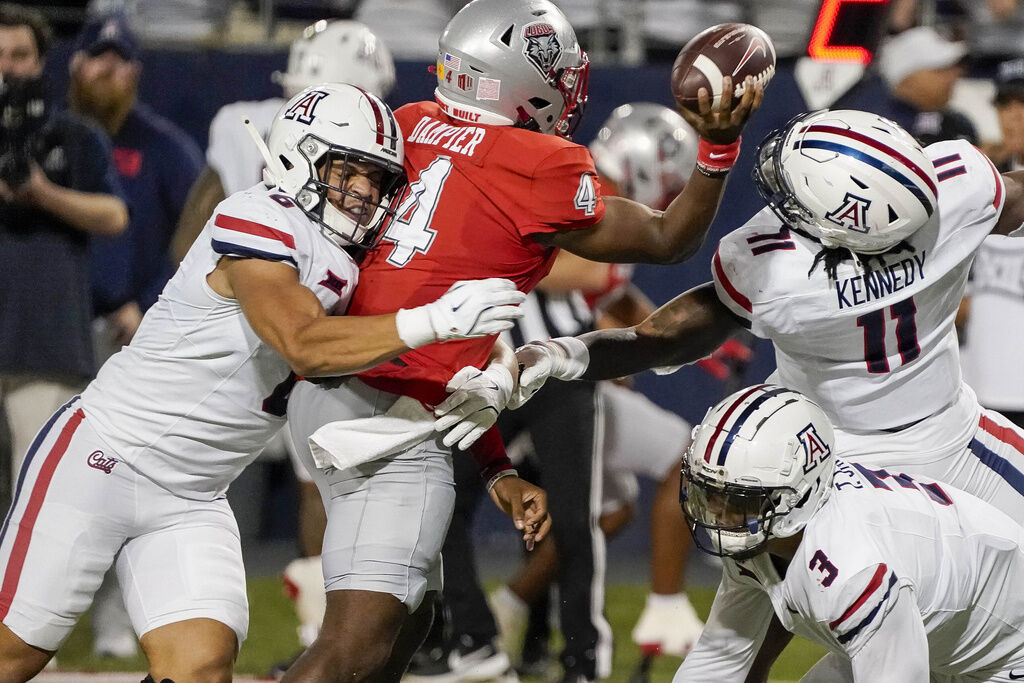
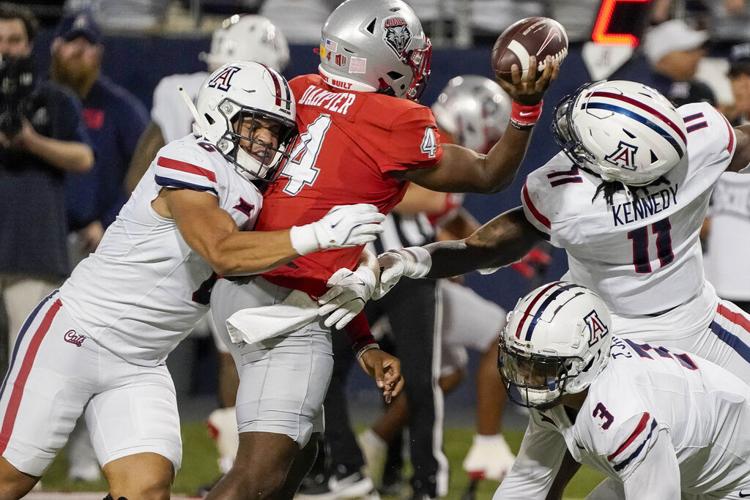
Arizona defensive players Taye Brown, left, Chase Kennedy (11) and Tre Smith (3) put pressure on New Mexico quarterback Devon Dampier during the first half of the Wildcats’ season-opening matchup on Aug. 31, 2024, in Tucson.
“I’m not going to short that we’re losing a great football player,” Akina said. “Like we’ve said, we just need to pick up the flag and keep marching forward. Next man up, I know everyone says that, but it happened.”
Brown’s “personality is much different than Manu’s in terms of being the vocal leader,” Akina said.
“He knows all of the answers, but Manu was kind of an alpha,” Akina said. “Now it’s (Brown’s) time, and he’s embraced that role.”
Smith, who has been teammates with Brown since they both played at Hamilton High School in Chandler, said Brown “used to not talk at all.”
“Now he’s out there communicating, having fun,” Smith said of Brown. “I feel like he has really improved his game, the mental part of the game. Just coming to college, there’s a lot more mental parts to defenses rather than see ball, get ball. He’s definitely improved in that (category).”
With Manu sidelined for the rest of the season, “it’s definitely an opportunity for him to step up,” Smith added.
“He’s out there and has gotten plenty of reps,” Smith said. “Whoever I’m out there with, I’m comfortable with and know they’re going to do their job, and I’m satisfied with that.”
Smith, who has started at three different defensive back positions this season, has taken pride in the big brother role, “just talking, over-communicating with everybody. I feel like I definitely have to step up,” he said.

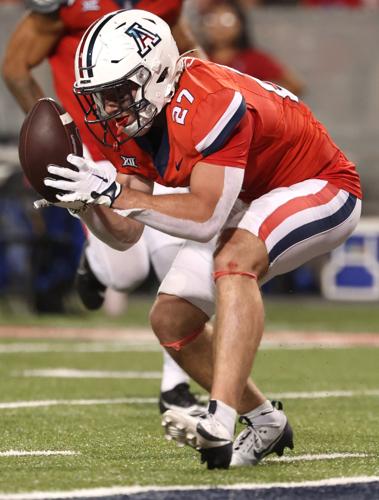
Arizona defensive back Owen Goss (27) downs a Wildcat punt inside the NAU 1 yard line during the fourth quarter of the UA’s nonconference victory over the Lumberjacks on Sept. 7 at Arizona Stadium.
Another rising player in Arizona’s defense has been Goss, a senior and Colgate transfer, who was thrusted into the game at Kansas State, where had a series of missed tackles and blown coverages. Goss, a safety and nickel back, was targeted four times and surrendered 81 receiving yards at Kansas State, according to Pro Football Focus, and had a team-worst 36.3 defensive grade on PFF.
“I feel like that was my first real test,” Goss said. “Just gotta roll with the punches and learn the concepts, learn the defense better and get adjusted.”
After posting a 50% missed-tackle rate at Kansas State, Goss averaged 11.4% in the last three games, an improvement he credits “eye discipline” and “just getting more experience.”
“It’s easier throughout the year. As the year progresses, you become more of a concept player,” Goss said. “You understand the defense more, the more reps you get. I think as the season has progressed, I’ve been getting better with all of it and understanding the concept as a whole and not having to think out there as much as the beginning.”
Sometimes, as Brennan alluded to on Monday, you need to go through it to get to it. Those in-game “reps matter” for developing players or inexperienced players still learning the scheme, Akina said.

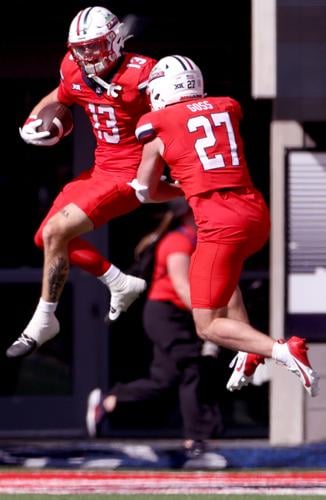
Arizona defensive back Jack Luttrell (13), left, and defensive back Owen Goss (27) celebrate Lutrell’s interception deep in Colorado territory in the second quarter of the teams’ Big 12 matchup Oct. 19, 2024, in Tucson.
“This is not a game of pour water, instant football player,” Akina said. “It takes reps. Unless you’re Chris McAlister and you just trot him out there and stay out of his way; just make sure he knows what time the game is.”
Arizona isn’t the only team dealing with the injury bug. The Wildcats’ upcoming opponent, West Virginia, has multiple injuries in its offense, including quarterback Garrett Greene, who is questionable for Saturday. Sophomore running back Jahiem White and veteran left tackle Wyatt Milum are also questionable for the Mountaineers’ first-ever matchup with the Wildcats.
“We just gotta worry about ourselves,” Akina said. “For us on the defensive side of the ball, because there are a lot of names you have never heard before, what can they do? What can the backups do? That’s where you have to be realistic, because we can draw a bunch of lines on the board, but what can we get executed? That’s where I’m at right now. ... We gotta know what we can execute and not worry about their situation.”
Akina remains optimistic about Arizona’s defense, which has improved over the the course of the season. After allowing over 200 rushing yards in each game against New Mexico and Kansas State, the Wildcats haven’t allowed more than 147 yards in a game and have forced a takeaway in four straight games.
“It’s a commercial for next man up,” Akina said. “We just can’t lose the culture of our room that we worked so hard to get a year ago. From what I understand when I got here, it wasn’t always warm and fuzzy for the defense from the year before.”
In the last year, Arizona “slowly developed a culture of resilience and toughness,” Akina said. With so many starters out, “I’m not sure I’ve ever had a year ... that you just have to be really creative with your lineup,” Akina said.
The Wildcats deployed a dime package with one linebacker (Manu) and a stand-up blitzer in defensive end Chase Kennedy, with six defensive backs. Akina said Arizona could conceivably use its seven-defensive back dollar package on Saturday, which has been seldomly used this season.
The different lineups and Arizona’s defensive depth taking a hit is “just a commercial for life,” Akina said.
“That’s the thing about football, if all we do as coaches is teach you X’s and O’s and how to defend the pass, we’re not doing our job,” said Akina. “Part of this, is overcoming adversity. That’s a life lesson in itself.
“This game of football is a great laboratory for life, too. We just gotta keep moving forward. Whoever is able to play, we’ll line up, somebody blow a whistle, put the ball on the ground and let’s go.”

