




The truth, the whole truth, half-truths, shades of the truth and other items admissible as sports news:
Item I: One of the first casualties of a disappointing football season is the loss of perspective. It’s greater than any loss to USC or Washington State, and on Monday it hit me between the eyes.
Football 1, Perspective 0.
Arizona senior safety Will Parks, who leads the Wildcats with 59 tackles, sat behind a microphone in a room with 15 or 20 grown men and women and spent seven minutes talking about his mom and dad, and about how much he loves playing football at Arizona.
His voice cracked, his eyes filled with tears and, pretty soon, so did mine.
Will didn’t talk about a three-game losing streak or a botched fourth-down play USC. He talked about his life, and how far he has come from his impoverished upbringing in Philadelphia.
“My mom is coming to the Utah game and she’s going to be proud,” he said. “I have no regrets.”
In a season that lacks a singular play, a season that has been detoured by Scooby Wright’s foot injury and Anu Solomon’s concussion, it took seven minutes of heartfelt dialogue from Will Parks to remind me, a grown man who should know better, that it’s not about the football. It’s about those who play it.
Item II: Five years ago today, when Arizona senior forward Ryan Anderson signed with Boston College (Nov. 10, 2010), he was not part of the ESPN 100, or any Scout.com or Rivals.com list.
He was a three-star player from Lakewood, California, who took recruiting visits to Cal and San Diego State. When the ESPN’s Top 100 from the Class of 2011 was released it included No. 11 Josiah Turner, No. 33 Jahii Carson, No. 73 Angelo Chol and No. 84 Sidiki Johnson.
Big miss. Big misses.
Anderson was ranked behind Brett Kingma, who signed with Oregon, transferred to Washington State and is now playing at Western Washington. Anderson was also ranked below Martin Breunig, who signed with Washington and completed his career at Montana.
Anderson is 22 now, mature, confident and eager to be part of something big. Who wouldn’t after enduring a 9-22 season at Boston College and the firing of the coach, Steve Donahue, who recruited him?
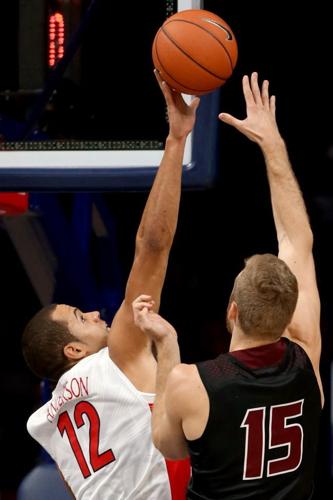
Here’s my point: Anderson is a more valuable “get” by Arizona than Stanley Johnson was a year ago. Both are one-year players in Tucson, but as Anderson displayed in Sunday’s exhibition victory over Chico State, he’s a leader who makes those around him better.
Anderson was in no one’s Top 100 in the Class of 2011, but as it sits today, he’s probably one of the five or 10 top recruits of 2015.
Item III: Arizona has stunned six Top 10 teams in November games at Arizona Stadium over the last 50 years.
1982: Arizona 28, No. 6 ASU 18 (Arizona was 5-4).
1986: Arizona 34, No. 4 ASU 17 (Arizona was 7-2 and ranked No. 14)
1992: Arizona 16, No. 1 Washington 3 (Arizona was 5-2-1 and ranked No. 12).
2005: Arizona 52, No. 7 UCLA 14 (Arizona was 2-6).
2006: Arizona 24, No. 8 Cal 20. (Arizona was 4-5).
2013: Arizona 42, No. 5 Oregon 16 (Arizona was 6-4).
At kickoff, the combined record of those six losers: 57-4-1.
Two weeks ago on the Pac-12 Networks, Utah coach Kyle Whittingham told his team it was “a Goliath.”
On Monday, Arizona coach Rich Rodriguez said the No. 10 and 8-1 Utes have “no weaknesses.”
Cue David and load the slingshot.
Item IV: Over the weekend, the Arizona Diamondbacks quietly severed their last connection to Tucson. They told their Southern Arizona marketing representative Mike Feder that he would not be retained.
Why? Budgetary concerns.
Don’t laugh. It’s true.
The Diamondbacks had a payroll of $56.2 million last season. Their staff directory currently lists 389 employees, including seven interns for communications, social media, photography and publications.
But they have no room for a single goodwill man in Tucson.
Feder didn’t really have a title. He was an ambassador to Tucson and he did it so well, with such passion, that at times I thought he was going too far, beating the drum for a team that abandoned Tucson as a spring training site and ceased playing even a single March exhibition game here.
What Feder did mostly was arrange a “Diamondbacks Express” to Chase Field. This season he filled 30 Tucson buses with 1,700 D’backs fans and accompanied them on their drive to the ballpark.
It wasn’t a money-maker, but it was a link to the state’s second largest market. In the last two seasons, the D’backs played to 52 percent capacity at Chase Field.
No wonder.
Item last: Arizona played its first basketball game with a 30-second shot clock Sunday night and two fewer timeouts allowed.
A year ago, the Wildcats averaged 67 possessions per game. On Sunday night, they had 71 possessions against Chico State. I didn’t notice a faster tempo, but neither did I notice any dawdling.
Any increase in tempo is a good thing.
It was also the first game Arizona played with the NCAA’s new mandate of one fewer timeout, per coach, in the second half ( a limit of three.) On Sunday, Sean Miller didn’t even call a timeout in the second half.
But the game lagged on and on. Why? The referees called 48 fouls. Only one UA game last year had more fouls: 51 at Stanford.
Perhaps the next time the rules committee considers changes, it will instruct the refs to back off a bit.

