


Ask Mitch Katz and Shirlee Bertolini what songs the UA Marching Band played in Super Bowl I, and it comes off as an echo.
“Bugler’s Holiday,” said Katz.
“Bugler’s Holiday,” said Bertolini.
That’s it? One song?
“We also played ‘The Hills Are Alive’ from ‘The Sound of Music,’” said Bertolini.
“I’m pretty sure we played that ‘Sound of Music’ song, ‘Hills Are Alive,’ ’’ said Katz.
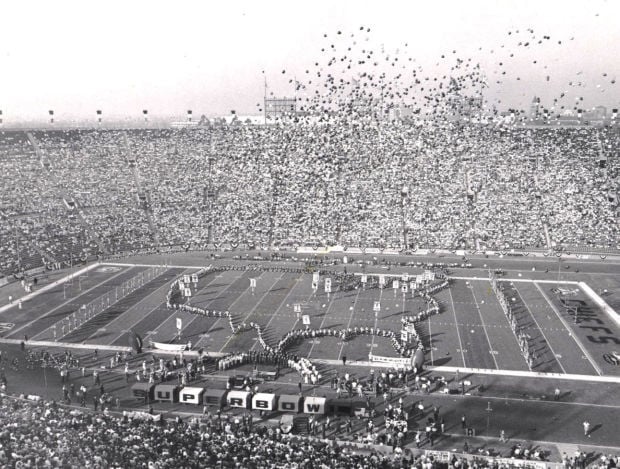
The UA played five songs at halftime of Super Bowl I in Los Angeles. You can see the total performance in 14 minutes 35 seconds on YouTube. It was polished. It stands the test of time.
“It was dynamic,” said Bertolini, who was the UA’s twirler coach then as now. “I’ve seen it on DVD many times.”
“It would think it holds up well,” said Katz, who taught music for 35 years in Los Angeles and New York.
The UA ensemble, about 210 strong, not only formed the Liberty Bell, but also, to perfect detail, the crack in the bell at the Los Angeles Coliseum in 1967.
No, it wasn’t Ella Fitzgerald (1972), Michael Jackson (1993) or Aerosmith (2001) — it wasn’t transcendent like, say, Springsteen in 2009 — but for the debut of all Super Bowl halftime shows, it was and remains credible.
Credible? It works even when the UA band and twirlers do a skit about the OK Corral, playing “Bury Me Not On The Lone Prairie,” as an Arizona tuba player pretends to be shot and tumbles onto the 50-yard line.
What remains fascinating about the UA’s role in Super Bowl I is that it was invited, or even considered to be invited.
“This is what happened: Jack Lee was widely respected and his reputation was greater than that of the bands at UCLA and USC,’’ said Bertolini, who has been at Arizona as a twirler and twirler coach since 1954.
In the summer of 1966, Lee, the man who wrote “Bear Down, Arizona,” took a phone call from Tommy Walker, who had been Disneyland’s original director of entertainment.
Walker told Lee he had been hired by the NFL and AFL to provide halftime entertainment for the inaugural “World Championship Game.” Would the UA be interested? Walker was working on a theme in which 1960s superstar trumpet player Al Hirt would be featured with the UA band.
Lee once told me that Walker was conflicted about booking Arizona; Walker was, if nothing else, a symbol of USC football.
“He chose us over USC,” Lee said. “That meant the world. It told me that our work here was respected.”
Walker was USC’s high-profile drum major in the 1940s, creating an identity as “Tommy the Toe,” in which he would throw down his drum major’s hat and kick a football through the goalposts. He later became the director of USC’s marching band.
Yet he chose UA over USC for Super Bowl I in part because his father, a musician and band director in Milwaukee, remembered Lee as a young musician at both Michigan and Ohio State.
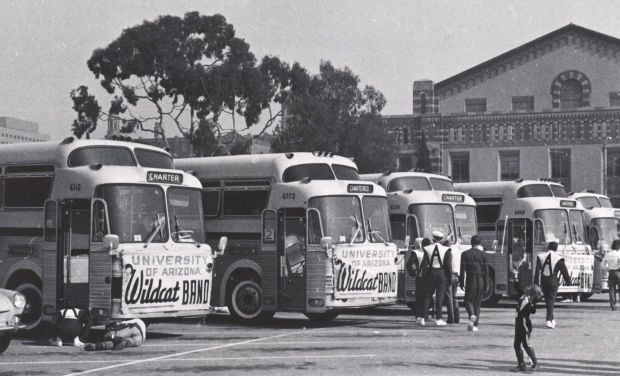
“There was never a discussion of money,” Lee told me. “We all went over on a bus on the Wednesday before the game. We stayed in a hotel near the 405 Freeway and rehearsed at UCLA. Our expenses were paid. That’s it.”
The so-called Super Bowl was not of global significance on Jan. 15, 1967. Katz, a sax-playing UA freshman from New York City, flew home from Christmas break without knowing he would be at the L.A. Coliseum a few weeks later.
“My cousin, who was a business law professor at the UA, picked me up at the airport,” Katz remembers. “He handed me a newspaper and said, ‘Look at this.’ ”
The one-column headline said:
Wildcat Band
To Play
In Bowl Game
It turned out to be The Bowl Game.
“I said, ‘Whoa, you’ve got to be kidding,’ ” Katz recalls. “It turns out Jack Lee was friends with a guy from Disney. No one would’ve guessed it would turn out to be a game of such magnitude.”
Tickets for the first Super Bowl — in which Green Bay beat Kansas City 35-10 — were $10 and $12. Attendance was 61,946, about 30,000 shy of capacity. The game program, which Katz still has, cost $1.
“It wasn’t all this fancy million-dollar stuff,” said Katz, who lives near Los Angeles. “But it was big because it was the first one.”
The Grambling Marching Band joined the UA about nine minutes through the 14-minute performance and helped to form an outline of the United States. The playlist, typical of the 1960s, included:
“Way Down Yonder in New Orleans.”
“When the Saints Go Marching In.”
“Don’t Fence Me In.”
There were neither wardrobe malfunctions (2004) nor ZZ Top singing “Tush” (1997). It was Jack Lee and his band, the most unlikely Super Bowl performers of the half-century.
“When it came to band stuff, I thought Jack Lee was a genius,” said Katz.
“It was so low key then,” said Bertolini. “I stood on the field the entire game. I enjoy football, but I was ‘sooooo’ excited to work with Al Hirt.”
Word got around.
Years later, when Katz was teaching middle school in Pacoima, California, one of the teachers distributed a weekly bulletin to students and faculty. It always included a trivia question.
One year it was: Which of our faculty members played in the Super Bowl?
No one guessed it was Mitch Katz. He played the saxophone in Super Bowl I.
“It’s a trick question,” he said. “But it’s true.’’

