



Tolson, Hollinger and Corbett are among the three leading names in Tucson baseball history, and that’s not all: the Tucson Unified School District named elementary schools after all three men.
Today, you cannot play baseball at any of the schools named after Andy Tolson, Chuck Hollinger and J. Knox Corbett.
You cannot play baseball at almost any Tucson elementary school. I recently made a tour of more than 20 schools, and there is not a baseball field in existence. Where? Ochoa Elementary, Davidson Elementary, Steele, Lineweaver, Cragin, Sunrise, Dietz, Van Buskirk, Duffy, Wright, DeGrazia and on and on and on.
“It’s a sign of changing times,” said Tolson’s son, Brad, an all-conference pitcher at Arizona and state baseball champion at Tucson High. “The choices are so much different than when we were kids.”
His father’s old school, located behind “A” Mountain, still has eight basketball hoops and two soccer goals — but no baseball diamond.
That’s life in 2018, and it continues to change.
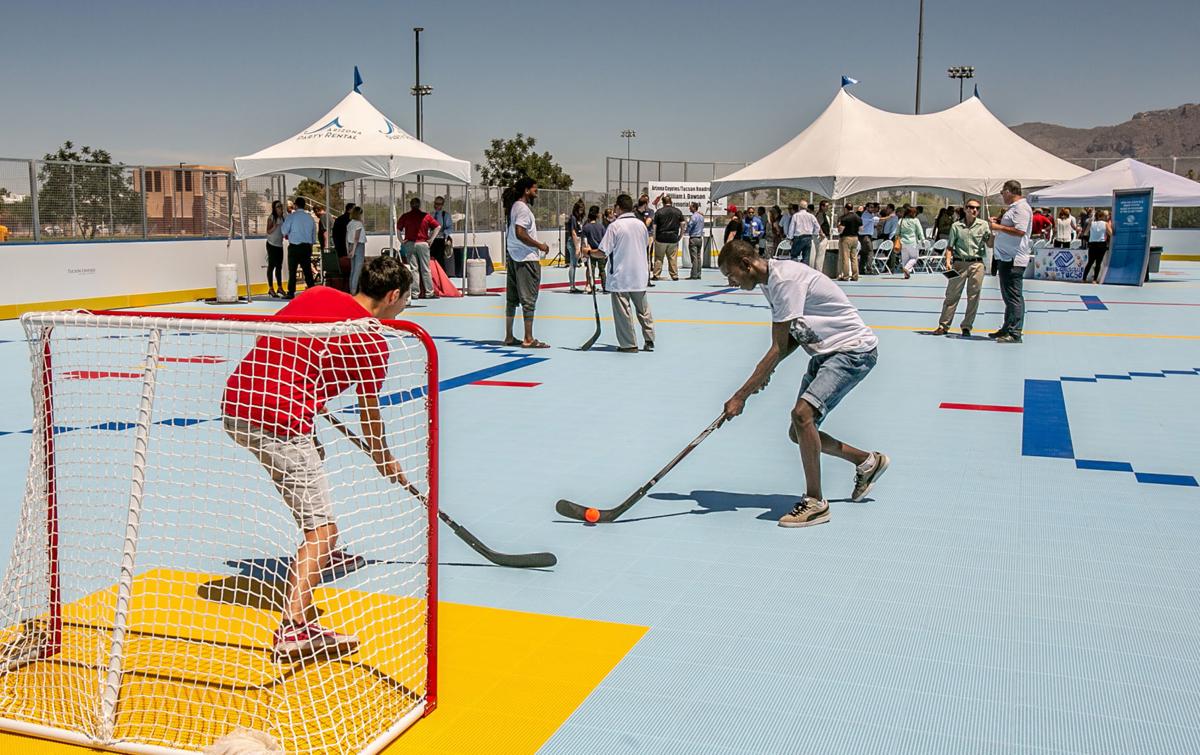
The Tucson Roadrunners last week debuted a wonderful outdoor hockey rink at Doolen Middle School, which required removing the last trace of baseball — an old backstop and dirt infield — from the school.
Doolen still has four functional basketball hoops and two well-kept courts, as befits the school’s namesake, Bud Doolen, who was a four-time state championship basketball coach at Tucson High. Otherwise, the outdoor sports facilities at Doolen include two monsoon-fed soccer fields, but no trace of baseball or softball.
Hollinger was “Mr. Baseball” in Tucson for almost a half-century, coaching youth baseball to such excellence that two of his American Legion teams played in the national finals. He was later secretary of the Arizona-Texas League and part of the leadership of the Tucson Baseball Commission.
Now at the Hollinger school on West Ajo Way, there remain two old backstops, relics from the mid-20th century, but no basepaths. A soccer field bisects a place where shortstops and centerfielders once played.
This reflects American sports society. Soccer and basketball are growth sports. Baseball, a slow game that demands a longer attention span, is becoming a specialty sport among younger generations.
At Lineweaver Elementary just off Columbus Boulevard, an old backstop, probably 50 years old, remains in place. But a soccer goal now sits where first base would be.
Over the last decade, massive solar-power structures have replaced baseball and softball fields at many Tucson elementary schools.
Ochoa Elementary in South Tucson is blessed by two well-kept basketball facilities and soccer fields. But a solar panel complex is now part of the old baseball infield.
At Wright Elementary on Columbus Boulevard, solar panels occupy an area that used to be first base.
Corbett Elementary School is even worse. With the growth of charter schools such as Basis, Corbett is deserted. A for-sale/lease sign occupies a once-busy area near the front of the school, built in 1955. Two old baseball backstops remain standing, but the field was long ago replaced by weeds.
In a city short of soccer facilities, a place like Corbett should be a good possibility to be repurposed as a soccer facility.
Charter schools do not construct baseball fields or backstops, either. The Basis school for elementary-age students on Alvernon Way has an all-turf playground, but nothing for baseball or softball.
Plus, most school districts would no longer entertain the possibility of allowing their K-8 students to play a potentially harmful game like baseball, so don’t expect any change. This is the era of SPS: solar panels and soccer.
All of this makes me reflect on my upbringing, when baseball was universal at every age.
How things have changed: My mom allowed me to ride my bike to school once the snow melted. It was a perilous, three-mile journey down Old Main Hill at Utah State University, which then required a turn across the city’s busiest highway, to the old Whittier School.
The lure of getting to school early was the pre-school baseball games played each spring morning. Dozens of kids, 8 to 11, played. The magic was that the right-field line had a short-porch, chain-link fence that was reachable by those who batted lefty or could hit to the opposite field.
There was no image-builder greater than hitting a home run before school. We would play until the bell rang, each eager to get another crack at a home run.
It had such an influence on me that I started to bat left-handed just so I could reach that short porch one day.
Those slow trots around the bases became things of local legend.
A year ago, while visiting my mom, I drove to the old Whittier School. The grass had been replaced by blacktop. The old backstop was gone.
Where have you gone, Joe DiMaggio? The shrinking baseball industry turns its lonely eyes to you.

