


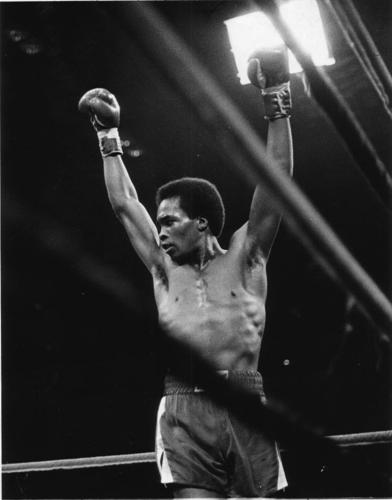


MARCH 24, 1979 – SUGAR RAY LEONARD IMPROVES UNBEATEN BOXING RECORD IN TUCSON
Aside from an aging Muhammad Ali, the two biggest names in American sports in 1979 were probably combative TV analyst Howard Cosell and charismatic boxing star Sugar Ray Leonard.
After wining the 1976 Montreal Olympics gold medal and impressively winning his first 19 professional fights, Leonard agreed to a made-for-TV fight at the Tucson Convention Center against 66-2 welterweight Daniel Gonzales.
Cosell was the key part of ABC’s “Wide World of Sports” telecast on a Saturday afternoon in March, attended by 6,422 Tucsonans.
It remains the largest boxing audience in Tucson history, surpassing the 5,100 who saw local boxers Paco Flores and Johnny Rico fight at the TCC five years earlier.
Leonard knocked out Gonzales in 2 minutes 3 seconds of the first round, and the crowd was not happy at the brevity of the long-anticipated fight. They threw empty beer cups, some of them hitting Cosell.
“They’re animals,” Cosell said. “This is the last time I’ll ever do a fight in Tucson.”
Cosell was later escorted to a car by 10 policemen.
Leonard, then 23, went on to win five world championships, a star among stars, matched against boxing immortals Roberto Duran, Thomas Hearns and Marvin Hagler.
In 2004, I played golf with Leonard at Arizona National while he was in town promoting boxing events at a casino.
He recalled his knockout over Gonzales not as anything controversial, but as a indication of his prowess.
“I was still a young fighter, and at the time (Gonzales) was probably the toughest opponent I’d faced,” he remembered. “The crowd wasn’t happy, but what could I do? I couldn’t just carry him. I still consider it a big step in my career.”
Getting Cosell and Leonard to Tucson was an idea generated by Phoenix promoter Steve Eisner. He told reporters he put up $75,000 of his own money to pay for use of the TCC, a local hotel, travel expenses, publicity and guarantees to the fighters.
The fight grossed more than $200,000; TCC officials said the previous largest gate for an event was $120,000 for an Elvis Presley concert. Leonard was paid $46,000, while Gonzales got $10,000.
Leonard was so popular that Eisner said about 2,000 of the tickets were bought in Phoenix.
When Leonard arrived in Tucson, he was accompanied by Hall of Fame trainer Angelo Dundee. He told reporters he anticipated a difficult fight. Gonzales had not been knocked out in 68 fights.
“He’s clean-faced, and I don’t like that,” said Dundee. “It means he knows how to cover himself up, to protect himself, and he hasn’t taken too many punches.”
But in the first round, Leonard delivered a quick right-hand punch that landed squarely on Gonzales’ chin.
He was out.
“I hope the sportswriters continue to say I can’t punch,” said Leonard. “It was a beautiful punch. I’m as happy as the devil. There’s no wear and tear on me.”
Gonzales was on his feet at the count of six, but wobbled and spit out his mouthpiece. “I didn’t know what was happening,” he said.
After five more fights in 1979, including another first-round knockout, Leonard won the world welterweight championship, beating Wilfred Benitez on Nov. 30 in Las Vegas.
Where are they now: Leonard, 49, retired from boxing after a failed 1997 “comeback,” when he was knocked out for the only time in his career by Hector Camacho. He is an occasional TV analyst and actor.
How he did it: While playing golf at Arizona National in 2004, Leonard saw a bobcat near the green at the No. 3 hole. He refused to continue until the bobcat moved back into the desert.
Three foursomes piled up behind Leonard’s foursome, irritated, wondering what stopped play. When two men drove their cart to the No. 3 green to complain, Leonard got out of the cart and pointed to the bobcat.
They recognized the boxing champion, waved to their playing partners, and for about 15 minutes, Leonard signed autographs and took photographs with golfers, maintenance workers and beverage cart drivers.

