


In February 2020, Tucson marathon runner Sarah Sellers placed 11th in the U.S. Olympic Marathon Trials in Atlanta, missing out a spot in the Tokyo Games by less than three minutes.
Before Sellers, 30, could even figure out her next step, the world was engulfed in the coronavirus pandemic, and competitive racing stopped.
Sellers then found out she was pregnant with her first child. The Tucson nurse anesthetist set a few goals for herself: The first was to be a good mom, but in close second was her goal of getting back into racing after giving birth — and hopefully quickly.

Sellers gave birth to a daughter, Emery Jane, in January. While the distance runner is feeling good about her first goal, the second has not been as easy.
"I tried to get back so quickly, it's been a really hard time," said Sellers, who first made headlines in 2018, when she came out of nowhere to finish second in the Boston Marathon. "My body has not come back as quickly as I hoped."
Sellers is facing a dilemma common to working moms everywhere: Should she prioritize her dreams, or focus on her child?
Fortunately, Sellers has not had to make a choice just yet. A recent $25,000 sponsorship from Ally Financial as part of its new campaign, #TheUnsponsored, will provide Sellers with money that will allow her to train.

Sellers is one of three athletes whose journey will be highlighted in film spots across Ally's social media platforms. The company has committed $250,000 in funding to elite athletes who are competing without brand sponsorships.
"When Ally got in contact with me, it kind of fit perfectly because I was really struggling on my own to get back into competitive racing and trying to prioritize my baby and also be financially responsible," Sellers said. "It was really hard for me to justify things that would help me get back into racing, like physical therapy specific to postpartum running. It's hard to justify paying for those things on my own, out of pocket while I’m trying to prioritize my baby right now."
The digital financial services company's funding will enable Sellers and others to pay for essential items, like training equipment and coaches' fees, as well as basic life expenses.
"Thousands of athletes train for years chasing down a dream to represent our country at the highest level, and while some will make it this year — and even go on to enjoy glory and lucrative contracts — many will have to stay at it, training, sweating and competing for another three years," Andrea Brimmer, chief marketing and public relations officer for Ally, said in a news release. "The road is hard and expensive. We wanted to bring the stories of the unseen and the unsponsored to the forefront, offer our support and hopefully spur others to follow suit."
Sellers said Ally's financial help has taken the pressure off, and now she's able to prioritize the things she needs to get healthy and competition-ready without having to take away from her financial responsibility to her family.

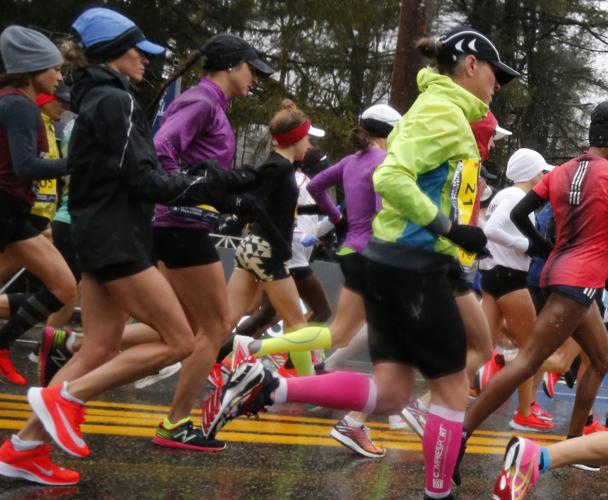
Sarah Sellers, center in purple with a black cap, came out of nowhere in 2018 to finish second in the Boston Marathon.
"I thought (the campaign) was a really generous and cool idea. I feel like Ally reaching out specifically to unsponsored athletes, I think that’s kind of a novel idea," Sellers said. "I don’t know if I’ve ever heard of a campaign like that. It's always companies going for who has the most exposure and whoever is going to give them the most immediate return on their investment."
The vast majority of elite U.S. athletes compete without sponsorships but still have plenty of potential, despite balancing regular lives and full-time jobs that carry with them additional challenges, Sellers said.
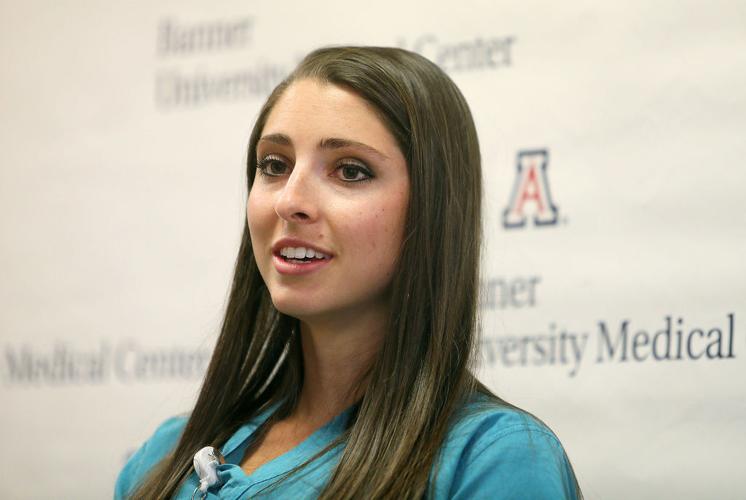
Sellers is a full-time certified registered nurse anesthetist at Banner-University Medical Center Tucson. She said her work schedule can make it difficult at times to train and keep up with her nutritional needs. It's harder to recover from a morning workout, she says, when she can't eat or drink until the mid-afternoon.
"When I run before work, I run at four in the morning, and it's hard to do a solid track workout or something really structured that early in the morning," Sellers said. "Also, just not being sure, my nutrition and fluids are always up in the air when I'm working."
A month before the Olympic trials, Sellers cut her work schedule down to three days a week and focused on training.
"I would try to structure it so that my hard training days were on my days off," she said.
The pandemic threw both Sellers' work and racing life for a loop, and things got a bit more complicated when she learned about her pregnancy.

"Because I was pregnant through the majority of the pandemic, during that time, I did not take care of COVID-positive patients," Sellers said. "I was willing to, but my coworkers were extremely thoughtful and decided because I was pregnant, they didn't want me being around positive patients."
With elective surgeries shut down more than once due to coronavirus restrictions, Sellers' workload came in waves. At times, she was deployed to other areas of the hospital that were short-staffed.
Now that the pandemic is waning and with Emery hitting the 6-month mark earlier this month, Sellers is starting to get back into the swing of things when it comes to training.
"I think I'm finally starting to feel more normal," she said. "I kept up a really good aerobic base and I've been able to do a lot cross training."
And although she's not back to where she wants to be physically just yet, Sellers thinks the Ally campaign will be a game-changer when it comes to getting there.
"I still have a hard time actually running. That's the only thing that gives me significant pain, is when I actually do run. That's why this campaign is going to be so helpful. There are a lot of ancillary treatments and things that will really help me to get back and be healthy running," Sellers said. "Originally I had hoped to do a fall marathon. If I'm able to start training hard soon, I think I could still do a fall marathon, but most likely it'll be an early spring marathon."
Sellers is planning on competing in the 2024 Olympic Marathon Trials but says she likes to have other goals along the way, like improving in the marathons leading up.

"For this last Olympic (Marathon) Trials, between 400 and 500 women qualified for trials and only the top three made the team," Sellers said. "There were kind three favorites in the race, and none of them made the team. It's just such a gamble on the date, that while it is a big goal, I don’t want it to be everything's a failure if that doesn't happen."
So she's keeping her focus on those goals she set before Emery's birth: Be a good mom, get back into competitive racing.
"(I've had) my own personal reality check that being a parent and competing at a high level, you're faced with a lot of decisions," Sellers said, with the sounds of Emery cooing softly in the background. "Being a parent is obviously your first priority, but it can be really challenging to compete at the level that you were previously and still feel like you’re giving your very best to your family."
Washes and rivers were flowing steadily Friday morning after a monsoon storm swept through Tucson the night before. More than two inches of rain were reported in some parts of Tucson.

