


On April 25, 2024, the future of the Arizona Cardinals lay in the hands of Monti Ossenfort and his staff.
Over the next three days, the Cardinals drafted 12 rookies, including two in the first round. No other team had as many selections. Beginning with the fourth overall pick and finishing with the 226th, it was an opportunity to reshape the foundation of the organization.
In order, they spent those picks on Marvin Harrison Jr., Darius Robinson, Max Melton, Trey Benson, Isaiah Adams, Tip Reiman, Elijah Jones, Dadrion Taylor-Demerson, Xavier Thomas, Christian Jones, Tejhaun Palmer and Jaden Davis.
“I think we’ve added a lot of good football players and … raised the talent level of our team,” Ossenfort said at the time.
But 19 months later, as the Cardinals lost to the Jaguars — their eighth defeat in nine tries — those players made little impact, continuing what has become an unfortunate trend.
The Cardinals did get remarkable production from a wide receiver, but once again, it was Michael Wilson, a 2023 third-round pick. In two games without Harrison, Wilson has averaged 12.5 catches for 151.5 yards. Both marks would easily be career highs for Harrison.

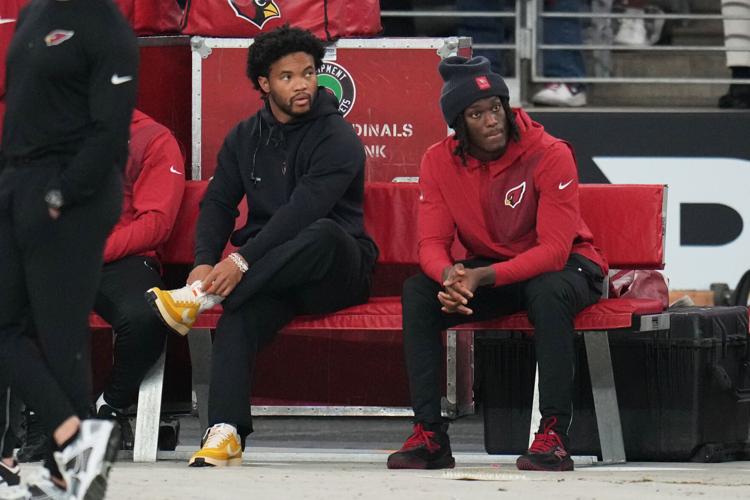
Arizona Cardinals quarterback Kyler Murray, left, and wide receiver Marvin Harrison Jr. sit on the bench during the first half against the Jacksonville Jaguars on Sunday, Nov. 23, 2025, in Glendale.
On defense, Robinson finished with zero quarterback pressures for his third consecutive game. Melton was largely benched after struggling the previous week. In fact, only one member of the Cardinals’ 2024 class played more than 32 snaps — and that was Adams, who entered as an injury replacement.
It may have been just one game, but it was emblematic of the lack of production from that crucial 2024 class.
Arguably their only player — in the entire class — who has lived up to his draft capital is Taylor-Demerson, who looks like a key part of the secondary moving forward.
There is an injury caveat here, as the Cardinals have struggled to stay healthy, but their 2024 class has been the healthiest of any group Ossenfort has brought in. Each of their first six picks has been healthy for at least 15 of 28 possible games. That’s enough of a sample size to understand who they are — at least for now.
And it’s a picture that has been underwhelming, especially with the Cardinals’ first few selections.
At No. 4 overall, Harrison was the top non-quarterback off the board. But 26 games into his career, he ranks fifth in his class in receiving yards. He’s been a good player, not a star. His sophomore leap also has not fully materialized, though he has crept up from 52.1 yards per game last year to 58.3 this time around.
Meanwhile, the two picks immediately after Harrison — tackle Joe Alt and receiver Malik Nabers — are among the best in the NFL at their positions.
Then there’s Robinson. It was easy to write off his rookie-year struggles as the result of a calf injury that sidelined him for 11 games, but his encore has not been much more impactful.
Cardinals coaches have noted Robinson’s work in the run game, and he’s been encouraged by his own progress in that area. But as a pass rusher, he has two career sacks and a poor 3.2% pressure rate, per Pro Football Focus. PFF also grades him as the league’s worst interior defensive lineman, among 112 with at least 200 snaps.
“On my true one-on-ones, I gotta win,” Robinson said.
And how can he do that?
“Just playing faster, not thinking as much,” Robinson said. “If you don’t win the first one, go to the second. Just keep my feet going. I think that’s the big thing right now is keeping my feet going in my rush.”

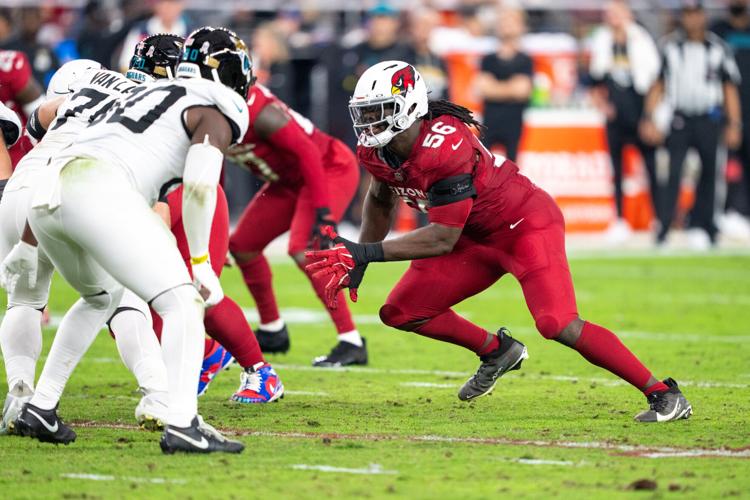
Arizona Cardinals defensive end Darius Robinson (56) charges Jacksonville Jaguars tight end Quintin Morris (80), Sunday, Nov. 23, 2025, in Glendale.
For much of last season, it was Melton who looked like the Cardinals’ best early selection. There were rookie bumps, but also standout performances, like when he didn’t allow a single reception against the Rams. But he’s had more struggles this year, both with missed assignments and with not winning one-on-ones. It culminated in his move to the bench in Week 12, when he played just 15 of 62 defensive snaps.
“Max can go out there and play winning football, absolutely,” Rallis said. “It’s a matter of doing it all the time.”
That pick, in particular, looks like a missed opportunity based on the early returns. The Cardinals traded down from 35th overall to 43rd to add an extra third-rounder. But between their initial pick position and the one they ultimately used on Melton, cornerbacks Cooper DeJean, Kool-Aid McKinstry and Kamari Lassiter all went off the board. All three are already above-average players, with Lassiter developing into one of the league’s top outside cornerbacks.
It’s not just the early picks from the class who have struggled. None of the four third-round picks have yet established themselves.
That group has been unfortunate with injuries — Benson has been sidelined since Week 4 with a knee injury and Reiman suffered a season-ending ankle injury a week later — but they have not maximized their opportunities when healthy. Adams was benched in October after opening the year as the starting right guard, and Jones has not yet played a single defensive snap in his career, despite injuries to other players at the position.
There hasn’t been much production from four of the five Day 3 selections, either. Only Taylor-Demerson has regularly seen the field.

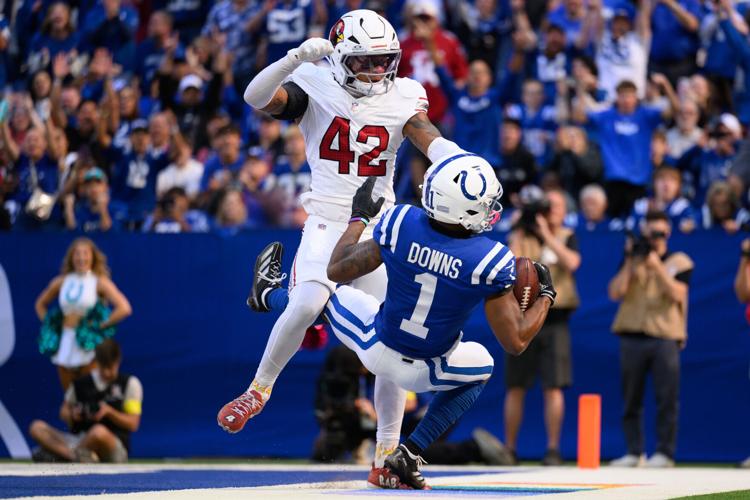
Indianapolis Colts wide receiver Josh Downs (1) holds on to the ball after getting tackled by Arizona Cardinals safety Dadrion Taylor-Demerson (42), Oct. 12, 2025, in Indianapolis.
The story, of course, is not yet written on any of the Cardinals’ draftees, all of whom remain in the organization. Seattle’s Jaxon Smith-Njigba — a front-runner for Offensive Player of the Year — did not break out until November of his sophomore season. Josh Sweat, the best player on this Cardinals defense, became a sack machine only toward the end of his rookie contract.
There’s also the reality that no team is going to hit on every draft pick, even in the early rounds. That’s part of the business.
But imagine if this roster had Malik Nabers or T’Vondre Sweat or Kamari Lassiter or Bucky Irving or Tarheeb Still. Those are the types of players who accelerate a rebuild, as the Cardinals envisioned on that April night 19 months ago.
Instead, their own draft class has helped leave this rebuild stuck in neutral.

