



All spring and all summer, a pervasive sense of optimism has seeped out of the Arizona Cardinals facility.
Since they were hired nearly three years ago, Jonathan Gannon and Monti Ossenfort have built toward 2025. They established a culture in 2023, despite winning just four games. They discovered an on-field identity in 2024, doubling their win total to eight. That’s all important. But this year is, for the first time in their tenures, truly about winning. The playoffs are the measuring stick.
“I’ve been to the playoffs once,” Kyler Murray said, bluntly, at the conclusion of last season. “That’s not what I’m used to. I mean, I’m getting used to it, but I’m trying to change that narrative, change this culture around this place.”
Finally, the Cardinals believe they have the pieces in place to make that happen. Here are five reasons why they can reach that goal:
The defensive front has high-level talent
Last season, the Cardinals defense ranked 15th in points allowed and 21st in yards allowed. Those results might seem fairly unremarkable — until you consider the players with whom they produced those results.
Their top five defensive lineman, by snaps played, were Zaven Collins, L.J. Collier, Dante Stills, Roy Lopez and Naquan Jones. None of them has ever finished a season with more than five sacks. Together, they were paid just $10.9 million against the cap.
That the Cardinals were able to finish with the results they did is a testament to defensive coordinator Nick Rallis. In pass rush win rate — an individual stat that measures how often a pass rusher beats his offensive lineman — they ranked 28th. In sacks — a team stat — they ranked 13th.
Now, Rallis has legitimate, NFL-caliber talent to work with. Even with first-round pick Walter Nolen beginning the season on the PUP list, the top five defensive linemen should be Josh Sweat, Calais Campbell, Dalvin Tomlinson, Darius Robinson and Baron Browning.

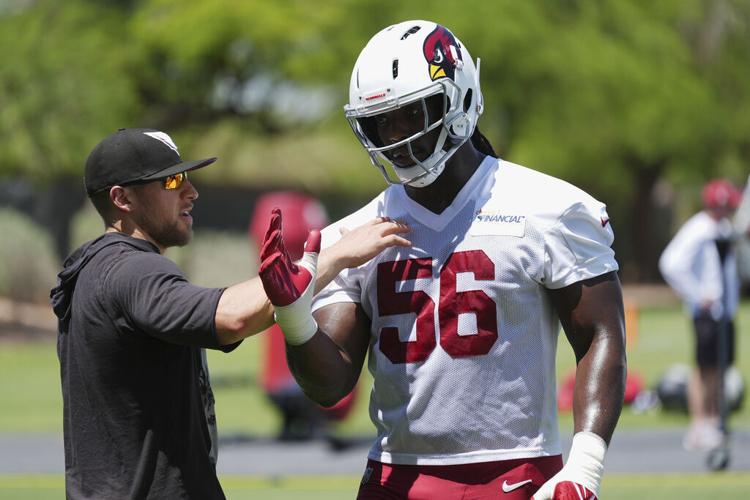
Arizona Cardinals defensive lineman Darius Robinson (56) talks with Cardinals defensive coordinator Nick Rallis during practice June 3, in Tempe.
Remember how the previous group had never produced more than five sacks in a season? Excluding their rookie campaigns, this year’s group has averaged 5.7 sacks each per season. Campbell, on his own, has 12 seasons with more than five sacks.
They are also, unlike last year’s group, being paid like legitimate NFL contributors. They’re making a combined $29.6 million — and that number is deflated by Sweat’s backloaded deal.
With so much investment at the most important defensive position, it’s not hard to imagine Rallis putting together a top-10 defense. That alone could vault the Cardinals to the playoffs.
Cardinals are built to generate turnovers
The defensive line wasn’t the only area that the Cardinals reinforced this offseason. In the second round of the draft, they added Will Johnson, a cornerback widely seen as a top-10 talent before injury concerns caused a draft day slide.
At Michigan, Johnson’s biggest strength was his ball-hawking ability. He pulled in nine interceptions in 32 college games, returning three for interceptions.
Now, he joins a secondary where that’s the norm. Max Melton had eight interceptions in his final two years at Rutgers. Garrett Williams once led the ACC in pass breakups in back-to-back seasons. Budda Baker forced nine turnovers from 2020 to 2022. All of them have the anticipation and ball skills to generate turnovers.

Arizona Cardinals cornerback Max Melton, right, breaks up a pass intended for Los Angeles Rams wide receiver Puka Nacua during the second half Dec. 28, 2024, in Inglewood, Calif.
But over the past two years, the Cardinals didn’t have the pass rush necessary for their secondary to succeed. They allowed opposing quarterbacks the seventh-longest time to throw. Those passers didn’t have to throw into dangerous situations because there was minimal pressure.
As a result, the Cardinals ranked 24th in interceptions forced. This year’s group has top-10 upside. That’s certainly the goal internally.
“That’s been our biggest thing we’ve been preaching in the secondary,” Williams said. “Just getting the ball more.”
The offensive line could be a legitimate strength
Most of the reasons for the Cardinals to improve center on their defense. After all, the only offseason additions to the offense were backup quarterback Jacoby Brissett and fourth-string running back Zonovan Knight.
But despite a lack of external additions, the offensive line could evolve into a legitimate strength.
Last year, they ranked between 10th and 15th in most key metrics. They were, in a welcome change for this organization, above average.
It’s easy to envision that group taking the next step in 2025. At two spots — right guard and right tackle — they primarily had to rely on backups last year. Now, Isaiah Adams is ready to step into a starting role at guard and Jonah Williams is healthy at tackle. Adams, in particular, has drawn consistent training camp praise. He could be a step above the production they saw at that position last season.

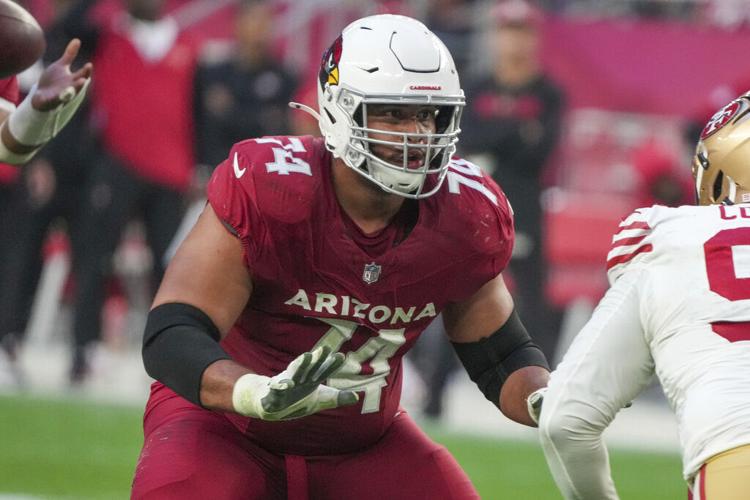
Arizona Cardinals guard Isaiah Adams (74) faces off against the San Francisco 49ers Jan. 5, in Glendale.
Paris Johnson Jr., meanwhile, is entering his third season. The former sixth overall pick took a leap last year from being merely solid to being well above average, despite switching positions from right tackle to left tackle. With a year of continuity, he has all the tools to become an elite blindside protector.
There’s a real possibility that the Cardinals offensive line has a top five left tackle and above average starters at the other four spots. That would enable them to further lean into their power run game while also making life easier on Murray. After the Cardinals bye, Anthony Richardson was the only starting quarterback to average fewer yards per attempt under pressure than Murray did.
Downfield passing game has nowhere to go but up
It might not have felt like it, but the Cardinals offense was above average last year. They ranked 11th in points, yards and defense-adjusted value over average (DVOA). They were even above average as a passing offense, ranking 14th in net yards per attempt and 13th in passing DVOA.
It just didn’t feel that way because there was no explosiveness. Among starting quarterbacks, Murray averaged the third fewest yards per attempt on downfield throws (passes that traveled at least 20 yards past the line of scrimmage). He completed those throws at the seventh-worst rate. The Cardinals, as a result, had the seventh fewest passing plays of at least 20 yards.

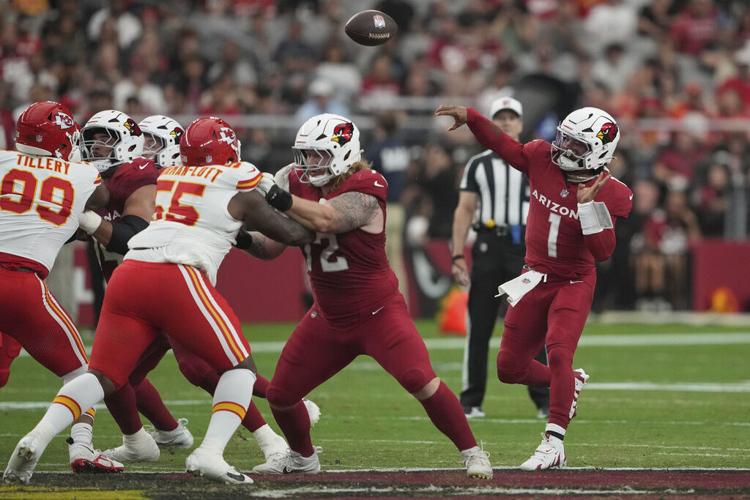
Arizona Cardinals quarterback Kyler Murray (1) throws against the Kansas City Chiefs during the first half of a preseason game, Aug. 9, in Glendale.
All of that made life difficult on the offense. They had to sustain long, grinding drives. Nothing was easy.
So, imagine if the Cardinals can become merely average downfield.
Murray certainly has the ability to do that. In his first three seasons, he averaged 15.4 yards per attempt on downfield throws. And his top receiver, Marvin Harrison Jr., excelled downfield at Ohio State. As a junior in college, he had 598 receiving yards on those plays. As an NFL rookie, he had just 267.
Unlocking some of that skill set — for both players — could easily shoot this offense into the top 10.
Cardinals have a cohesive philosophy
Under Gannon and Ossenfort, the Cardinals have displayed a clear ethos. They want to embody Gannon’s favorite traits, “motor and violence.”
On offense, that means excelling at running the ball and consistently deploying multiple tight end sets. Nobody fits that philosophy better than Tip Reiman, the tight end whom they drafted in the 2024 third round to dominate as a physical, run-blocking force. They’ve also fortified the offensive line and built up the running backs room, with both James Conner and Trey Benson taking major roles.
On defense, the philosophy is about versatility. The Cardinals want players, like Garrett Williams, Mack Wilson and Baron Browning, who can do multiple things. Now that they have those assets, they can maximize Rallis’ creative playcalling.

Arizona Cardinals linebacker Baron Browning (5) works with Cardinals outside linebacker coach Matt Feeney during training camp July 31, in Glendale.
This matters because the best teams — and particularly the ones who outperform expectations — are the ones who have a cohesive philosophy inside their building. They know what they want to be.
The Lions, under Dan Campbell, became one of the league’s best teams by building their identity on grit. The 49ers at their peak had a clear directive to find playmakers who could excel in space. The Broncos have recently built their team around the offensive line. The Eagles won the Super Bowl by doing the same with the defensive line.
The Cardinals, at least from a standpoint of their roster-building philosophy, are following in the path of that group.

