


In NFL history, only three teams have started 2-5 and finished with 10 or more wins. Only two have ever ripped off a five-game losing streak and hit that mark.
In a deep, competitive NFC, the Arizona Cardinals have not left themselves with much historic precedent for a second-half turnaround. To have any chance at all of a playoff berth, they would likely need to finish 8-2.
And they would need to do so against a schedule that includes six opponents currently over .500, two at .500 and only two under .500. It is the hardest remaining schedule in the NFL — for a team that has not beaten a winning opponent in more than a calendar year.
All of this is to say, a playoff berth is extremely unlikely.
These are some ways that the Cardinals can make their second half a success, even without a miraculous playoff berth. Here’s a look at what they will need to do.
Play competitive football
The most frustrating aspect of the Cardinals’ first two months is that it feels as if the organization is threatening to return to square one.
This franchise started over in 2018, with Steve Wilks and Josh Rosen. It started over in 2019, with Kliff Kingsbury and Kyler Murray. It started over in 2023, with Jonathan Gannon and Monti Ossenfort.
Nobody wants yet another reboot, even if it comes with a top draft pick.

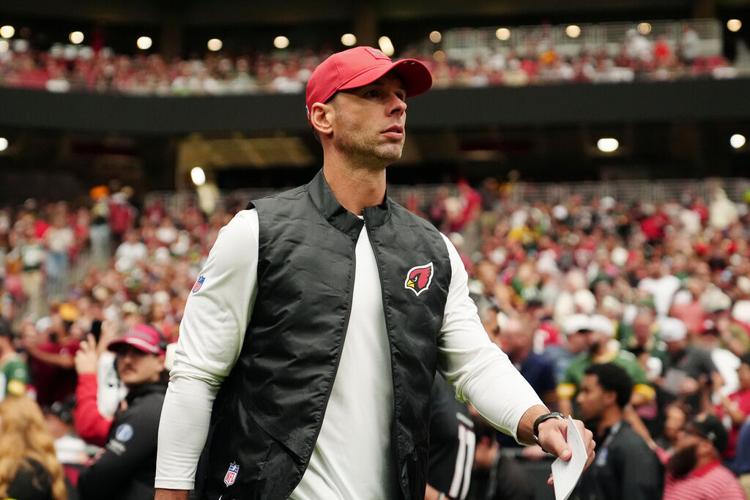
Arizona Cardinals head coach Jonathan Gannon walks on the field prior to a game against the Green Bay Packers, Oct. 19, 2025, in Glendale.
For two years, it was easy to see the positives from Gannon’s tenure. The Cardinals lacked talent, but the culture was stable. They played clean, penalty-free football. They got the most out of their players. They were, most importantly, competitive.
Some of that remains true this year. The Cardinals’ five losses have been by a combined 13 points, a frustrating run of heartbreaking defeats. But the 2024 Cardinals didn’t drop touchdowns at the goal line or commit senseless pre-snap penalties or let defensive linemen go unblocked because of miscommunications.
Now, their season can go two ways. They can let those issues compound and fall into a spiral that ends at 4-13 or 5-12 with no discernible direction. Or they can turn close losses into wins, push for .500 and look like a well-coached, competitive football team.
The latter might not produce a playoff berth, but it would make it easier to continue trusting Gannon.
Clarity at quarterback
The Cardinals’ offense has been rejuvenated with Jacoby Brissett behind center. In the season’s first five weeks, with Murray, they ranked 25th in DVOA, a stat that measures offensive efficiency and adjusts for quality of opponent. In the past two weeks, with Brissett, they’ve ranked 13th.

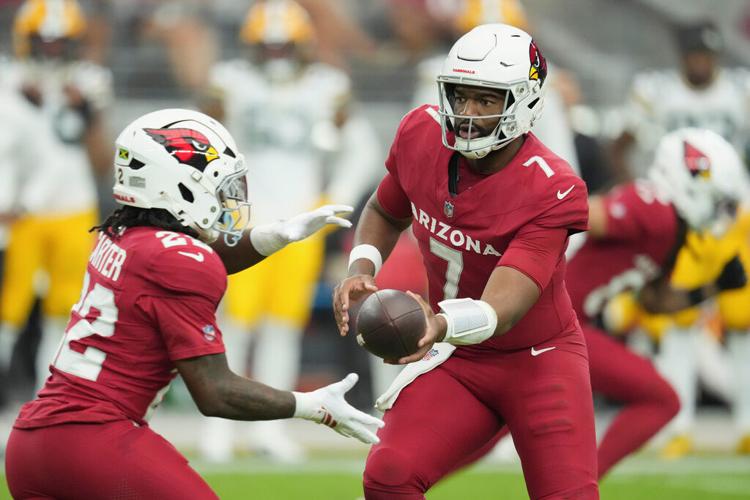
Arizona Cardinals quarterback Jacoby Brissett hands the ball off to Cardinals running back Michael Carter during the first half against the Green Bay Packers Oct. 19, 2025, in Glendale.
And yet, Gannon has remained adamant: When Murray returns from his foot injury, he will be the starting quarterback.
“Nothing’s changed,” Gannon recently said three times in the span of two days.
Part of the reason to stick with Murray, even if the Cardinals will never publicly admit it, is to determine whether he remains the future.
That answer needs to arrive by the end of the season, in one direction or the other. The Cardinals must enter 2026 with a long-term plan at quarterback. That can be a new face or it can be Murray on the back of a rejuvenated second half. But it cannot be Murray, in year eight, still with more questions than answers.
Harrison’s breakout
A year ago, there was an Ohio State wide receiver who had, by all measures, been something of a disappointment in the NFL. After a prodigious college career, he was drafted in the first round by an NFC West team, but he was seven games into his second season and did not yet look like a star. He was averaging just 39.5 yards per game in his pro career, far below the expectations given his draft capital.
That receiver was Jaxon Smith-Njigba. Since then, he’s tallied 1,630 receiving yards in 17 games. He is, unquestionably, one of the best receivers in the NFL. In the process, he’s helped elevate the Seahawks offense, helping turn Seattle into a fringe Super Bowl contender.
There are no shortage of parallels between Smith-Njigba and Marvin Harrison Jr. At the same point as Smith-Njigba began his turnaround, Harrison is averaging 53.4 career yards per game. He hasn’t been bad, but he also hasn’t been worth the fourth overall pick.
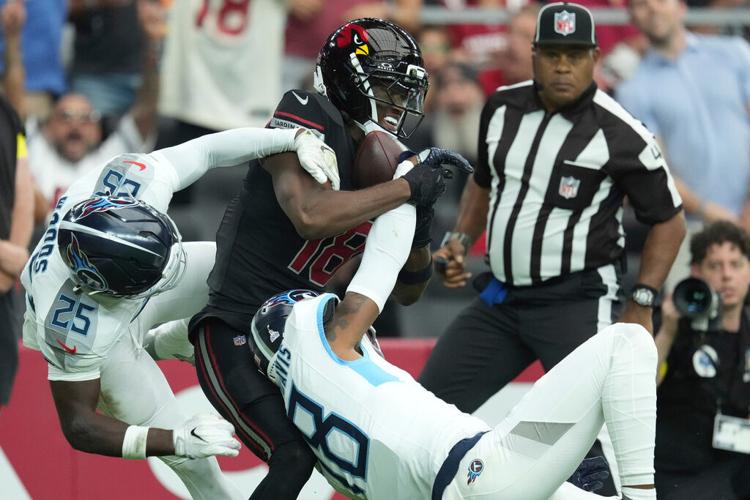
Recently, though, there have been encouraging signs. Harrison has brought in 67% of his contested targets, up from 37% as a rookie. That now looks like it can be his defining trait at the NFL level.

Arizona Cardinals wide receiver Marvin Harrison Jr. (18) makes a catch beetween Tennessee Titans free safety Xavier Woods (25) and Titans cornerback Jalyn Armour-Davis during the first half Oct. 5, 2025, in Glendale.
After a difficult Week 4 performance against the Seahawks, Cardinals wide receivers coach Drew Terrell worked on the simplest of tweaks with Harrison. He wanted the receiver to get into his stance quicker at the line of scrimmage, so that he could get into his route faster.
“Going fast cures all your problems,” Terrell said. “His ability to take release, get on an edge, go fast. ‘I’m hauling ass — oh, I feel all this space right here, let me throttle.’ As opposed to running across the field thinking about, ‘Is there gonna be space? Is there not gonna be space?’ Don’t think. Just go and then react.”
Since then, Harrison’s routes look sharper. He seems to be playing with more confidence. If it’s the beginning of a breakout, Harrison could elevate the Cardinals’ offense for years to come — as he was drafted to do.
First-round defensive linemen emerge
In the same vein as Harrison, the Cardinals need to see more production out of their two recent first-round defensive linemen, Darius Robinson and Walter Nolen.
Since Ossenfort took over as general manager, he has made four first-round picks:
– Paris Johnson, 6th overall, 2023
– Harrison, 4th overall, 2024
– Robinson, 27th overall, 2024
– Nolen, 16th overall, 2025
So far, Johnson is the only player to make good on that draft capital.
Of course, that’s incredibly unfair to Nolen. He suffered a calf injury in July and has not yet debuted. But that’s why the second half of this season is so important for him. He returned to practice in Week 7 and should debut soon.
The Cardinals desperately need him to be an impact player. So far this season, their only above-average performer on the interior of the defensive line has been Calais Campbell, who is 39 and likely to retire after the season. Nolen has the ability to immediately be a disruptive pass rusher — the type of player who would both elevate their current defense and be a focal point of the future.
Robinson has also dealt with his share of injuries. As a rookie, he missed 11 games with a calf strain. This year, he missed two games with a pectoral issue.
That doesn’t entirely excuse his lack of production when on the field, but it’s a notable caveat. Plus, Robinson recorded three pressures in Week 7 — his first career game with multiple pressures.
Arizona Cardinals head coach Jonathan Gannon walks on the field prior to a game against the Green Bay Packers, Oct. 19, 2025, in Glendale.
If that is a sign of things to come — and if Nolen is an immediate difference-maker — the Cardinals’ defensive line could transform from a question mark into a strength by the end of this season.
A top 10 defense
It’s easy to envision a sell for 2026 that goes something like this: The Cardinals’ culture is good, their defense is good and their offense has weapons to build around. With some offensive changes — perhaps at quarterback and/or coordinator — that could be the framework of a competitor, no matter what the 2025 record says.
But given that Gannon is a defense-first head coach, it’s harder to make that sell without a strong defense.
And so far this season, that unit has been just average. They rank 15th in points per game, 10th in yards per play, 21st in expected points added (EPA) per play and 22nd in DVOA. Mediocrity personified.
The bizarre — yet perhaps encouraging — element here is that their defense has been elite for three quarters. In those three quarters, they rank second in EPA per play. In the fourth, they rank dead last. The ingredients are in place, they just haven’t been put together for 60 minutes.
But imagine this: An 8-9 finish, with clean competitive football. Clarity at quarterback. A breakout second half for Harrison, Nolen and Robinson. A top-10 defense.
It’s not what anyone envisioned back in August, when a playoff run was the ambition. But it might just be enough to bring optimism back to Arizona.

