



After what may have been the Tucson Roadrunners’ last game in the Old Pueblo — though the team moving is a long way from definite — some postgame questions caused Tucson head coach Steve Potvin to pause a bit as he choked up.
He was asked what it’s been like to coach in Tucson, where he’s been a part of the coaching staff for nearly all of its existence in Southern Arizona.
“Oh man, I don’t even want to answer the question because ... I don’t want to go there to be honest with you,” he said. “But I’ll just say that it’s been tremendous.”
Attempting to hold back those emotions, he added: “It’s been good being here.”

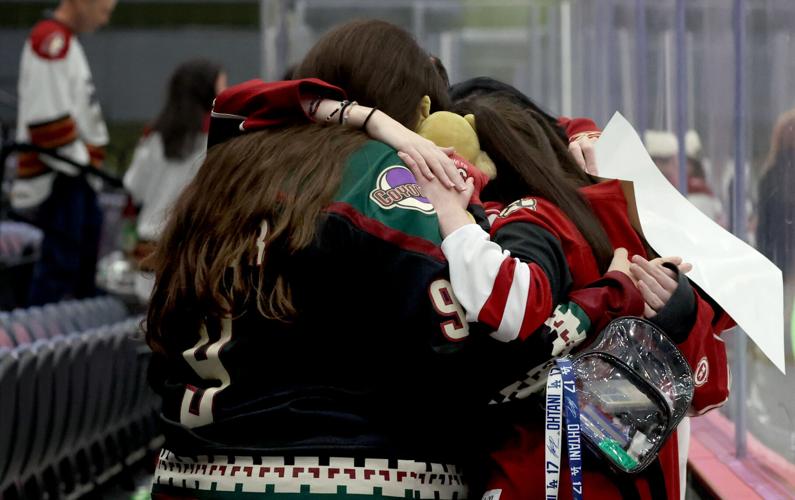
A group of Roadrunners embrace after the team’s 4-3 loss to Calgary on Friday night at Tucson Arena.
The Roadrunners, the AHL Pacific Division’s second seed in the 2024 Calder Cup Playoffs, lost 4-2 to the seventh-seeded Calgary Wranglers on Friday night at Tucson Arena to end their season. Calgary swept the best-of-three series by winning the first two games.
It’s the first time Tucson has been swept in a playoff series in its eight-year history.
The end of the season meant that Friday’s game could be the Roadrunners’ last in Tucson as ownership has talked about moving the team to Tempe after the NHL’s Arizona Coyotes were paused as an NHL franchise; owner Coyotes owner Alex Meruelo sold all hockey elements of the Coyotes to new ownership based out of Salt Lake City, though Meruelo kept the American Hockey League’s Roadrunners in his portfolio, with the Tucson-to-Tempe talk building up immediately as the NHL sale went through.
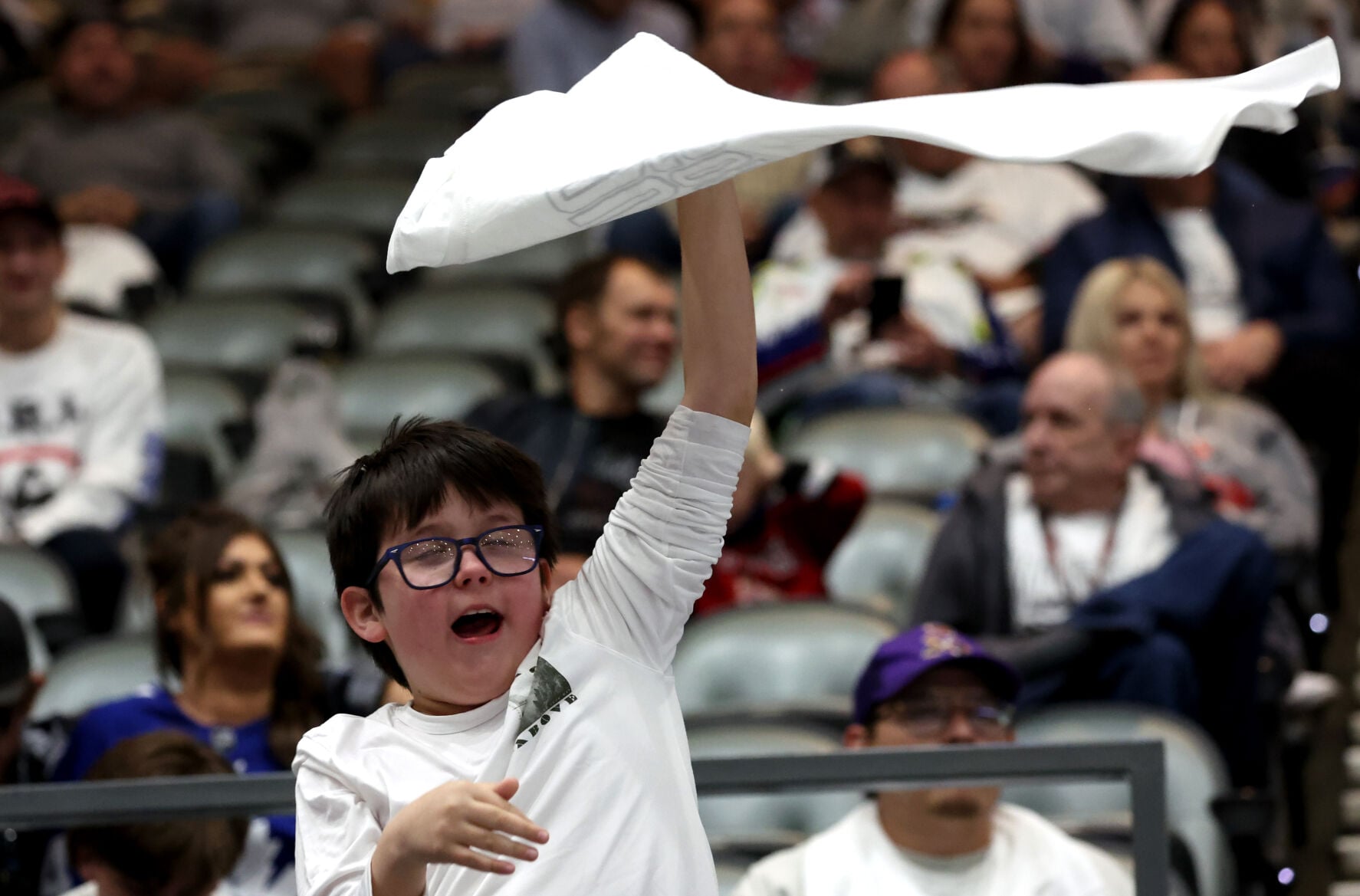
A young fan tries to lift the team early in the first period of the Roadrunners’ game against Calgary on Friday.
A number of hurdles still exist for the Roadrunners to move up Interstate 10 to the Phoenix area. Those include dealing with the remaining two years of the team’s Tucson Arena lease; unless negotiated down, Roadrunners ownership would be on the hook for north of $3 million to the city. Meruelo would also need to negotiate a new lease with the only viable hockey arena in the Valley (Mullett Arena on ASU’s Tempe campus, where the Coyotes played the last two seasons, but wherein the Coyotes’ old lease is reportedly not directly transferable to the Roadrunners, should they move north). Meruelo would also reportedly need approval from the AHL’s Board of Governors for such a relocation.
This year was Potvin’s seventh with the Roadrunners, but he’s been connected to the Tucson-based club for all eight of its seasons. After serving as a skills coach in 2016-17 for the Arizona Coyotes — in that role he often worked with Coyotes prospects, some who ended up as Roadrunners — Potvin mixed four seasons as a Tucson assistant with three as its head coach.
“It’s just meant a lot to me and my family,” Potvin said about the Tucson community. “There’s no way that (any) of us could grow or build these types of relationships without this community and this team and being here.
“I’m so thankful for the opportunity to have been here, so it definitely means a lot to us.”
Tucson center Cameron Hebig, who was the Roadrunners’ nominee for the AHL’s Man of the Year award for his outstanding contributions to community this season, said he has “nothing but great things to say about Tucson,” as he praised his teammates, coaches, the staff and the city.

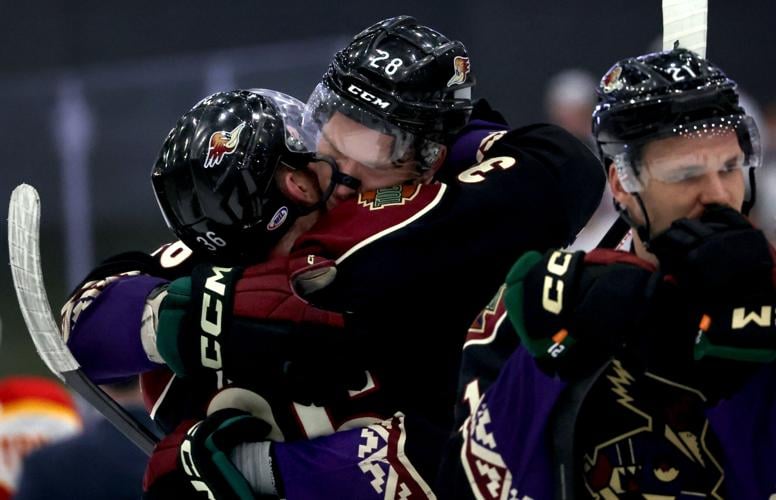
Roadrunners right wing Hunter Drew, left, and center Curtis Douglas hug at mid-ice after Tucson was eliminated Friday.
“Tucson’s been great. I love it here,” Hebig said. “The fans and interaction with them and the player appearances — they love it, we love it, so it’s been a lot of fun.”
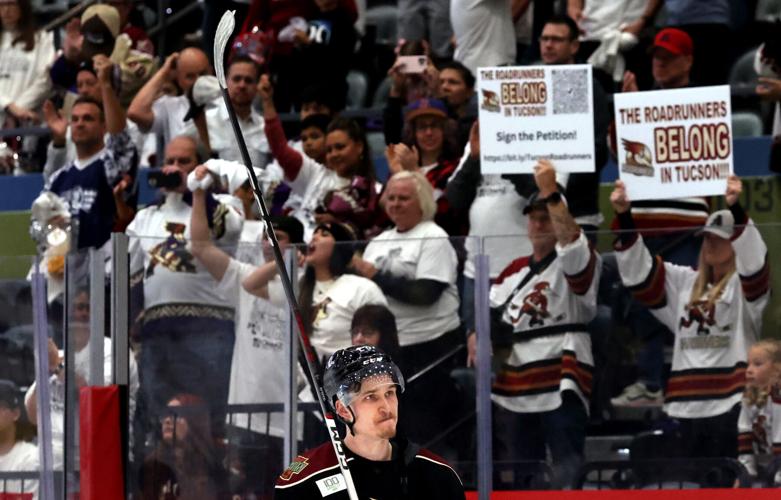
Since a potential move to Mullett Arena on the campus of ASU first surfaced, numerous fans have brought signs to Tucson Arena with messaging like “the Roadrunners belong in Tucson” or “Tempe won’t love you like Tucson does.”
Roadrunners home games often include videoboard segments featuring players called “This or That.” The videos show the players picking between two like-minded choices, such as “Nike or adidas,” or “summer or winter,” and often ending with “U of A or ASU”. On Wednesday, one fan had a sign that read: “This or That: TCC or Mullett.”
After the game Friday when the players gathered for the traditional post-playoff series handshake line, fans chanted “stay in Tucson” before cheering the Roadrunners as they left the ice.
After the game on the Jumbotron, the Roadrunners put up a graphic featuring images like Dusty the mascot holding up a “we love Tucson sign” and “YOU are hockey in the desert” in a dominant font size. The graphics were also posted to the team’s website and social media.
Despite the Roadrunners’ potential lame-duck status, the fans supported the franchise until the end of the season. On Saturday, April 20, 6,205 fans came for the regular-season finale against the San Jose Barracuda, who had long been eliminated from playoff contention.
On Wednesday, attendance was 4,823, a Roadrunners record for a weeknight playoff game. Finally, on Friday, attendance was 5,178, the largest home playoff crowd in Roadrunners history.
The Tucson Arena’s capacity for hockey is about 6,500.
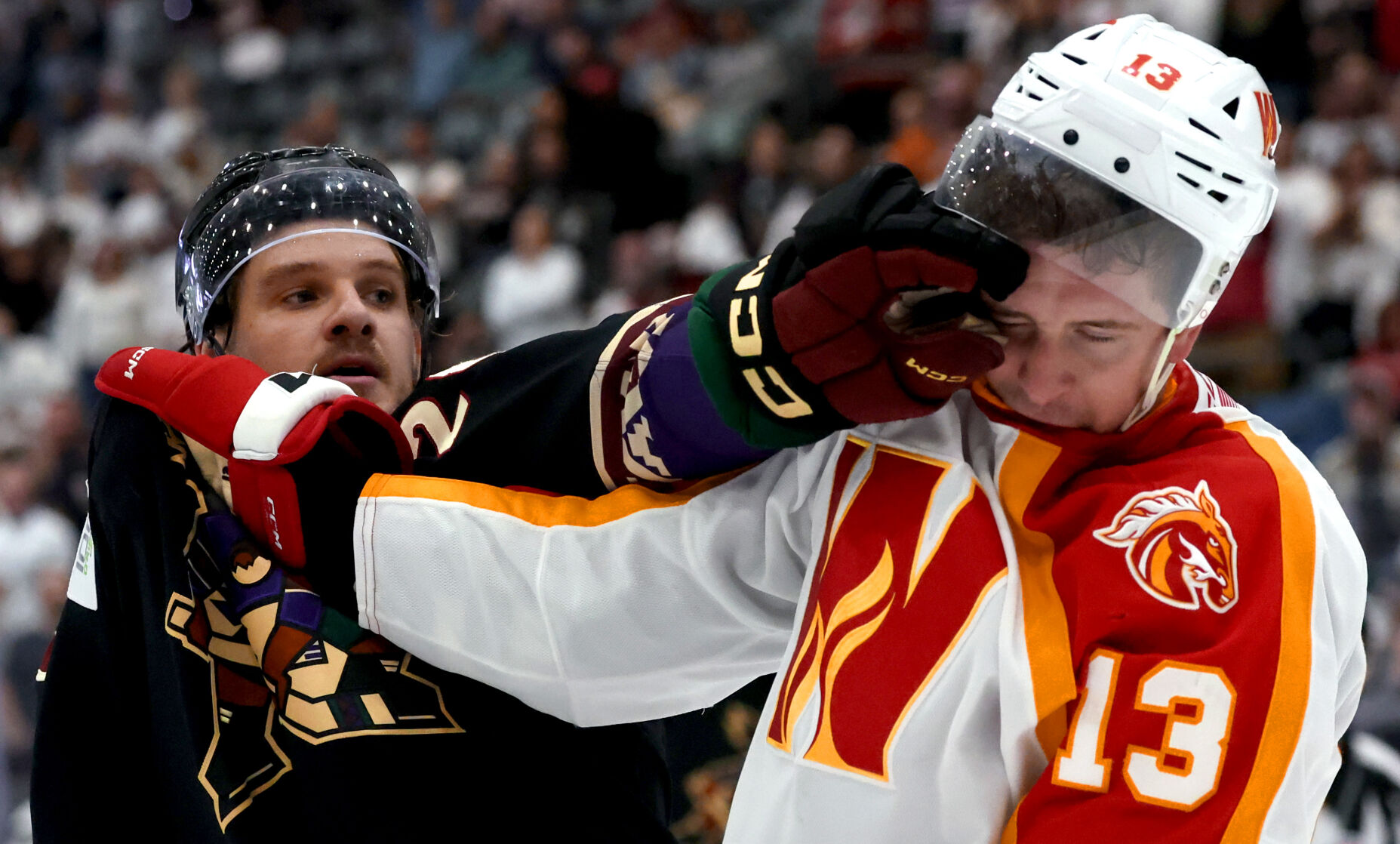
Roadrunners forward Milos Kelemen left, and Calgary defenseman Mark Pysyk scuffle during a skirmish late in the third period of Game 2 on Friday.
“We really appreciated it,” Hebig said. “The Whiteout was outstanding and sure lived up to the hype. We fed off the energy and to have them come out and support us like that. It was huge
“Obviously we wish we could have pulled out the ‘W’ for them but we sure appreciate them coming out and supporting us and cheering us out like that and not just (Friday) night — it was all season long,” Hebig added. “Such a great fanbase.”
Potvin was excited he got to go to a bit of the pregame tailgate on Friday and meet with the fans there.
“They’re just awesome,” Potvin. “You could see from 3:00, 3:30, people were starting to come into the arena.
“I was able to sneak out and say hello to some fans. It was tremendous support. We’re so excited to see everybody out, it was so much fun to be around them,” he added. “To really see it meant a lot to them and it definitely meant a lot to us.”
Slap shots
Season tickets for 2024-25 appear to still be available for purchase on the Roadrunners’ website and season ticket flyers were on seats in the arena on Saturday. The former Coyotes owners, who still own the Roadrunners, came under fire for not promptly refunding season ticket holders after the team was moved to Utah.




