



Despite the rumors of potential relocation, the Tucson Roadrunners are staying in the Old Pueblo through the 2028 season.
Tucson's American Hockey League franchise announced its contract extension to play its home games at Tucson Arena inside the Tucson Convention Center through the 2027-28 season.
The lease extension was approved by the Rio Nuevo District board. Roadrunners team president Bob Hoffman said the lease extension "is really exciting" and the conversations surrounding the Roadrunners' future "started a few months ago, having those conversations in the late fall and the winter."
The Roadrunners operating out of the TCC was on the agenda of Rio Nuevo District's board meeting multiple times since the fall.
"Sometimes it takes a little bit," Hoffman said. "Obviously we need to put things to paper and you have to do the review and all of that. To get it done before the conclusion of the regular season, so we can announce it and let our great fans know that, it was exciting and something we're trying to do. Now we can look forward and think exactly about what's in front of us with at least two seasons remaining."
After the Roadrunners' NHL affiliate, the Arizona Coyotes, sold their franchise to the Smith Entertainment Group (SEG), which also owns the NBA's Utah Jazz, they became the Utah Mammoth.
Former Coyotes owner Alex Meruelo still owns the Roadrunners, and his ownership of Grand Sierra Resort and Casino in Reno kick-started rumors of the Roadrunners relocating to Reno — which wouldn't be the first time a professional sports team in Tucson left for Nevada. The Tucson Sidewinders, the Triple-A affiliate of the Arizona Diamondbacks, became the Reno Aces in 2009.

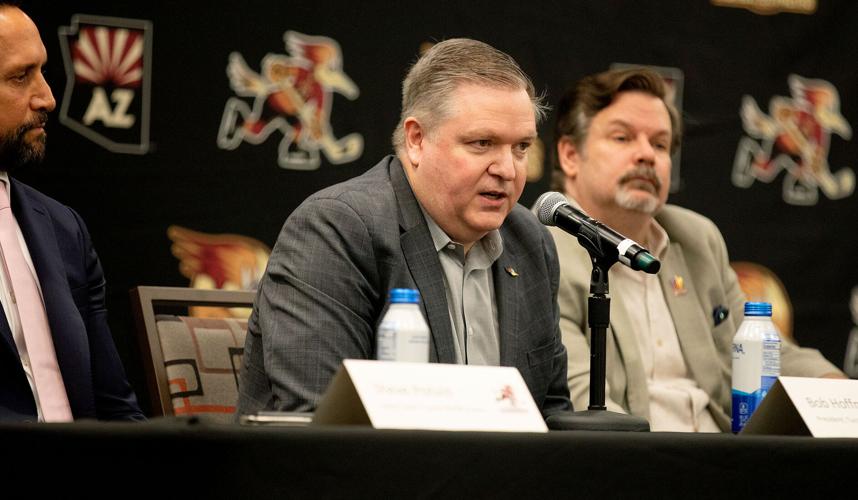
Tucson Roadrunners President Bob Hoffman talks during a press conference in 2024.
Grand Sierra Resort and Casino is part of a $1 billion entertainment district project that will include a 10,000-seat arena, which will also be the home of Nevada Wolfpack basketball.
After the Coyotes relocated to Salt Lake City, Rio Nuevo District voted to keep the Roadrunners at the TCC for three years in 2024. With one more season under contract, the Roadrunners were given another year to operate in Tucson.
Rio Nuevo District "has been outstanding" in accommodating the Roadrunners since the franchise established roots in 2016, Hoffman said.
"They did everything in the world that was asked of them, from renovations, to making it a professional-level facility with locker rooms and back-end stuff that fans never see," said the Roadrunners president. "They did a great job in doing that, and now they've done a great job in adding pieces to that. ... That vision starts and comes from the Rio Nuevo board."
In the Roadrunners' 10th season in Tucson, they set a franchise record for single-game tickets sold and the largest ticket gate in team history on Jan. 31, 2026. Over 140,000 fans have attended Roadrunners home games this season — 1.25 million in 10 seasons.
Tucson Mayor Regina Romero said, "keeping the Roadrunners here means more great memories for years to come."
"Recreation and sports tourism are an important part of our economy," Romero said in a press release. "Having such a great team right here in town is both good fun and good business, and I’m very happy to reach such a mutually beneficial agreement."
Hoffman recently joined "Spears & Ali" on ESPN Tucson to discuss the significance of the Roadrunners staying in Tucson through 2028, and what it took to keep hockey in the desert for the next two years.

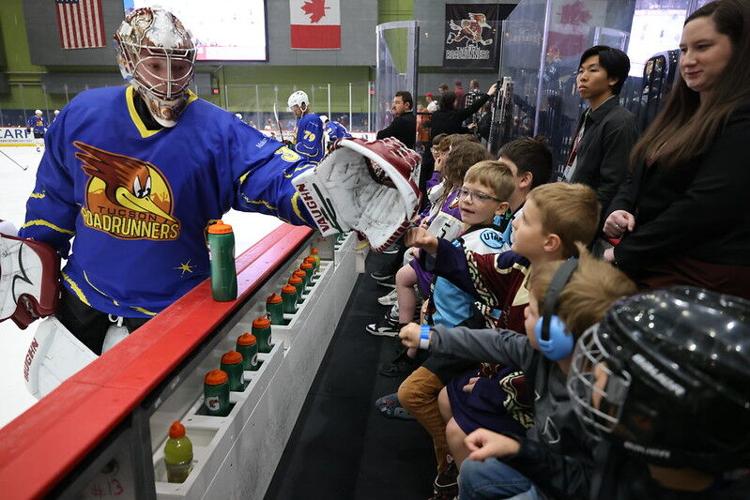
A Tucson Roadrunners player greets young hockey fans on April 18, 2025.
What were the conversations like in the meetings between the Roadrunners and Rio Nuevo to keep the franchise in Tucson through 2028?
A: "It's quite a collaboration, but it's also very lucky and fortunate on our end because of the support we have with partners and relationships we've put together in Tucson, Rio Nuevo, the arena.
"It's a little different than some markets. There are several different entities that are a part of it. ... There's a few different voices and few different groups. Since 2016, when the team started here in Tucson, we've been fortunate for the connectivity and relationship with those groups.
"Everyone had the same goal in mind: keep pro hockey here in Tucson. We've established and proven we're a hockey market. We had the goal in mind, so it was about getting to the point of signing and getting it done in time. We were able to do it, so we're really fortunate."
How did the Roadrunners become embedded in the Tucson sports scene and make it challenging for the team to relocate?
A: "When we first came in, we had to learn a lot. We had to learn the market and learn what the fanbase was going to be. We wanted to provide fans with a great entertainment option and value, and an opportunity to get out and come downtown.
"Regardless if they were a hockey fan or if they knew what icing was or if they knew the point system, we wanted to cover the bases. What we found out is Southern Arizona has an embedded core of hockey fans. We gave them an outlet and an opportunity to watch the best and young talent from the National Hockey League.
"That was something they grew into and resonated with. ... Here we are with 80-plus players that have played in the National Hockey League, and they spent their time in Tucson."

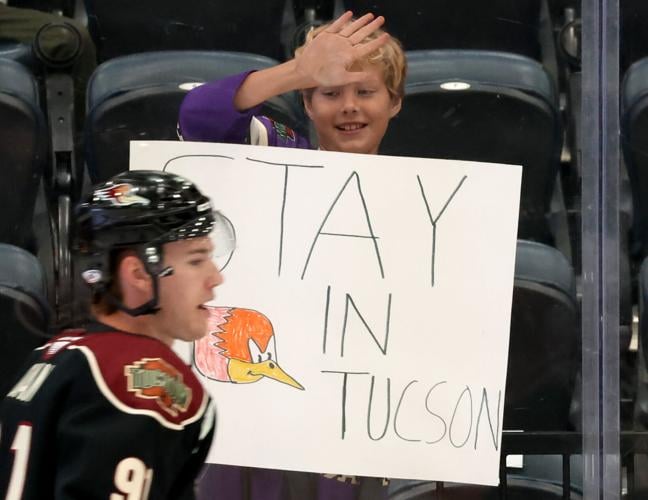
A Roadrunners fan holds a sign imploring the team to remain in town before the opening game against Calgary in the Calder Cup play-offs, April 24, 2024, in Tucson.
Did you feel a sense of urgency to keep the Roadrunners in Tucson, considering it wouldn't be the first time a professional sports team in Tucson relocated or shut down operations?
A: "That's the unfortunate thing. We had to live through their eyes. Some of the teams that have struggled here and left Tucson, it was financial in some cases. In some cases, it was lack of support or bad leases or all of those different things that go into a business decision in moving or relocating the team.
"With the Roadrunners, it was different because none of those things are in play. We've developed a fanbase, we've had success. It was challenging to look at that and say in the spirit of doing nothing wrong, you might lose a team. To have those conversations, it was challenging. Yes, there was an apprehension. With changes like that, there could be future changes.
"All we can do is continue to put a great product out there and continue to show Tucson is a hockey market, which is what we've done. I think the hockey world has taken note of that. Tucson is a great sports town. Everyone can see that it can support a hockey team.
"Hockey will stay here in Tucson. I don't think there will be a break at all. We won't skip a beat. There will be hockey in Tucson, and the fans can thank themselves for that. They've shown that and showed that there is a fanbase here."


