



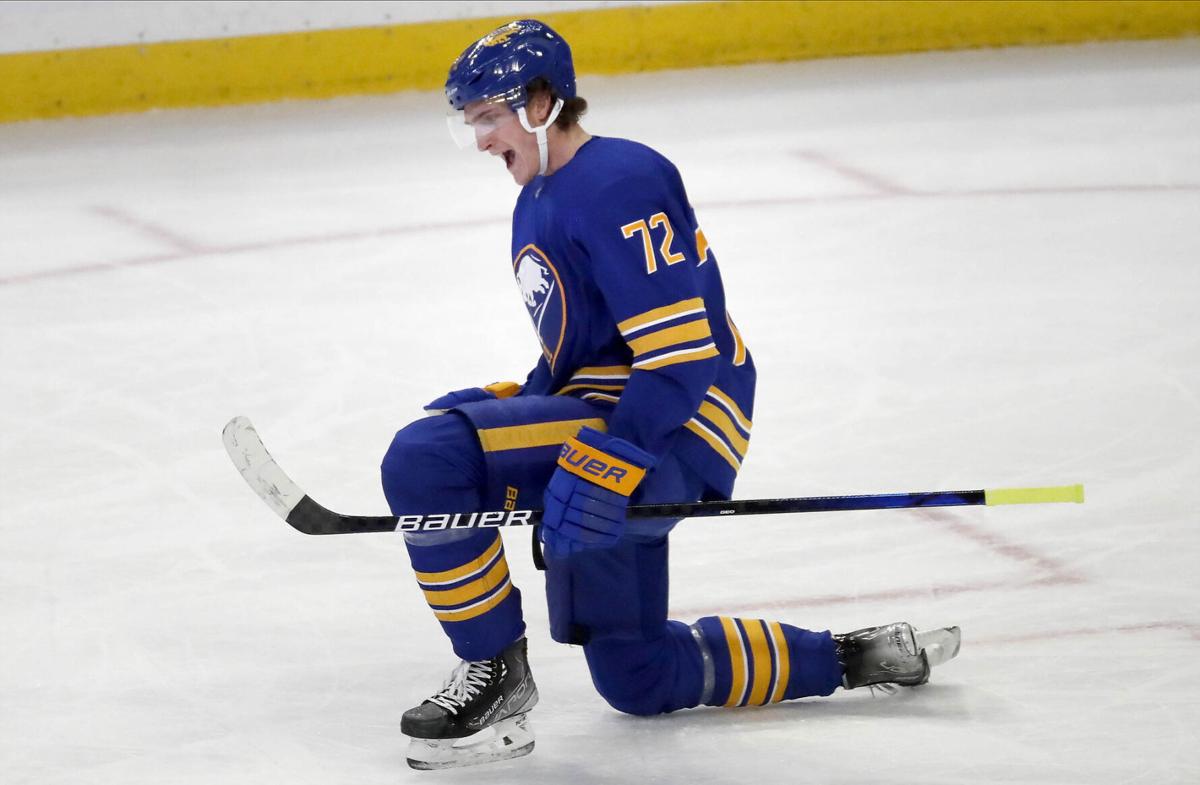
The first half of the Buffalo Sabres’ season was filled with calamity and reminders that the young core isn’t ready to consistently win.
Injuries depleted the Sabres of their depth, particularly in goal, where coach Don Granato has used six netminders, and rarely have they been able to use a lineup that includes all their top players. Casey Mittelstadt’s return Tuesday in Ottawa showed, at least on paper, what to watch over the final three months.
Granato had Mittelstadt, Dylan Cozens, Peyton Krebs, Tage Thompson, Rasmus Dahlin, Alex Tuch, Jeff Skinner and Rasmus Dahlin, among others.
We’ll start there with my latest mailbag, which features reader-submitted questions:
Andrew Sember: How can we evaluate this team with all the injuries and goaltending struggles?
Lance: You evaluate based on the progress of the young core. Dahlin has taken another step in his role as a top-pair defenseman, Cozens is driving play like a future elite centerman in the NHL, and Thompson emerged as a reliable scorer down the middle. None of the prominent young players has taken a step back, and the coaches and development staff have helped prospects progress in Rochester.
We always knew this was going to be a transition season and the injuries should have reminded fans why that is. The Sabres don’t have the depth yet, and their young core is still learning how to win close games in the NHL.
Luke Hoelscher: Who will have a greater impact for the Sabres over the next two years: Peyton Krebs or Jack Quinn?
Lance: Krebs will make the bigger impact early because his game is further along than Quinn’s. Remember, Krebs was drafted one year earlier and arrived in Buffalo with NHL experience in Vegas. He plays a very mature game and seems physically ready for the grind of an 82-game schedule. Quinn, like many young players, needs more time to get stronger and, as a scorer, will learn how to use his shot against NHL goalies. Krebs is a play-making center. This is very close, though. Both are long-term solutions for the Sabres.
Jeffrey Johnson: Why would the Sabres wait until close to the March 21 deadline to trade their pending unrestricted free agents?
Lance: Prices go up as injuries occur and general managers across the league have a better idea what their respective team needs and where they are in the standings. No one wants to be the GM to rush to make a trade six weeks before the deadline, only for your club to fall apart.
Also, teams don't hold their pro scouting meetings until right around this time of the season. This is when trade talks start to ramp up.
Dennis Michael: Will we see management stop signing veteran depth forwards like Cody Eakin so a prospect like Brett Murray can have a consistent role?
Lance: Depth forwards are necessary, particularly when it pertains to nuances such as faceoffs, penalty-killing and experience. It’s the team’s job to find the right fit for those roles. The Sabres did a better job with that last summer. You can’t have a team filled with prospects, and Murray has shown he needs more time in Rochester. Take advantage of that development path while he’s exempt from waivers.
@DisplacedSabres: What are the odds the Heritage Classic between the Sabres and Maple Leafs in Hamilton will go on as scheduled, March 13?
Lance: As of now, very good. We've learned in the past two years that it’s impossible to predict what the state of the world will be months from now, but it bodes well that the World Cup qualifier Sunday at Hamilton’s Tim Horton’s Field is sold out.
Rob R: Does Owen Power join the Sabres at the conclusion of his season at Michigan?
Lance: Yes, Power will sign. This was the plan all along. He could have played in the NHL this season, but this allowed him to develop specific areas of his game to prepare for what’s ahead. There's no reason for Power to return to Michigan for another season.
Tyler Hickey: Is it OK to have goalie prospects Devon Levi and Erik Portillo in Rochester at the same time to avoid one signing with a different NHL team?
Lance: No, the Sabres will roll the dice here. You don’t want two prospects sharing the net. Young goalies need to play games and given Levi’s precise technique in the crease, he’s my choice to become the first goalie prospect to receive a contract. The organization wants both signed in the future, but Portillo is better off shouldering a heavy workload at Michigan for another season.
This is where relationships come into play. Sabres goalie development Seamus Kotyk has worked with Portillo since the draft in 2019. They would continue that in Rochester if Portillo signs with Buffalo and, if all goes as planned, the Amerks’ net would be his in 2023-24.
@MountUncle: If Craig Anderson returns to the ice and performs well, could the 40-year-old goalie be traded before the deadline?
Lance: Yes, Anderson would be a strong low-cost option for a contender. One team to watch is the Florida Panthers, who need help behind Sergei Bobrovsky. Anderson and his family make their home in nearby Parkland, Fla., and the Panthers are a Cup contender.
Erik Walden: Of the Sabres’ pending unrestricted free agents, who do you expect they will try to bring back next season?
Lance: Malcolm Subban or Michael Houser as a depth option in goal for Rochester, Vinnie Hinostroza given his role and relationship with Don Granato, and defenseman Mark Pysyk. It’s going to be a short list. Pysyk has a right-handed shot and the Sabres have few of those in the system. These are depth players to fill out the roster.
The big question is what they will do with Victor Olofsson. Olofsson is a restricted free agent and has zero goals in his last 26 games. You can’t sign Olofsson long-term if this continues, regardless of the reasoning behind his struggles. I’m not suggesting they’ll get rid of Olofsson, but he’ll need a big second half to avoid a one-year contract.
Patrick Westin: Should the Sabres use their cap space to help cap-strapped teams make trades to acquire picks and players? If yes, who to target?
Lance: Absolutely. I’ll get to an option on defense later in this piece, but at forward, call the Vegas Golden Knights to see if they’re moving Jonathan Marchessault or Evgeny Dadonov. Something has to give in Vegas with Jack Eichel returning. Another possible option is Kevin Fiala of the Minnesota Wild. He’s a pending restricted free agent, and the Wild are going to have trouble affording his contract. This sort of trade will likely have to wait until the offseason.
Garry Mar: Where do the Sabres find a short-term solution in goal?
Lance: Anderson and Ukko-Pekka Luukkonen for now. Beyond this season, the Sabres will need to acquire an experienced goalie to work in tandem with Luukkonen. As far as offseason options, Joonas Korpisalo and Alexandar Georgiev are two names to watch. Korpisalo will be an unrestricted free agent – the Sabres would be wise to not overpay – while Georgiev is restricted and likely to be on the trade block.
As always, the trade market is the easiest avenue for an upgrade, and the Rangers might not want to pay Georgiev’s $2.65 million qualifying offer.
Keagan Anders: Is there any word on defenseman Ryan Johnson signing an entry-level contract after his season at the University of Minnesota?
Lance: No word yet. NHL teams like to keep those discussions private. The last thing they want is for a prospect to lose focus on developing at the NCAA level. But I do see the Sabres signing Johnson at season’s end with the intent of assigning him to Rochester. The prospect cupboard with the Amerks will need to be restocked and Johnson can be a top defenseman on that team.
Eddie Rutanga: If you’re running the Sabres, do you keep the first-round draft picks or make a trade to improve the team now?
Lance: Trade one if you can. The Sabres aren’t in an ideal spot to trade futures. Their prospect pipeline isn’t strong enough yet – look at Rochester’s roster without Quinn and Mattias Samuelsson – and realistically, the NHL club isn’t one piece away from contending. But there are two significant holes on this team that are easier to address through trade as opposed to free agency: right-shot defense and goaltending.
The latter won’t be addressed during the season given teams’ unwillingness to part with goaltending for anything less than an overpay, but Adams should stock his war chest of picks to take advantage of a cap-strapped team this offseason.
Jack Kach: With the Sabres well-stocked at right-shot defense, should they make a trade to get better on the right side?
Lance: The best course of action here is to make a trade with a team that needs to create cap space. Matt Dumba of the Minnesota Wild is one name to watch this summer. He’s a right-shot defenseman with one year remaining on a contract that carries a $6 million cap hit, and the Wild needs to create space. Dumba has a 10-team no trade list and isn’t having a strong season, but he was great in 2020-21 and would be a perfect fit in the Sabres’ system. Even if Dumba is a rental with no intention of signing in Buffalo, he can be flipped at the deadline.
The Sabres also have a great bargaining chip if they opt to address the hole in free agency. Whoever signs with Buffalo would have the opportunity to play next to Power or Dahlin.

