


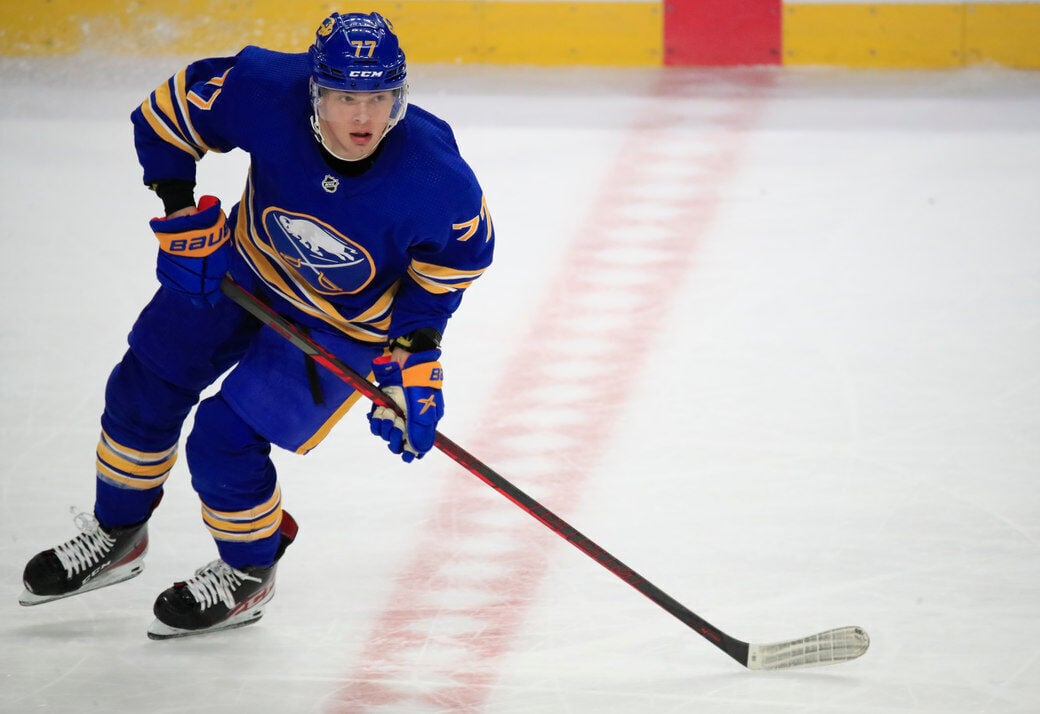
Yanick Dube knew something was wrong when JJ Peterka couldn’t make a routine pass one crisp November day at Red Bull Ice Hockey Academy in Salzburg, Austria.
Dube approached the bashful 15-year-old about the mishaps at practice. Peterka explained that he was using a broken stick. Nine of the 10 sticks given to him at the start of training camp were already broken, most snapped into two pieces during Peterka’s long hours in the shooting room above the facility’s two sheets of ice. He was saving his only functional stick for games.
The academy’s equipment manager refused to give Peterka more. Only Red Bull’s pro players in Munich, Germany, would be given such grace. Dube pleaded with the staff to make an exception, knowing why Peterka broke graphite shafts at the same rate young boys go through wooden pencils. For years, Dube saw up close the drive and determination Peterka possessed to be the best.
“I haven’t seen a player work as hard as he did on his shot,” said Dube, a longtime professional player now working as a skills coach at the academy.
The dilemma was resolved and Peterka was equipped with left-handed sticks that set him on a path to the Buffalo Sabres. He skated circles around defenders in Czech Republic’s Under-18 league, worked his way up from a smaller role to a go-to scorer in Germany’s top professional league with EHC Red Bull Munchen and became a second-round pick of the Sabres, 34th overall, in October 2020.
There was also a remarkable showing at the IIHF World Junior Championship and, more recently, the 19-year-old winger narrowly missed out on the Sabres’ opening-night roster. His insatiable appetite to improve every area of his game has led to an impressive start to his rookie season with the American Hockey League’s Rochester Americans.
Those who coached Peterka as a teenager aren’t surprised by the ascent. They’re watching from afar as the kid who broke too many sticks shows he’s willing to work himself to exhaustion to reach the NHL.
“He’s got the ability, that’s for sure,” said Don Jackson, the Minnesota-born longtime coach of EHC Red Bull Munchen. “The rest is mental and taking advantage of the opportunity, which he has right now.”
'Our next player'
Don Jackson remembers the newspaper clipping. A 15-year-old player at Red Bull’s academy in Salzburg was making headlines by using an elite skating stride and dynamic shot to fool his opponents. One of the team employees in Munich told Jackson, “Here’s our next player.”
It wasn’t the first time Jackson heard Peterka’s name. During an Under-23 camp the previous summer, Jackson and his staff were in Salzburg to view the young talent in Red Bull’s pipeline, all of whom were living and training at the state-of-the-art facility. One player stood above the rest.
“He was scoring on everything,” recalled Jackson. “He was scoring on every shot. He would pick his spot and hit them.”
Scoring wasn’t always Peterka’s strength. He wasn’t much of a skater at 8 years old when he first trained under Dube. At the time, the bulk of Peterka’s on-ice training had been in Olympic-style speed skating, yet he wasn’t much of a skater before he met Dube. Peterka had the hands to make plays with the puck and had an uncanny ability to find space in the offensive zone. Dube, a Canadian who had a long playing career that included time in the AHL and various leagues in Europe, thought Peterka could someday become a dynamic offensive player, even in a country that typically trained its hockey teams to focus on defending.
Together, they skated daily to improve Peterka’s stride and edge work. Those quickly became strengths. His shot wasn’t as strong as most of his peers’, but Peterka showed enough to join the elite young players in Salzburg. Through a bout of homesickness that required many phone calls to his parents the first few days, Peterka targeted what he needed to do next.
“My shot was really, really bad when I first got to Salzburg,” Peterka said with a cackle.
Early dominance
The youth training center in Salzburg includes facilities for soccer and hockey. There are two ice rinks, off-ice training equipment and a shooting room equipped with synthetic ice. It was on the synthetic ice that Peterka rifled puck after puck at the target hanging from the crossbar.
At 15 years old, Peterka totaled 21 points in 18 games against older competition in the Czech U18 league. He totaled 94 points in 48 games the following season. But Peterka typically wasn’t facing players with comparable talent. It wasn’t until international exhibitions against players in his age group that Dube and others recognized what Peterka could become. He wasn’t alone, either. Tim Stutzle and Lukas Reichel, fellow Germans also born in 2002 who became first-round draft choices, showed the country had the chance to develop top-end NHL talent.
“We saw that we had a really good chance to have those guys all get drafted,” said Dube. “We have to work with those guys, not only on the ice but off the ice to prepare them for North America.”
Peterka was no longer the most talented player on the ice when he joined EHC Red Bull Munchen for his first professional training camp. He was competing against men for loose pucks and ice time. It was a drastic change for Peterka. He didn’t know how to play defense and never had a lesser role.
“He had been playing in the U18 Czech league before he came to us and basically all he did over there was run around and score,” said Jackson, a former NHL assistant coach and player. “That’s what it was all about. There was basically no defense.”
Peterka learned the hard way. Mistakes led to less ice time. There was also far more video study as a pro. Following each game, Jackson sat down with Peterka to go over each shift. Together, they talked through mistakes. Jackson was admittedly hard on Peterka, holding him to standard higher than most young players. Peterka had only 11 points in 42 games before the Covid-19 pandemic ended their season in March 2020.
Peterka earned a prominent role with Munich in 2020-21, gaining a spot on the power play and finishing with 20 points in 30 games to earn an entry-level contract with the Sabres.
“It was frustrating for me that first season. I wasn’t used to that,” Peterka said. “As the season went on, I think I realized I had to play that role first and be good defensively, so the coaches would trust me. Over that year, I think I really earned their trust to earn a bigger role in my second year.”
Relentless
Rochester coach Seth Appert wasn’t a fan of Peterka’s first game with the Amerks this season. Peterka wasn’t moving his feet enough during a 6-2 loss. Following the game, Appert addressed the issue with Peterka, who narrowly missed out on an NHL roster spot by totaling three goals and four points in five preseason games with the Sabres.
“I think it was just a good learning lesson of how hard the American League is, how physical it is, how demanding it is,” Appert said. “Everybody is fighting, scrapping, and clawing to either get to the NHL or to stay in this league. JJ’s a competitor and knows he didn’t have his best performance.”
Over the next two games, Peterka totaled a goal and four assists while skating on a line with 2020 first-round pick Jack Quinn and West Seneca native Sean Malone. Peterka needs to continue to resist the urge to drift from the net, a natural instinct for a young player with a remarkable shot, and he isn’t done learning the nuances of defensive-zone coverage. There’s also the different angles on the smaller North American ice, less time to make plays and he occasionally forces passes that lead to turnovers.
Peterka, though, has shown since the age of 8 that he’s willing to work tirelessly to accomplish his goal, no matter how many sticks are broken along the way.
“I really grew as a player,” Peterka said. “I had a bigger role when I left Munich compared to when I first got there. It was a big, big learning process there. I always wanted to come over here, but I knew it wasn’t going to be easy. And there’s still a lot of work to do.”

