




The so-called “offseason” in college football is one of the sport’s biggest dilemmas. It’s a problem that lacks a clear solution.
The latest effort to fix it, or at least improve it, arrived this week: Making the early signing period even earlier.

Michael Lev is a senior writer/columnist for the Arizona Daily Star, Tucson.com and The Wildcaster.
It used to land on the third Wednesday of December. Now it begins on the first one.
“It’s the worst recruiting calendar that’s ever been made,” Pitt coach Pat Narduzzi told reporters earlier this season.
When I talked to Arizona coaches and General Manager Gaizka Crowley at the Wildcats’ National Signing Day event Wednesday, I expected to hear similar complaints. None were forthcoming.

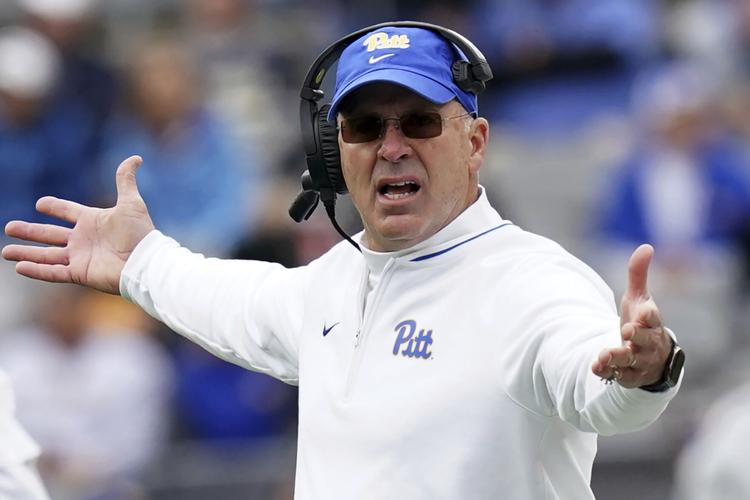
Pitt head coach Pat Narduzzi, shown vs. Clemson on Nov. 16, believes the current December logjam in college football has created “the worst recruiting calendar that’s ever been made.”
It might have something to do with the DNA most college football coaches and front-office personnel possess: They’re workaholics.
The only gripe came from running backs coach Alonzo Carter, who lamented the mandatory recruiting “dead period” that runs from Dec. 2-8 — preventing coaches from going on the road to visit prospects and attend high school championship games. In other words, more work.
The flaw in college football’s so-called offseason schedule is that, for the majority of the schools, it occurs while the season is still going. Eighty-two of the 133 eligible FBS teams still have postseason games to play, starting with this weekend’s conference title tilts and running through the national championship game on Jan. 20.
Meanwhile, the early signing period ran from Dec. 2-4, and the first transfer-portal window — the most important one — runs from Dec. 9-28.
What other sport conducts its offseason during the season?
School ties
The main reason the calendar falls this way is that inconvenient impediment known as school — specifically, the desire for incoming freshmen and transfers to enroll in winter so they can get used to their new surroundings, start training and participate in spring football. If the early signing period were nixed and we went back to the old ways — a singular National Signing Day on the first Wednesday of February — it wouldn’t be possible for freshmen to enroll in time. Likewise midyear transfers. (In Arizona’s case, the spring semester starts Jan. 15.)
College football analyst Max Browne, via social media, suggested a “grace period” that would enable newcomers to enroll in February and make up the schoolwork they missed. It’d be clunky but not impossible, especially with so much instruction now available online.
As Browne also suggested, school administrators “need to get on board with the changing times.” Football players (among others) are about to be paid directly by schools via revenue-sharing. Yet they’re still considered student-athletes and subject to the same rules as the rest of the student body. Veering away from that would put college athletics on an extremely slippery slope. One could argue we’re already there.

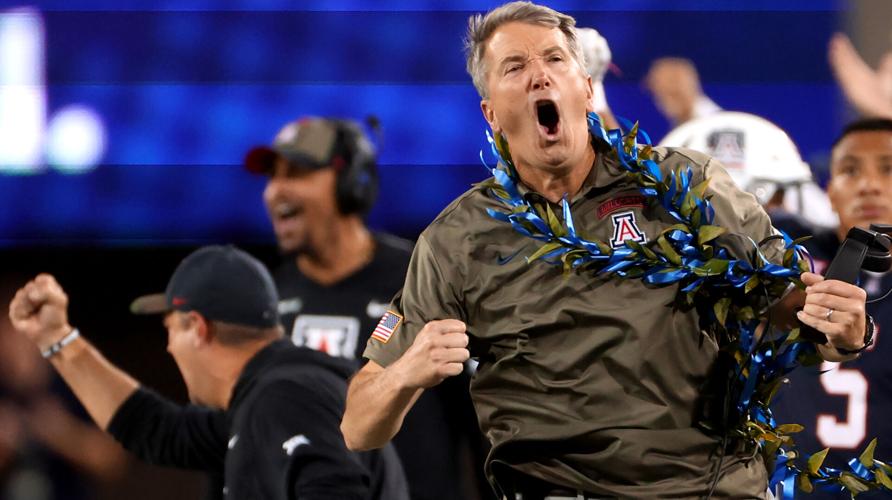
Arizona coach Brent Brennan celebrates a review that eventually ruled Texas Tech had fumbled and the Wildcats recovered in the third quarter of their Big 12 game on Oct. 5, 2024, at Arizona Stadium.
UA coach Brent Brennan views midyear enrollment as a “catch-22.” On the one hand, players such as receivers Isaiah Mizell and Gio Richardson — who signed Wednesday and will be arriving in January — get a several-months-long head start on classwork and weight training, plus 15 spring practice sessions. On the other hand, they and countless others miss out on senior prom and other activities that make the last semester of high school “magical” (Brennan’s word) and memorable.
Could college football survive without midyear enrollment? Of course. It didn’t used to be a thing. But I doubt it’s a sacrifice that coaches would be willing to make.
In a conversation with UA linebackers coach (and former New Mexico head coach) Danny Gonzales, I suggested moving at least the portal period back to either the day after the national championship game or after spring football. Gonzales quickly shot that down.

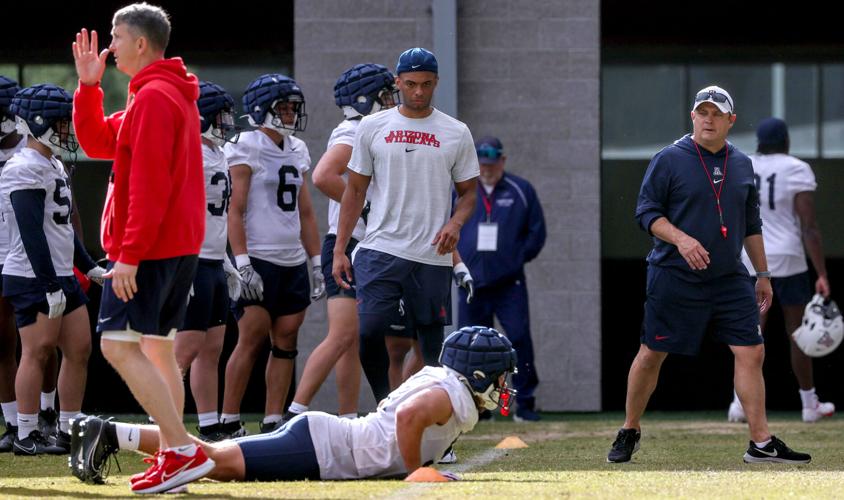
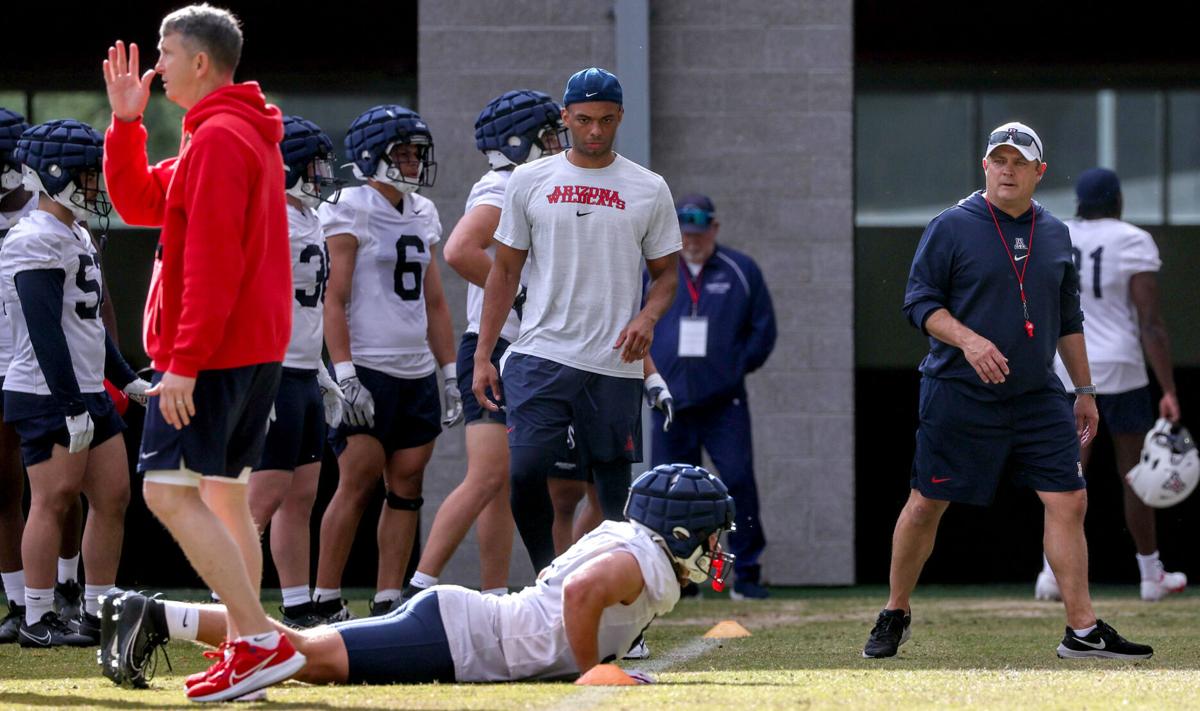
Arizona linebackers coach Danny Gonzales, far right, shown during spring football practice in March 2024.
“If you have to keep a kid until February that you absolutely know is not going to be on your roster, you’re not serving anybody,” Gonzales said. “If they know they’re not gonna be somewhere, and they have to stay somewhere, you’re gonna create a ton of problems, both amongst your current team (and) with guys that are half-in, doing nonsense. Kids that age, when they’re bored, what do they do? They get in trouble. So now you’re gonna have to deal with those issues, as well.”
Point taken. Gonzales did offer an alternative to the early signing period: Staging it before the season. Other sports, such as baseball and softball, do it this way. But it’s problematic for football, where players — in particular linemen — often develop at their own pace.
Two of Arizona’s late additions were products of senior-tape evaluation: offensive lineman Jaxon Griffin and defensive back Kason Brown.
“The senior eval to us will always be a critical piece,” Crowley said. “We evaluate every one of our commitments and tons of guys who are not committed.

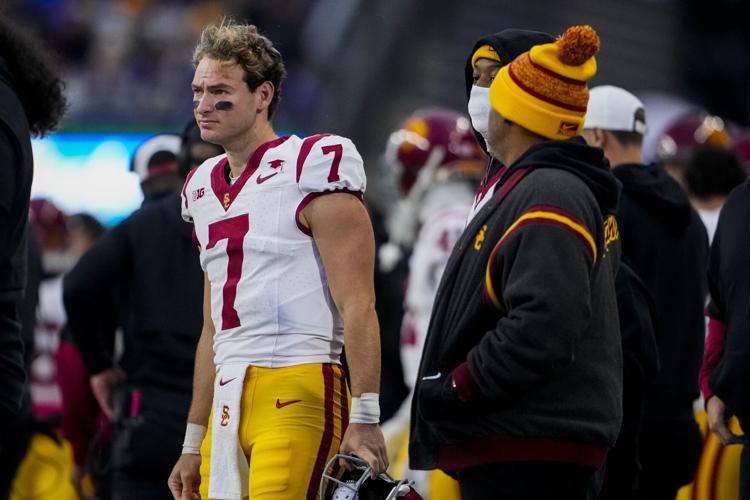
Miller Moss (7) is one of two USC quarterbacks to enter the transfer portal, leaving the Trojans with only one scholarship QB for their upcoming bowl game.
“You’ll be surprised how many guys are like that that turn out to be really good players.”
Crowley said moving the signing period to August “would be like if the NFL drafted kids a year before they were done playing.” So yeah, scratch that one.
Acceleration situation
In lieu of preseason or postseason options, we have this multicar pileup where game prep, the early signing period and the portal overlap and cause all sorts of issues. For example: USC’s second- and third-string quarterbacks have entered the portal, leaving the Trojans with only one scholarship QB, Jayden Maiava, for their bowl game.
Or how about this hypothetical: Let’s say Desireé Reed-Francois had decided to move on from Brennan. Doing so likely would have nuked Arizona’s signing class, leaving the Wildcats without a full class for two straight cycles — a devastating proposition for a school like the UA, even in the portal era.

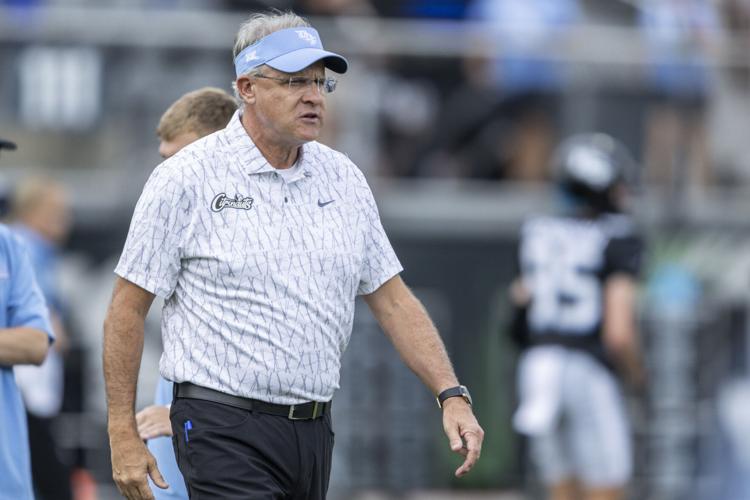
Gus Malzahn, shown during warmups before the UCF-Arizona game on Nov. 2, recently resigned, leaving the Knights without a head coach for the early signing period.
Two Big 12 schools have head coach openings. One of them is UCF, where Gus Malzahn resigned to become the offensive coordinator at Florida State. The Knights have the fewest commitments and signees of any school in the conference.
Any coaching maneuvers require an accelerated timeline because of the portal, which is akin to speed dating. Just as Arizona, in the interest of keeping the roster together, had to act fast to hire Brennan in January, so too does Brennan in hiring new coordinators with the portal floodgates about to open.
The ironic twist for programs such as Arizona that didn’t qualify for postseason play is that they’re actually at an advantage this time of year: They don’t have games to worry about.
“We’ve already had a full week of nothing but scouring some tape and having a plan ready for when Dec. 9 and 10 comes,” Gonzales said.
It’s almost like pro sports, where the worst teams get the highest draft picks. Meanwhile, other teams will be playing deep into January under the new CFP format. Any portal activity could result in bruised egos and locker-room angst among current players expecting to return next season.
Of course, Arizona isn’t striving for a less-cluttered calendar. The goal is to compete for championships or, at a minimum, to play in bowl games. Multitasking beats the alternative.
Besides, as Crowley pointed out, recruiting is never-ending. It has no offseason.
“We talk about that all the time in the office: You can’t coach or recruit; you can’t recruit or coach; you gotta do both,” Crowley said. “(It) doesn’t matter whether you’re in the summer, in July, when you got a couple days off. Recruiting doesn’t stop.”

