




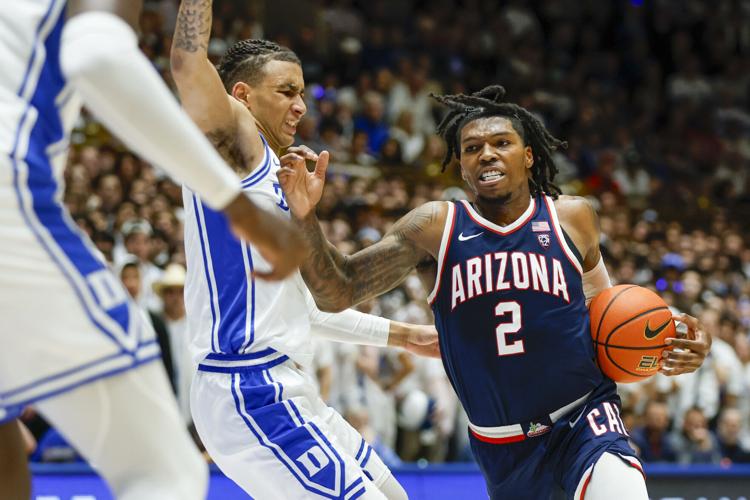

Thanks in part to his consumption of Kobe Bryant and Michael Jordan documentaries, plus two years at a New Hampshire prep school, Arizona freshman Dwayne Aristode has successfully added English to the list of five other languages he can speak.
But there was a recent moment where the words still didn’t come out easily.
“Just the connectively and … how do you say that again? Complete? What was it? Effort together?” Aristode said, trying to describe reasons behind the Wildcats’ 12-0 start after they beat Bethune-Cookman on Dec. 22.
Aristode cupped his hands together and turned toward teammate Ivan Kharchenkov for help. But Kharchenkov, a German of Russian descent, also struggled.
“I know what you mean,” Kharchenkov said.
Finally, the media audience suggested the words “togetherness” and “collective effort,” generating a wide grin and a gesture of thanks from Aristode, the Dutch forward with a father from the Ivory Coast.
“Yeah. Togetherness. And effort. Something like that,” he said. “Collective effort. … The effort we bring to each other, and the way we competed in the summer, we just want to be better every day.”
It was a notably animated moment at what are often dry postgame podium press conferences, and it spoke to what may be the central reason this group of Wildcats may be the best team yet in the Tommy Lloyd era.
The Wildcats are together in a way they have never been before under Lloyd, who had never regularly started a freshman before this season but now starts three — while meshing them and Aristode off the bench with four other rotation players who are all in their third or fourth seasons.
It’s working, maybe because Lloyd said his staff felt that the freshmen “had a sense of maturity about them,” along with competitiveness and basketball IQ.
But also because, well, that collective togetherness, or whatever you want to call it.
“I mean, we spend so much time together, on the flights, in practice, even in class, study hall … apartments ... just in this short time,” Kharchenkov said. “And I feel like we all good guys, all understand each other. I think that helps a lot.”
Together, the Wildcats have built their longest undefeated streak to start a season in a decade while knocking off five ranked nonconference teams, something nobody has done in the past 30 seasons.
The Wildcats also had strong starts during Lloyd's first three seasons, going 11-0 in 2021-22, starting 14-1 in the 2022-23 season and becoming ranked No. 1 in December of the 2023-24 season.
Still, Lloyd declined to say if he felt he might have his best, or most complete, team yet.
“There’s this thing called recency bias — everyone starts getting excited and thinking, 'What we're doing now has never happened before,'" Lloyd said. “It's happened before. It's happened before, and it's had sustained success, it’s had failure. So we just need to stay locked in our moment and not get worried about other moments. That’s my mindset.”
Others can be the judge, Lloyd suggested. So let's take a look how those three earlier Lloyd-coached teams started and finished, then compare them to what's happened so far this season ... and everyone can make their own conclusions:
2021-22
Start: 11-0
Big early wins: 80-62 over Michigan in Las Vegas, 83-79 at Illinois
First loss: Dec. 22 at Tennessee, 77-73
How it played out: Unranked entering Lloyd’s first season, the Wildcats jumped quickly onto the national scene when they beat Wichita State and Michigan to win a mini-tournament in Las Vegas. While the Wildcats played a nonconference schedule ranked only 180th by Kenpom, the good vibes they built along the way helped build a cohesive rotation and quickly washed away the dark clouds that hovered over the end of the Sean Miller era.
Impact guys: Guard Bennedict Mathurin was the Wildcats' leading scorer (17.7), while Azuloas Tubelis averaged 13.9 points and 6.3 rebounds.
Surprise development: Around the rim, center Christian Koloko averaged 7.3 rebounds and 2.8 blocks, breaking out as an NBA prospect against Michigan, with 22 points, seven rebounds and four blocks, while preseason all-American Hunter Dickinson had only 11 points.

Arizona’s Christian Koloko, left, eyes the basket while being defended by Michigan’s Terrance Williams II on Nov. 21, 2021. Koloko was named the MVP of the Main Event tournament in Las Vegas.
Rotation: The Wildcats built a rotation of eight players, the core of which rolled over from the Miller era: Mathurin, Tubelis, Koloko, shooting guard Dalen Terry and outspoken point guard Kerr Kriisa. Off the bench were Pelle Larsson, a sophomore wing transfer from Utah; Justin Kier, a senior guard transfer from Georgia, and center Oumar Ballo, who followed Lloyd from Gonzaga.
Defining stat: 65.0 – Percent of field goals made off assists (ranking second nationally).
He said it: “It’s a dangerous path to go down where you start reading your own press clippings. We’re not on Easy Street. There’s a lot of things we’ve got to get better at, and those things are going to be addressed and emphasized.” — Lloyd, after the Wildcats moved to the No. 17 ranking upon returning from Las Vegas
Top ranking: No. 2 (four weeks, Feb. 21-March 14)
How it ended: The Wildcats went 18-2 in the Pac-12, losing only at UCLA and at Colorado, then beat Stanford, Colorado and UCLA to win the Pac-12 Tournament. They were given a No. 1 NCAA Tournament seed in the South Region, beat Wright State and TCU on the first weekend of the NCAA Tournament, but lost 72-60 to Houston at San Antonio in the Sweet 16.
Final record: 33-4 overall, 18-2 Pac-12, 5-1 conference/NCAA tournaments
2022-23
Start: 14-1
Big early wins: 81-79 over Creighton (Maui Invitational final), 89-75 Indiana at Las Vegas, 75-70 over Tennessee at McKale
First loss: Dec. 1 at Utah, 81-66
How it played out: With lower expectations and a No. 17 preseason ranking after Mathurin, Terry and Koloko went in the 2023 NBA Draft, the Wildcats shot back up after sweeping Cincinnati, San Diego State and Creighton to win the Maui Invitational. Ballo, stepping into Koloko’s departed center spot, was named the event’s MVP. The Wildcats were humbled upon starting Pac-12 play at Utah the next week, losing by 17 points, but won their next eight straight and started conference play at 3-1.
Impact guys: Tubelis led the Wildcats in scoring (19.8) and rebounding (9.1) inside, while grad transfers Courtney Ramey (40.3%) and Cedric Henderson (40.2%) were both credible 3-point threats.
Surprise development: After spending two seasons at Gonzaga as a long-term project, then playing behind Koloko in 2021-22, Ballo emerged as a force around the rim. Averaging 14.2 points and 8.6 rebounds — while drawing 6.4 fouls per 40 minutes and shooting 64.7% from two-point range — Ballo was named the Pac-12’s Most Improved Player after making 27 of 34 shots in Lahaina.

Arizona center Oumar Ballo, center, holds the winning trophy after Arizona defeated Creighton 81-79 in the Maui Invitational on Nov. 23, 2022, in Lahaina, Hawaii.
Rotation: Lloyd whittled it down to essentially seven players by the end of the season, while giving spot minutes to wing Adama Bal and post player Henri Veesaar. Tubelis started at power forward but played center when Ballo was off the floor, forcing wings Henderson and Larsson to fill in at the four. Ramey, Kylan Boswell and Kriisa stayed on the perimeter.
Defining stat: 56.5 – Effective field goal percentage (giving 50% more credit for 3-pointers), ranking third nationally.
He said it: “I think we’re playing our best basketball when everybody’s having fun. The past has shown us that when everybody is smiling, that’s a huge part of our program. When we were playing against Utah, we didn’t look like we wanted to be there.” — Kriisa, after UA beat Indiana on Dec. 10, 2022
Top ranking: No. 4 (one week, Nov. 28)
How it ended: The Wildcats skidded toward the end of the season. They lost three of their final six Pac-12 games to finish in a second-place tie with USC at 14-6 in the Pac-12, four games behind UCLA. While they earned some revenge by beating UCLA in the championship game of the Pac-12 Tournament and received a No. 2 NCAA Tournament seed, they became only the 11th No. 2 seed to lose to a No. 15 seed, Princeton, in the first round of the NCAA Tournament.
Final record: 27-8 overall, 14-6 Pac-12, 3-1 conference/NCAA tournaments
2023-24
Start: 8-0
Big early wins: 78-73 at Duke, 74-68 over Michigan State at Thousand Palms, Calif., 98-73 over Wisconsin at McKale, 87-74 over Alabama at Phoenix
First loss: Dec. 16 vs. Purdue at Indianapolis
How it played out: Expectations rose when well-regarded transfers Caleb Love (North Carolina), Keshad Johnson (San Diego State) and Jaden Bradley (Alabama) — plus highly rated freshmen KJ Lewis and Motiejus Krivas — joined a returning core of Ballo, Larsson and Boswell. They shot up further when the Wildcats shocked then-No. 2 Duke at Cameron Indoor Stadium in their second game of the season, and UA justified its first week atop the Associated Press Top 25 poll by hammering Wisconsin at home before losing at a quasi-away game against Purdue.
Impact guys: A Final Four hero at North Carolina in 2021-22, then a scapegoat for the Tar Heels’ struggles the following season, Love became the Pac-12 Player of the Year while improving his shooting efficiency slightly from both two-point (50.2%) and 3-point (33.2%) and leading the Wildcats in scoring at 18.0 points a game. Ballo averaged a double-double inside to make the Pac-12’s first team.

Arizona guard Caleb Love (2) drives against Duke guard Tyrese Proctor during the first half in Durham, N.C., Nov. 10, 2023.
Surprise development: Larsson accelerated his development during his third season with the Wildcats, improving his two-point shooting to 56.8% and 3-point shooting to 42.6% while proving a versatile and tough defender who could guard almost anyone on the court. The Miami Heat were impressed enough to take him 44th in the 2024 NBA Draft.
Rotation: Lloyd went with a set starting lineup and a firm eight-player rotation all season, moving Boswell into the starting point guard role, with Love and Larsson on the wings and Ballo and Johnson starting at the two post spots. Bradley and Lewis played heavy roles off the bench while Krivas averaged 12.2 minutes as a backup center.
Defining stat: 10 – Arizona’s ranking in defensive efficiency, after offenses more notably defined the Wildcats’ first two seasons under Lloyd.
He said it: “My goal is to win all our games in March and April. I don't have a November little checklist on my thing to win all my games in November. I'm glad we're winning. It's better than losing. But it's not anything more than that.” — Lloyd, after Arizona beat Duke on Nov. 10, 2023
Top ranking: No. 1 (two weeks, Dec. 4 and Dec. 11)
How it ended: The Wildcats left some gifts behind during their final Pac-12 road swing, losing somewhat unexpectedly at Stanford, Washington State and Oregon State. They still won the conference by one game despite losing twice to the second-place Cougars, but lost to Oregon in the Pac-12 Tournament semifinals. Assigned a No. 2 NCAA Tournament seed, the Wildcats beat Long Beach State and Dayton over the first weekend but lost 77-72 to sixth-seeded Clemson in the Sweet 16 at Los Angeles.
Final record: 27-9 overall, 15-5 Pac-12, 3-2 conference/NCAA tournaments
2025-26 (so far)
Start: 12-0
Big early wins: 93-87 over Florida in Las Vegas, 69-65 over UCLA at Los Angeles, 71-67 at UConn, 97-68 over Auburn at McKale, 96-75 over Alabama in Birmingham
How it’s playing out: With a high ceiling due to its freshmen talent and strong returning core — but also a shakier floor because it is depending on freshmen much more than ever under Lloyd — the Wildcats have received significant contributions from their three freshmen starters, with freshman guard Brayden Burries joining the club by scoring 20 or more points in three of his four past games after struggling early against ranked opponents.
Impact guys: The Wildcats have their most balanced offensive team under Lloyd so far, though Krivas and backup center Tobe Awaka have anchored them with dominant rebounding.

Arizona forward Tobe Awaka (30) and Arizona center Motiejus Krivas (13) chase a rebound during the first half against Alabama, Dec. 13, 2025, in Birmingham, Ala.
Surprise development: While freshman Koa Peat drew immediate national buzz with his 30-point opener against Florida, a less-noticed move has led to valuable stability in the rotation and chemistry in the locker room — when two starters from last season’s Wildcats, Awaka and wing Anthony Dell’Orso, accepted reserve roles and began thriving in them.
Rotation: After the Wildcats’ erratic rotation helped drag them into a 4-5 start last season, Lloyd identified five starters and three reserve players immediately and has stuck with them. Bradley, Burries and Kharchenkov are on the perimeter, Peat and Krivas are inside. Off the bench, Dell’Orso has brought 3-point and clutch free-throw shooting, and Aristode has made more than half his 3s while Awaka leads the nation in defensive rebounding percentage (33.3) and is second in offensive rebounding percentage at 23.7.
Defining stat: 13.1 – Arizona’s rebounding advantage over its six high-major opponents (Florida, UCLA, UConn, Auburn, Alabama and San Diego State).
He said it: “That was four years ago. I’m a grandpa now. I wasn’t then. So lots of change. Life keeps moving. I really don’t draw any comparisons. I mean, I like this team. I like where we're at and I like where I think we can go, but we're going to have to continue to get better and stay the course to get there.” — Lloyd, when asked to compare this season to his first UA season after the Wildcats beat Bethune-Cookman on Dec. 22 to become 12-0

