

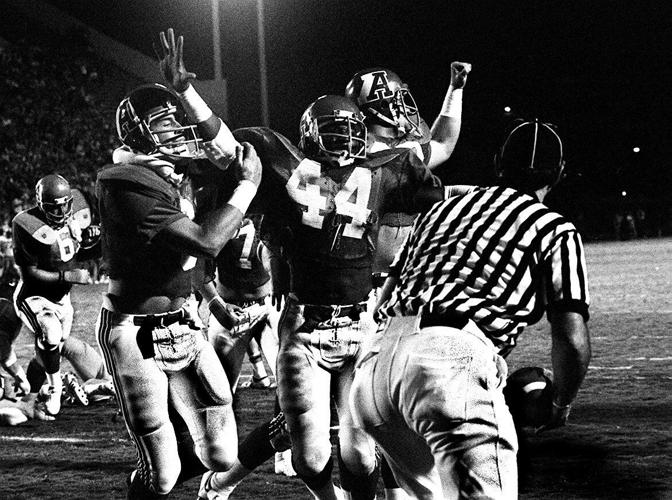

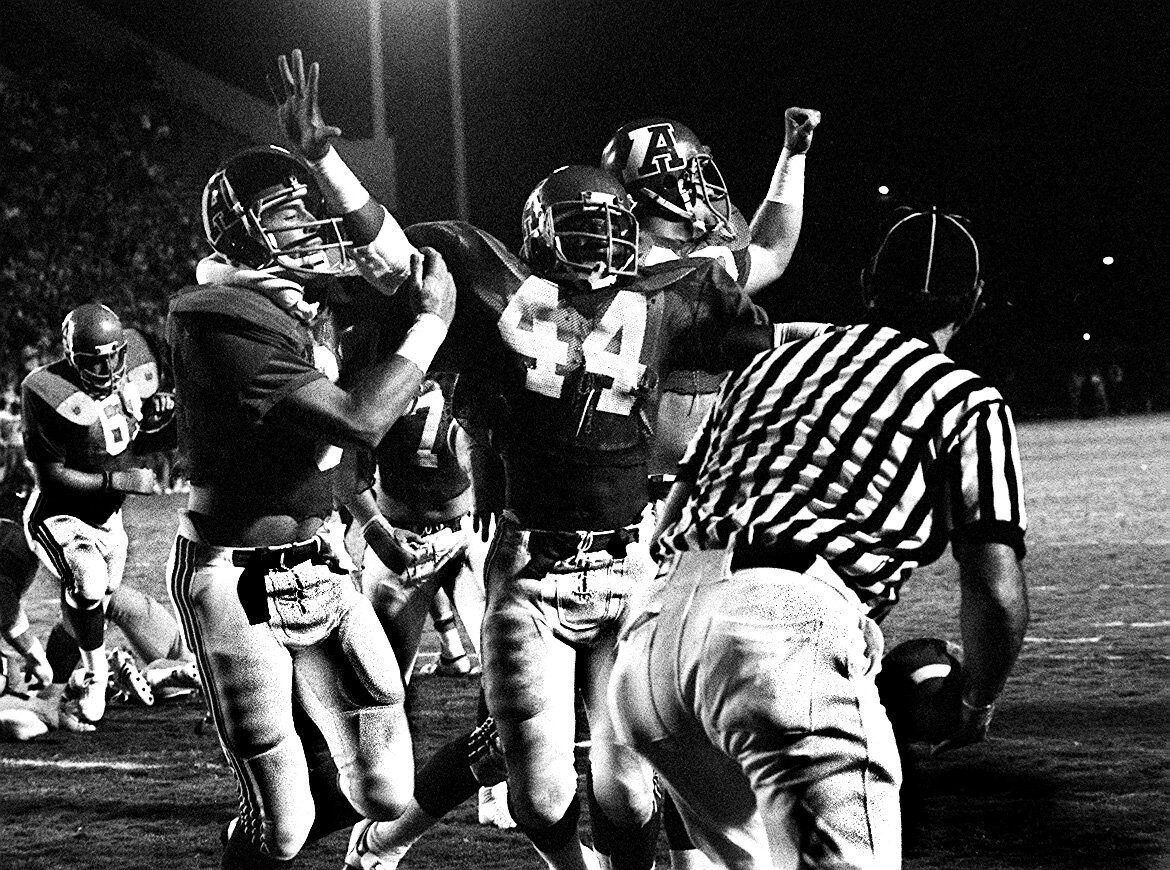
Arizona entered the Pac-10 in the fall of 1978 with not just second thoughts, but third, fourth and fifth. It went beyond butterflies. It stretched all the way to trepidation.
“Frankly, it could be a disaster,’’ the Arizona Daily Wildcat wrote a day before the Wildcats inaugurated their Pac-10 membership with a home game against Oregon State.
“This is the biggest crisis in UA sports history,’’ wrote the Tucson Citizen. “The Wildcats have to produce and we don’t think they have the stuff to do it.’’
Was the Pac-10 really that daunting? In retrospect, not even close.

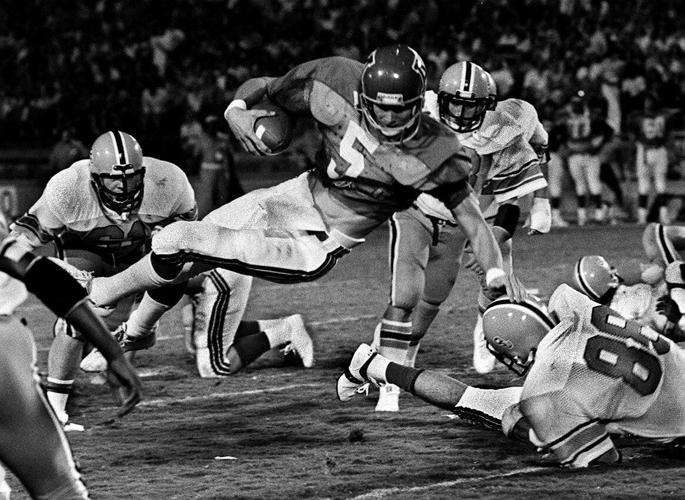
Arizona quarterback Jim Krohn (5) goes airborn during the Wildcats’ first Pac-10 Conference game at Arizona Stadium, on Sept. 9, 1978 against Oregon State.
The Pac-10’s sports image was of a terrifying series of USC football teams and the blockbuster UCLA basketball program (which, unknown in 1978, would rarely be ranked No. 1 over the next 45 seasons).
Beyond that, the old WAC conference from which Arizona and ASU abandoned was not much less than the Pac-10 in football, basketball and baseball. If it was less at all.
No one could’ve known. Such was the clout of those big initials at USC and UCLA that hid from view the soft mid-major type athletic departments of the ‘70s at Cal, WSU, OSU, Oregon and even Stanford.
The UA beat Oregon State 21-7 that night at Arizona Stadium, an age when the Pac-10 was more a true academic consortium than a collection of Top 25 sports programs, or anything close.
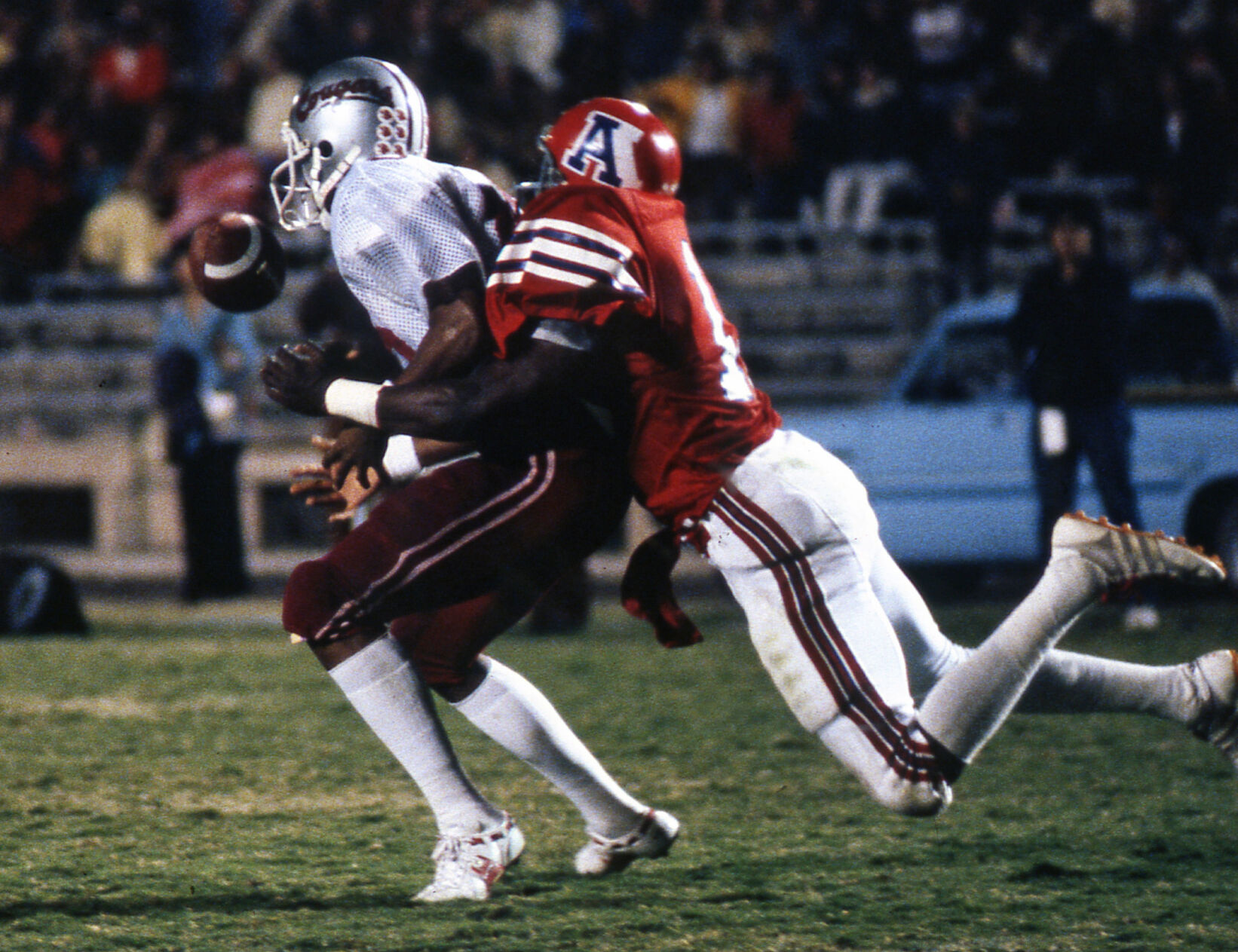
Arizona defensive back Reggie Ware knocks the football loose from the hands of Washington State receiver Mike Wilson at the one-yard line, saving a WSU touchdown during Arizona's first Pac-10 season at Arizona Stadium on Nov. 20, 1978.
Arizona’s jump to the Big 12 will be far more formidable. It may truly be a sports crisis.
Put it this way: over the past five seasons, Arizona’s basketball team is 69-15 at McKale Center, or a winning percentage of .821. That would be fifth place in the Big 12, the nation’s acknowledged basketball powerhouse:
Kansas, 73-4 (.948)
Houston, 80-6 (930)
Baylor, 68-10 (.872)
Texas Tech, 69-15 (.821)
And all four have made the Final Four in that span, with Baylor and Kansas each winning the whole thing.
The Pac-10 of the late ‘70s turned out to be a perfect time for Arizona’s jump to national consciousness. In the decade of the ‘70s, only Washington (10th in 1977), Stanford (eighth in 1970), UCLA (5th in 1975) and mighty USC (almost yearly) were ranked in the Top 10 of the final AP football poll.
“We thought the future was gonna be brighter as a member of the Big 12. … I think this is a very exciting deal for us.” — Arizona president Robert Robbins; Video by Justin Spears/Arizona Daily Star
The Rose Bowl, then one of America’s top five sporting events every year – and one of the few college football games televised nationally every season – twisted the national perspective of Pac-10 sports.
Today, by comparison, Big 12 football teams not including Texas and Oklahoma have finished in the Top 10 of the final AP Top 25 nine times in the last 10 seasons: Baylor (5th in 2021 and 7th in 2014); Oklahoma State (7th in 2021; 10th in 2016); Iowa State (9th in 2020); and TCU (2nd in 2022; 9th in 2017; 7th in 2015; 3rd in 2014).
Playing a Big 12 football team on their home turf is viewed as mayhem.
Big 12 football teams last year averaged 93 percent capacity — including 100 percent at Baylor’s McLane Stadium and TCU’s Amon G. Carter Stadium and near sell-out averages at Iowa State’s Jack Trice Stadium (57,334), Kansas State’s Bill Snyder Stadium (51,165) and Texas Tech’s Jones AT&T Stadium (56,870).
In the Pac-12, only Utah (100 percent capacity at 52,057 per game) came close to a season of sellout crowds. Overall, Pac-12 football teams averaged 61 percent capacity. Bedlam? Not here.
Arizona president Robert Robbins says UA and other Pac-9 schools were “expecting Friday morning to show up together and sign in blood our Grant of Rights over to the Pac-12 Conference.” Then a president from either Washington or Oregon notified him about their move to Big 10. Video by Justin Spears/Arizona Daily Star
Utah should fit in nicely in the Big 12, a “bring it’’ conference in football and men’s basketball, something the Pac-12 has rarely approached. At least the Wildcats should consider themselves warned they are getting into a much more competitive situation in 2024 than they did in 1978.
Why was there so much apprehension in 1978? Simple. There was rarely a chance for an eye-test. College football games on national television were almost nonexistent.
For example, on the day Arizona beat Oregon in their first-ever Pac-10 competition, Sept. 16, 1978, there were no college football games on national TV. None. No media rights money. Few coaches and administrators getting rich quick.
At 11 a.m., NBC broadcast a Yankees-Red Sox game.
At noon, ABC’s Wide World of Sports featured highlights of the previous day’s Muhammad Ali victory over Leon Spinks, and the Michigan 150 Auto Race.

At 1:30 p.m., CBS’ weekly CBS Sports Spectacular was centered around a match race behind horse racing titans Seattle Slew and Affirmed, followed by the world weightlifting competition.
The Arizona-Oregon game? It was delayed for a Sunday morning viewing on Tucson’s independent Channel 11.
In 1978, America’s three networks considered the prime time evening time slots holy grail. On that night, there was no football. ABC aired Love Boat at 7 p.m., while NBC broadcast CHIPs and CBS televised Good Times.
ESPN was a year away from existence and a decade shy of “College Football GameDay.’’ Broadcasting college football double-headers (and triple-headers) was another decade away.. Paying schools $30 million or more a year in TV rights was unimaginable.
But Arizona somehow survived on a break-even budget with no one in the athletic department — not even Lute Olson — earning $100,000 a year until the late 1980s.
In Arizona’s first five seasons of Pac-10 football, it went 18-18-1 in conference. It beat No. 1 USC and No. 2 UCLA and proved it belonged. The “disaster’’ was averted.
Now, if only they can match that in their first five years of the Texas-loaded, football-lovin’ Big 12.

