


Editor’s note: This is part of the Star’s ongoing “Big 12 Blitz” series, where we introduce U of A fans to the on- and off-field need-to-know details surrounding each member of the new 16-team Big 12. Today: The University of Houston, located in the nation's fourth-largest city.
The Star's Big 12 Blitz is presented by Tucson Appliance Company.


Tucson Appliance Company has something for everyone! We specialize in new, reconditioned, scratch-and-dent, and high-end appliances. Known for…
There’s probably nobody better qualified to introduce Arizona and Houston as new conference rivals than Fendi Onobun.
The 6-foot-6 standout athlete grew up in Houston, played basketball for Lute Olson and two interim coaches at Arizona, including in games against Houston in 2007-08 and 2008-09, then moved back to Houston for a graduate season … where he played football for the Cougars before beginning a four-year NFL career.

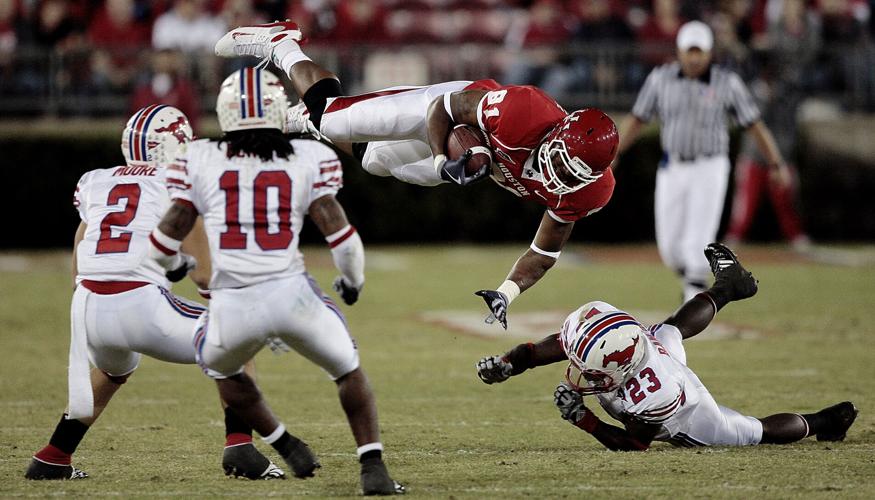
Houston tight end Fendi Onobun goes airborne amid SMU defenders working to take him down during a matchup between the Cougars and Mustangs on Oct. 24, 2009. Houston won 38-15. After four years playing basketball at Arizona, Onobun, a Houston native, took his fifth college season to an entirely different playing field — joining the University of Houston football program, which led him to an eventual career in the NFL.
He’s a veteran of both schools, and both major sports.
“To be able to go from playing one sport, kind of up and down with the coaching changes (at Arizona), to playing a completely different sport, and being able to go pro in that sport after never really playing, is just an amazing story,” Onobun said. “I’m really blessed that I was able to experience that.”
Now living back in the Houston area after an injury cut short his NFL career in 2014, Onobun has told his life story in a book entitled “Transiton: One Kid’s Bank Shot to the NFL.” He also spends his time mentoring and speaking to youth in the Houston area (for more, visit fendispeaks.org).
But Onobun will also be busy as a fan this season, saying he intends to watch the Wildcats and Cougars when they meet in person (on numerous playing surfaces) during Big 12 play. He spoke with the Star prior to the start of the current football season about both schools and his journey:
Growing up in Houston, where the university has a really long history of great sports teams, what can you say?
A: "The growth that UH athletics has had over the last decade has been amazing. When I was there in 2010, they were still part of the Conference USA, and to see them go from Conference USA to the American (AAC) and now Big 12… the growth, the success of the basketball program with coach (Kelvin) Sampson and even in football.
“Last year, they struggled, but they’ve got a good coach (Willie Fritz) coming in this year. They’re gonna have to prove themselves. But being in the Big 12, they are considered a power four school, and it does a lot for the program and for recruiting. It does a lot for the city.”

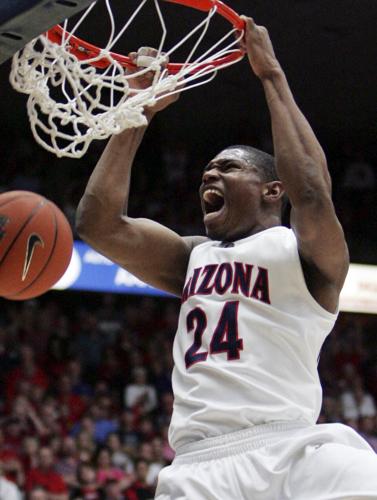
Fendi Onobun went from the hardwood in Tucson (like this February 2008 slam against USC at McKale Center) to the gridiron in Houston, providing a perpetual multi-sport link between new Big 12 foes in the University of Arizona and University of Houston.
How would you compare Arizona and Houston in terms of tradition and fan interest?
A: “It’s tough because Houston’s a bigger city, but there’s nothing like Arizona basketball. The true love for Arizona basketball is just something that I’ve never experienced anywhere. Tucson is not a big city, but they love their Wildcats. … The thing about football, there’s just more people. You’re in a stadium, 60,000 people, the crowd and the environment is so different. But like I said, man, nothing tops Arizona.”
Houston’s got a new stadium since you played, right?
A: "We played at Robertson Stadium. But now they have TDECU Stadium, which is a huge upgrade. They just got a new scoreboard. They just got a new AD (Eddie Nuñez). They’re in the Big 12 (entering their second year in the conference) now so they’re going to have to be able to compete when it comes to recruiting and things of that nature. You can see the changes that they’re making. I was actually at U of H a couple months ago watching them do some offseason practices and got a chance to talk to coach Fritz and meet some of the guys. So I’m really looking forward to what they’re going to do this year after having a tough year last year.”
Anything you’d say to Arizona fans coming to see a football or basketball game in Houston, to warn them or advise them about cool things to do?
A: "The traffic. The traffic is horrendous in Houston. But Houston is a huge melting pot. There’s a lot of great restaurants out here. The cuisine is amazing. Obviously, we’re known for our Tex-Mex, but you can find all different types of food here in Houston, especially in downtown. Around U of H, I wouldn’t say there’s too much but it’s really close to downtown and there’s a lot of things to do in downtown.
“I was really excited when I found out Arizona was coming to the Big 12 because now I get to see two schools that do have some history. We played Houston when I was at U of A.”
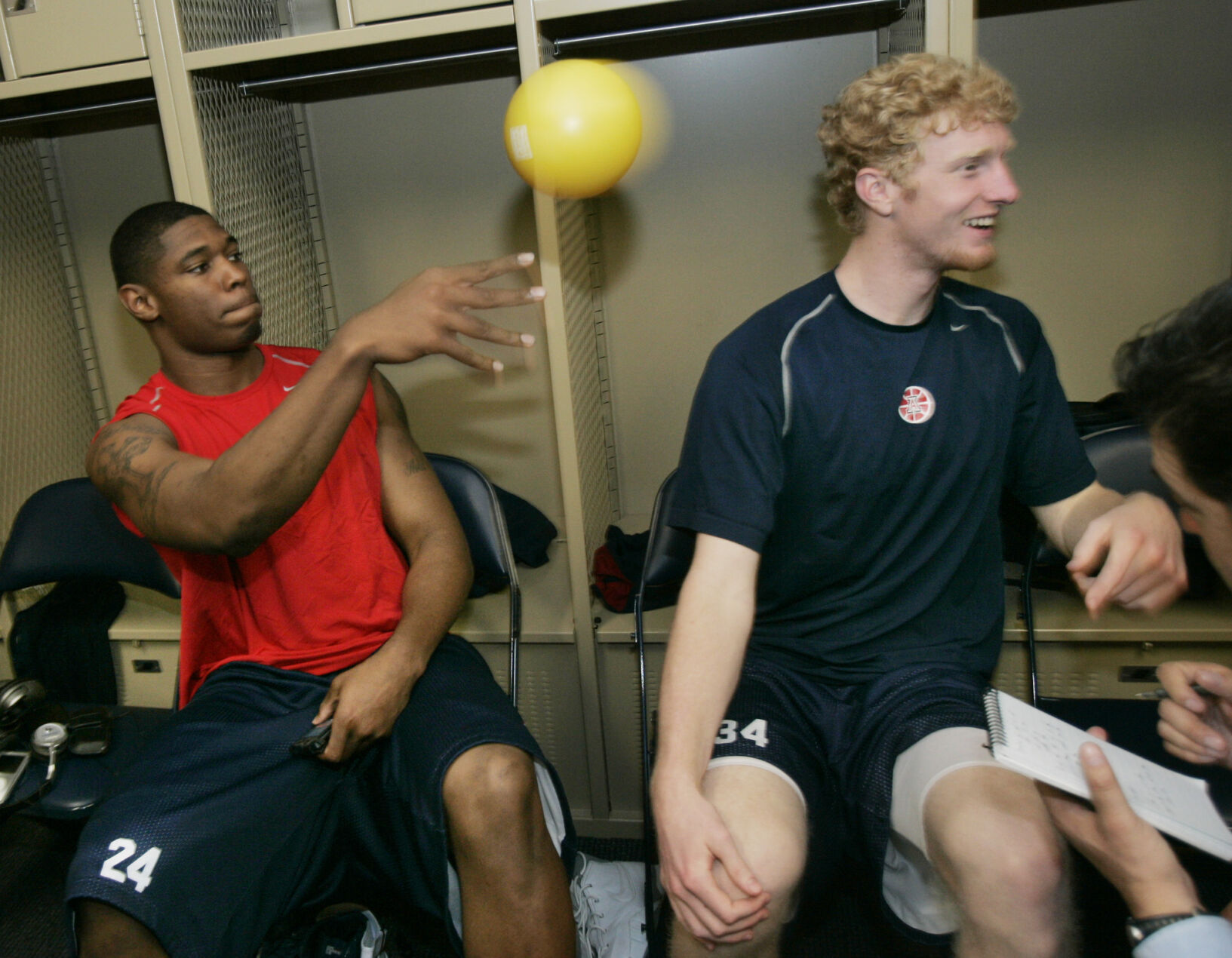
Fendi Onobun throws a ball at teammate Chase Budinger as Budinger conducts an interview in their locker room at the New Orleans Arena prior to the start of the 2007 NCAA Men’s Basketball Tournament that March. Onobun and Budinger have the distinction of being high-level athletes at multiple sports. Onobun played basketball at the UA and football at Houston and on to a multi-year professional football career in the NFL; Budinger parlayed his college career at Arizona into seven years in the NBA, before transitioning to beach volleyball. He notably competed for the United States in the Paris Olympics this past summer.
You played in those games, when they had the home-and-home (Arizona won 85-71 at Houston in 2007-08 and 96-90 in overtime in 2008-09, when future NBA Draft pick Chase Budinger’s face was infamously stepped on).
A: “Those were some wild ones. There was a lot of controversy in those games. And some of the best times. We had some good guys — Jordan (Hill), Chase and Nic (Wise). We battled through a lot. There was a lot of change taking place during those years after coach O.”
You looked like a prototypical tight end (at Arizona). Was there anything along the way (as a Wildcat) where you thought about trying football, or was it just when you finally got through your four years of basketball?
A: "It was towards the end. I never thought about football. I came to Arizona to play basketball. Arizona is one of the powerhouses in the country when it comes to basketball, so I went there to play basketball. I wanted to get my degree, and I wanted to put myself in the best position to make it to the NBA.
“Obviously, my career didn’t go the way that I thought it would, but I stuck it out, and opportunities presented themselves, and then you have NFL scouts looking at you, saying, `Hey, you look like a lot of the guys in our facility. I think you should give this a shot.’ Given the career that I had, I thought it was worth a try, and I’m glad that I did it, because who knows, if I didn’t would I be able to share this story?”

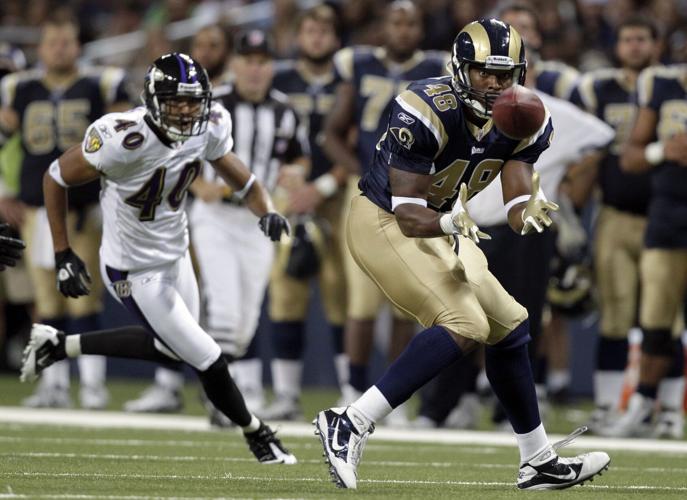
St. Louis Rams tight end Fendi Onobun — a former basketball player for the Arizona Wildcats and football player for the Houston Cougars — catches a pass for a 15-yard gain as Baltimore Ravens cornerback K.J. Gerard closes in during the fourth quarter of an NFL preseason game on Sept. 2, 2010, in St. Louis.
Was there a moment where Houston started recruiting you (for football), or how did that play out?
A: "When I graduated U of A, that was the year that coach (Sean) Miller was coming in with his staff, and I was leaving. James Whitford was one of coach Miller’s assistants, and he brought me into his office to talk to me about some of the guys that were already on the team, like Kyle Fogg, Jamelle Horne. They wanted to figure out what are these guys about? (Whitford) also wanted to know about my story and asked how he could help me transition out of school. He kind of heard about the football rumblings and one of the strength coaches, Corey Edmond, told me that there was an NFL scout that inquired about me and invited me to do a pro day.
“I was like, `Hey, why not? I’ll give it a shot.’ So I did the pro day and got some information, but I was obviously green behind the ears. I really hadn’t played football, didn’t know much about it, but coach Whitford was the one who said, ‘Hey, if you want to go play at the next level, let’s see if we can get you into a school.’ He actually called the University of Houston on my behalf and spoke to their tight ends coach, and the rest is history.”
There’s a lot to compress with your NFL experiences (Onobun was a sixth-round NFL pick in 2010 and played for six NFL teams) but was it at one of the stops where you said `I can do this,” or was it a constant learning curve?
A: “It was a lot. I’m not gonna lie. Obviously, being extremely athletic and running a 4.4 (40-yard dash) at 260 pounds was a huge advantage. So my first year, when I was drafted by the Rams, I made the 53-man roster, and I played a lot of special teams. I was able to kind of carve my spot out through special teams. But still, it was a lot to learn. At Houston, I had a small package where I really wasn’t doing too much — some backside zones, strong side zones, a few naked bootlegs and a couple of red zone plays, but nothing too strenuous.
“Then you go to the professional ranks, you get a playbook this thick and you’re responsible to know your job and do it at a high level. It was a lot of learning and catching up, playing against guys who’ve been playing the sport their entire life. They weren’t going to create a small package for me. It was my responsibility to learn the assignment and do the job, and if I couldn’t do the job, they find somebody else who could do it.
“But things really began to slow down for me when I was in Jacksonville. I had an opportunity with the Jaguars my final year, and finally, it felt like the game was slowing down, just reading different defenses and coverages and understanding assignments and blocking techniques. But that was the year that I ruptured my quadricep tendon and then my career was over. I felt like it ended before it started. But I was really grateful to have that experience and say that, `Hey, I can wear that badge, and say I was one of the guys that got the opportunity to play in the NFL for three years.”

