



No matter how you spin San Diego State’s inspiring run to the Final Four, inviting the Aztecs to join the Pac-12 is something that never would’ve been considered at this time a year ago. Never, never, never.
Never times 12.
A year ago at this time the Aztecs were coming off back-to-back seasons ranked Nos. 106 and 105 in the Learfield Directors Cup standings, the measure of an NCAA athletic department’s all-around success in men’s and women’s sports..
How good/bad is that? Grand Canyon was 102nd in 2021, and Southern Utah was 101st in 2020.
Few would have suggested San Diego State was a competitive fit for the Pac-12.
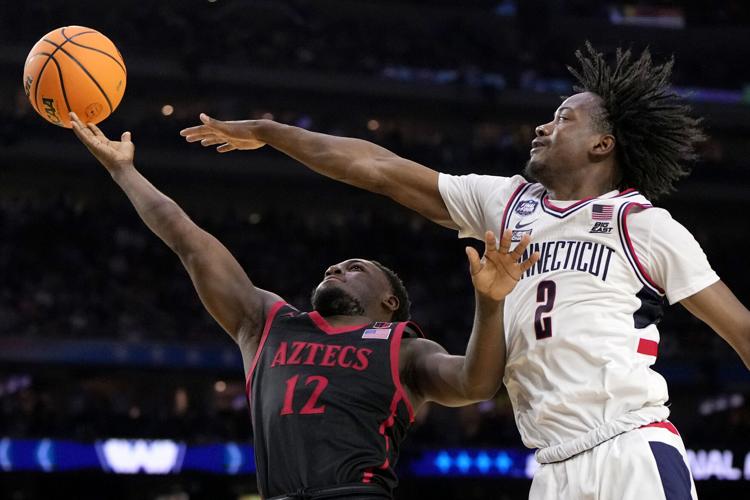
San Diego State’s appeal in college sports is (a) its climate and (b) a borderline Top 25 men’s basketball program that often filled all 12,414 seats at Viejas Arena, something rare to the Pac-12.
Borderline Top 25? The Aztecs finished in the AP Top 25 just three times in the last nine seasons.
But once UCLA and USC announced plans to bolt for the Big Ten, San Diego State’s stock shot into the stratosphere. The Aztecs’ SoCal footprint — geography and the potential to add more than a million TV sets to the Pac-12’s inventory — overcame their status as a school whose athletic department can’t match the overall year-to-year success (or lack thereof) at Oregon State and Washington State.
This isn’t meant as a protest to SDSU’s seemingly inevitable invitation to join the Pac-12. But once you get past men’s basketball, the Aztecs are lacking in athletic credentials.
The school has never won an NCAA championship in anything. SDSU would be replacing two schools, UCLA and USC, who both won more than 100 NCAA championships.
The Aztecs have never qualified for baseball’s College World Series.
They’ve never played in softball’s Women’s College World Series.
They’ve reached the Sweet 16 in women’s NCAA Tournament basketball once.
How in the name of Art Linkletter will San Diego State become competitive in soccer, swimming, golf, tennis, volleyball and gymnastics, sports in which the Pac-12 has won more than 300 NCAA men’s and women’s championships?
Art Linkletter?
Linkletter is the most famous letter-winner in San Diego State history. From the 1950s through the 1970s, Linkletter was an American household name, an uber-successful radio and TV personality who happened to be a three-year starter on SDSU’s basketball teams of the 1930s.

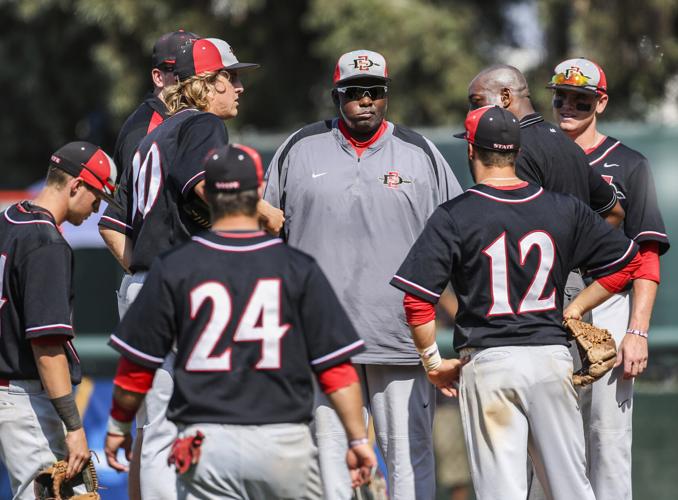
Although the late, great Tony Gwynn played for and coached at San Diego State, the Aztecs baseball team has never reached the College World Series.
San Diego State hasn’t produced an abundance of sports Hall of Famers, although Tony Gwynn, Marshall Faulk and Don Coryell offer instant historic credibility. The most prominent Aztec I ever met was golf’s Gene Littler, the 1961 U.S. Open champion who won 29 PGA Tour events.
Why am I telling you this? When Tucson hosted the Seiko World Match Play championships in the 1980s, I interviewed Littler on the putting green at the Randolph Golf Complex. He told me about a putter he had invented that might revolutionize putting.
A day later, Littler walked into the media room and gave me one of his new putters. It was a backward putter. Littler’s manufacturer labeled it the “Basakwerd’’ putter. Predictably, it flopped.
I think there are elements of the Basakwerd putter in the move to add San Diego State to the Pac-12.
In football, the Aztecs are 29-81-4 against the Pac-12, and 1-23-4 against UCLA and USC, the teams they would be helping to replace.
Even in their signature sport, men’s basketball, the Aztecs are 65-150 against the Pac-12, including 7-25 against Arizona. with a winning record against just one team, Cal, 7-6.
Baseball? The Aztecs haven’t been ranked in Collegiate Baseball’s final Top 25 poll since 1990.
So I ask: How does adding San Diego State to the Pac-12 make it anything but dilutive to the overall product (sunshine and TV sets not included)?
History suggests that when you expand, you pursue excellence.

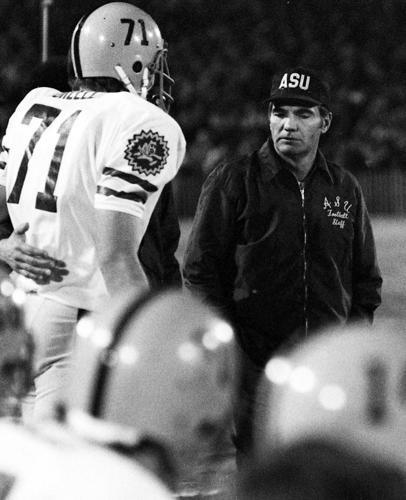
ASU head coach Frank Kush during the Arizona vs. Arizona State football game on Nov. 30, 1974. The Sun Devils had multiple seasons with double-digit wins before joining what became the Pac-10.
When the Pac-8 added Arizona and ASU in 1978, the Sun Devils were probably one of America’s 10 leading athletic programs. In football, the Sun Devils went 90-28 in the ‘70s with seasons of 12-0, 11-0, 11-1, 11-1 and 10-2. ASU had won baseball’s College World Series in 1965, 1967, 1969 and 1977.
In track, ASU won the 1977 NCAA championship and had finished No. 3 and No. 5 in the previous four years.
To its everlasting good fortune, Arizona, which couldn’t match ASU’s sports excellence, tugged on the Sun Devils’ shirt tails to get upgraded from the WAC to the Pac-10.
When the Pac-10 expanded again, in 2011, adding Colorado and Utah, it again improved the competitive product.
Utah had not only gone to three Final Fours and often averaged more than 13,000 fans per home game, it had finished No. 2 in football’s final AP Top 25 in 2008 (at 13-0) and No. 4 in football’s 2004 final Top 25 (at 12-0).
Colorado’s football résumé was inviting: The Buffaloes had won the 1990 national co-championship and finished in the AP’s final Top 25 poll 10 times from 1989-2002.
CU’s Ralphie the Buffalo gave the Pac-12 tradition and profile that the conference won’t be able to duplicate if it adds San Diego State.
True, the Aztecs have a remarkable new football facility, Snapdragon Stadium, and a reasonably good football program that will nonetheless be challenged to keep up with OSU, WSU and even the Arizona schools.
And it now has a legit. on-the-map men’s basketball program. It’s not UCLA. It’s not Pauley Pavilion. But it is better than a Basakwerd putter.
The NCAA tournament National Championship featured another dominant win from the UConn Huskies for the program's 5th title since 1999. Check out the best moments of the March Madness Mania here.


