







Editor’s note: This story originally ran on Aug. 3, 2025. We’re republishing this story with an update on athlete Skylar Sieben as the Milano Cortina Winter Olympic Games begin on Friday, Feb. 6.
Life has changed for former University of Arizona track and field athlete Skylar Sieben since the Arizona Daily Star caught up with her last summer.
Late last month, the former heptathlete-turned-bobsledder was named to the Canadian Olympic Team ahead of the Milano Cortina Winter Olympic Games, which kick off on Friday.
“Making the 2026 Olympic Team was a dream come true,” Sieben told the Star in a statement. “I felt a range of emotions: happiness, excitement, pride and also relief. It was such a long season and I’d been tested in ways, both physically and mentally, unlike ever before. I knew all season long I had to be diligent and patient. To know that all the hard work I had put in in both offseason and competition season paid off, I am so excited for what’s ahead this February.”
Ahead of the competition, Sieben is excited about living in the Olympic Village and walking in the Opening Ceremony with her fellow Team Canada athletes.
While competing on the world’s largest stage can be nerve-racking, Sieben told the Star she’s going into the Olympic Games feeling grateful.
“I know this is an opportunity not many get to experience, so I’m going into it with a mindset of gratitude and trying to enjoy every single moment of it,” she wrote in her statement. “It’s easy to start to feel nervous before big competitions, especially the biggest one of all, but I know if I keep the same mindset, I’m going to enjoy every aspect of it.”
The two-woman bobsleigh events take place on Feb. 20 and 21, with the medal event occurring on Feb. 21.
Before the Olympic Games officially start this week, Sieben had one last message to Tucson:
“From the bottom of my heart, THANK YOU! I truly could not have accomplished one of my lifelong dreams without the support and encouragement from everyone back home throughout my journey,” she said. “Whether it’s summer jobs, or training venues, or words of advice or encouragement when I was down, or simply people interested in hearing my story, every single person has played a small part in me achieving this goal.”
To learn more about Sieben’s journey to the Milano Cortina Winter Olympic Games, see the original story below.
A few years ago, when Arizona pole vault coach Dominic Johnson told then heptathlete Skylar Sieben she should be a bobsledder, she thought it was a joke.
Every time Johnson told her, “You’re a bobsledder, you’re a bobsledder,” she would shrug it off and laugh.
Bobsled, also known as bobsleigh, had never been a part of “the plan” or even a second thought in the mind of the UA track star and U.S.-Canadian citizen.
But the quips became a years-long running joke between the two, who didn’t directly work with each other but were a part of the larger UA track and field program.
It was a running joke until one day, it wasn’t.
During her last year of studying for her Master’s degree, bobsledding became a possible reality for Sieben when Johnson went behind her back and contacted the Canadian Bobsled Federation, known as Bobsleigh Canada Skeleton, on her behalf.

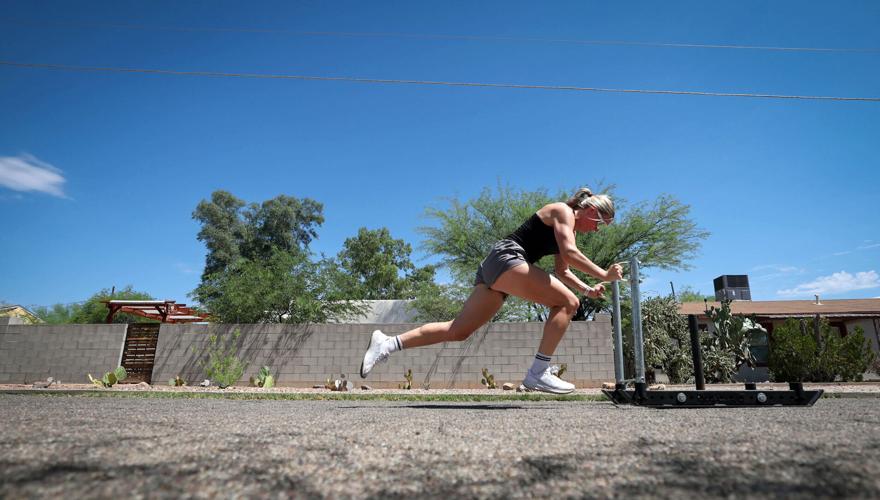
Skylar Sieben, former UA track and field athlete, pushes a sled down the road during a morning training session in Tucson on July 19, 2025.
“I said, ‘Hey, I’m a track coach down at Arizona, we have a Canadian athlete and I think she’d be amazing for it,’” says Johnson, who raced bobsled at a national level for two seasons. “At the time, they responded, and they reached out to her, but she still had a year of graduate school, and she had told them, ‘Well, I’ll get back to you in a year.’”
And she did.
What happened following graduation and numerous emails and conversations can only be described as a whirlwind.
Sieben declined a teaching job in Tucson, went to Canada to participate in a combine-style program called RBC Training Ground and then found herself on the Canadian national bobsled team as a brakeman (the person behind the sled’s pilot who is responsible for starting and stopping the sled). Along with her rookie year, the team was being filmed for a reality TV show in Canada that premieres next year.
“Everything went really fast and the next thing I know is I’m on the World Cup circuit,” she says.

Skylar Sieben, former UA track and field athlete, sits in her car to rest between sets during a morning training session in Tucson on July 19, 2025.
After bobsledding in places like Germany, Switzerland, Austria and Latvia last season, Sieben is back in Tucson training for her next journey: trying to make the Canadian Olympic team for the 2026 Winter Olympics in Milan and Cortina d’Ampezzo, Italy.
But how exactly does one train for a winter sport in Tucson? A place with no ice, no bobsled track and no temperatures below 90 degrees in the summer.
With a little innovation, of course.
Pushing her way to the Olympic podium
When Sieben is training in Tucson, there’s a good chance you’ll find her every weekend in front of her home near the university, pushing an all-metal prowler sled, mimicking the start push-off of traditional bobsledding.
As she goes back and forth with the makeshift bobsled on the street in her neighborhood, the sights and sounds of metal pushing along the asphalt leave her neighbors and those passing by curious.
She’ll get the occasional person stopping by and asking, “What are you training for?” To which she’ll reply excitedly, “Canadian bobsled,” before getting back to her training regimen.

Skylar Sieben, former UA track and field athlete, pushes a sled down the road during a morning training session in Tucson’s sweltering temps on July 19, 2025.
She spends a few hours doing the sledding routine in addition to at least four days a week of lifting sessions and working on her speed at the track.
When she’s in Canada, she spends a lot of her time running maintenance on the 600-pound sled and practicing sliding on an actual track.
Strength and speed are just two components needed to be a successful brakeman. But even then, no amount of speed and strength training could prepare you for your first run in the sled.
Sieben still recalls the feeling of her first time going down the track — a sensation she describes as being in an “industrial drying machine and put on the spin cycle.”
For reference, speeds can often reach 80 mph and above, causing the sled to pull 5Gs on turns.
“My first rundown on my start was the most wild thing I’ve ever experienced in my life,” she says. “I couldn’t explain it to anyone. It was just so insane, nothing like preparing for that. It was so loud and rough. And I don’t know what I was expecting, but I was like, ‘I see why people pack up and head out.’ It is so freaking terrifying.”

Skylar Sieben, right, poses with Canadian bobsleigh teammate Cynthia Appiah.
She’s slowly become more comfortable in the sled over the last year, partially thanks to her sledding partner and pilot, Cynthia Appiah, who has spent 10 years competing around the world.
Sieben was ecstatic to officially join the team and be a brakeman for Appiah.
“I was like ‘Holy crap, I’m going on the floor with her? I’m braking? This is going to be a crazy season,’” Sieben says. “When she fully was like, ‘Hey, Skylar, I want you to brake for me,’ I couldn’t even answer the message for like, four hours because I was like, ‘Oh my God. I’m in it. I’m not going back to Tucson. I’m spending the whole season on the road.’ And it was so terrifying. But this is probably the coolest thing I’ve ever done.”
It’s been a wild ride, but Sieben isn’t slowing down anytime soon.
Before the new season kicks off in October, Sieben expects to go between Tucson and Calgary, Canada, where the team trains, at least four times.
Once the season launches in mid-October, she’ll once again find herself around the world competing in seven World Cup competitions leading up to the Winter Olympics in February.

Skylar Sieben, former UA track and field athlete, pushes a sled down the road during a morning training session on July 19, 2025, in Tucson.
She’ll find out if she makes one of three starting brakeman positions on the Canadian Olympic team in January.
However, the cost of being an Olympian is high — mentally, physically and financially.
Training for gold takes a lot of green
Joining the Canadian national bobsled team costs around $30,000 a season, according to Sieben.
Through team fees, travel, food and any other necessities while training, the expenses add up quickly. The Canadian Athletes Now organization, which helps fund Canadian athletes in their ventures, estimates that bobsled equipment costs alone are over $3,000 a year.
Fortunately, Sieben had a sponsor last season that helped her offset some of the costs.
But this upcoming season, including the possibility of making the Olympic team, Sieben says that she’s expecting costs to triple and there are not many funding resources readily available to help.

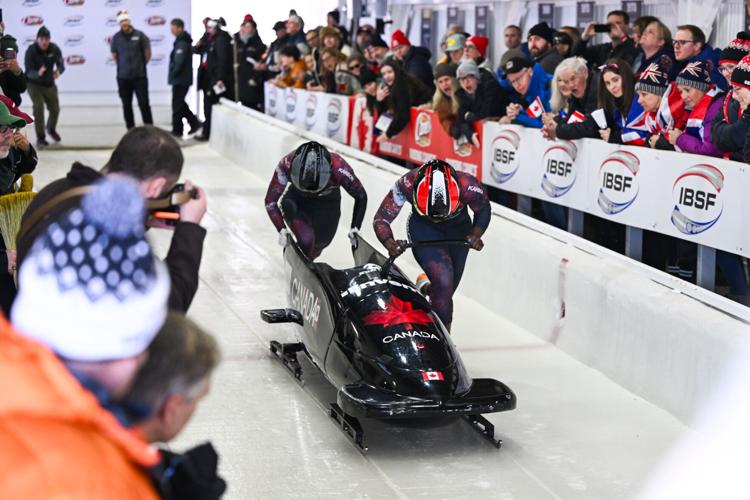
Skylar Sieben, back, pushes a bobsled during a run. Sieben hopes to make the Canadian Olympic team for the 2026 Olympics.
Bobsled, like many winter sports in Canada, is extremely underfunded.
While there have been some funding initiatives in Canada, like the “Canadian Olympic and Paralympic committees lobbying on behalf of national sport organizations for a $104 million increase in annual core funding” in 2024, the CBC reported earlier this year, “The money was not forthcoming, although athletes received a 23% increase in their monthly Athletes Assistance Program (AAP) checks.”
Bobsleigh Canada Skeleton’s CEO Kien Tran told the CBC that bobsledders put anywhere between $20,000 and $60,000 of their own money toward the sport each season.
“If I could sum it up, because of this lack of funding, sports in Canada is becoming just pay to play,” Tran told the Canadian news outlet. “It falls on the athletes. You may be not be getting the best athletes. You may be getting the best athletes that can afford this.”
Even her sledding partner, Appiah, shared with the CBC the financial struggles she faces of being an athlete, stating that she has to couch surf when training in Calgary and drives a car with rusty wheels and over 200,000 miles on it.
“No one really makes money (doing this),” Sieben says. “We just hope to break even.”
Built for ice, fueled by fire
Sieben began taking track and field seriously during her time at Cochrane High School in Alberta, Canada.
That passion for the sport led her to the UA, where she remained devoted to track and field until something happened that happens to many athletes — that spark slowly fades.
She wanted to stay in sports, especially after graduation, but she wasn’t sure what route to take.
But the stars kind of aligned for Sieben and her future when she had to participate in one of UA track and field’s mid-season tests while still in school.

A peek at Skylar Sieben, back, in action during a bobsled run.
The test included a backwards overhead shot put throw to test the athletes’ power.
When Sieben made that throw, it was the moment her future would change forever — and a half-joking running joke would develop — she just didn’t know it yet.
“I can specifically remember watching her do this one throw, and on that throw, I was like, ‘Oh my gosh, this girl’s a bobsledder,’” Johnson says. “Because to be a bobsledder, it’s just the right combination of speed and power and I just remember thinking, ‘Oh my gosh, this is it, she would be so good at this sport.’”
The change of sport, pace and challenge created a new spark within Sieben, one that would fuel the fire to make the Olympic team and represent Canada, her family and community, both in Canada and Tucson.
“Just having that little shimmer inside of you and that love for a sport, I think it changed everything,” Sieben says. “And competing at the highest level means so much. And I think it just fulfilled all those dreams that you have as a kid and I continue to have, which I felt like I lost for good and now … It means so much to me and my community and everyone (who) just supported me over the years.”

