





Editor’s note: This continues the Star’s ongoing “Big 12 Blitz” series, where we introduce U of A fans to the on- and off-field need-to-know details surrounding each member of the 16-team Big 12 Conference. Today: a special double edition, touching on rivalry shared by ASU Sun Devils and the hometown U of A Wildcats.
The Star's Big 12 Blitz is presented by Tucson Appliance Company.


Tucson Appliance Company has something for everyone! We specialize in new, reconditioned, scratch-and-dent, and high-end appliances. Known for…

is the longtime sports columnist for the
Arizona Daily Starand
Tucson.com.
On Halloween evening, 1932, the first time Arizona and ASU met in Tucson as Border Conference football members, Star columnist Chuck Kitner added a perspective that has lasted for 92 years.
“For the first time,’’ he wrote, “the little Salt River valley school, boasting only 1,000 students, is truly a respectful foe.’’

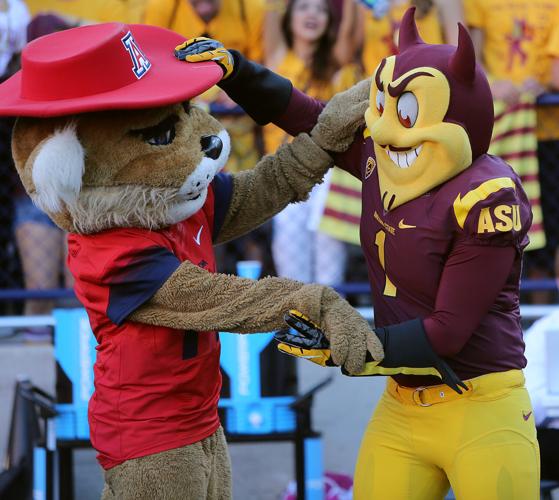
Wilbur and Sparky spar a bit as their respective teams battle it out for the Territorial Cup in the second half of a football matchup on Nov. 28, 2014 at Arizona Stadium. Arizona won that one, 42-35.
Gate receipts at Arizona Stadium, which normally averaged $500 per game, soared to $4,000.

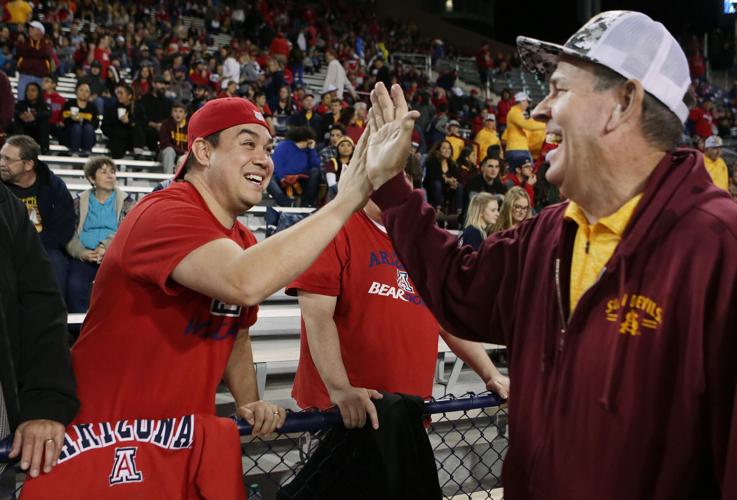
Arizona alum Chris Chavez, left, sets aside differences to high-five a passing Arizona State fan before the Wildcats and Sun Devils meet in a Territorial Cup football game in Tucson on Nov. 25, 2016.
Bingo.
The Wildcats and Sun Devils have since been in lockstep, inseparable partners in all sports, a fascinating journey that has taken them from the Border Conference to the WAC to the Pac-12 and now, to the Big 12. Back on Friday, Aug. 2, the teams’ officially onboarded to their new league.
You could write a book — good times, bad times — about their partnership.
April, 1931, Pioneer Hotel, Tucson: Representatives of Arizona, ASU, NAU, New Mexico and New Mexico State met for two days to form the Border Conference.
“It will add a great deal of athletic prestige to this section of the country,’’ said UA representative A.L. Slonaker. “It will also gain us a great deal more publicity.’’
January, 1960, Gilhooley’s Restaurant, New York City: Representatives of Arizona, ASU, BYU, Utah, New Mexico and Wyoming met during the NCAA Convention to form the Western Athletic Conference.
“We’ve had talks for 2 ½ years,’’ said UA athletic director Dick Clausen. “There is explosive growth in these (WAC) cities.’’

Fans and players try to get their hands on the Territorial Cup after Arizona State faced Arizona in a football matchup at Arizona Stadium on Nov. 25, 2022.
December, 1976, Fairmont Hotel, San Francisco. Representatives from Arizona and ASU met with the presidents of the Pac-8 Conference, who voted unanimously to add the Wildcats and Sun Devils to the league.
“We feel we have much to gain by adding the two Arizona schools,’’ said Stanford dean of students James W. Lyons. “It improves the destiny of all of us.’’
It wasn’t always easy. The UA-ASU partnership encountered significant resistance, sometimes internally.
In 1931, UA president H.L. Shantz doubted that creation of the Border Conference would “foster progress.’’ Shantz cited “tramp athletes’’ and “righteous isolation’’ as negatives to forming a partnership with any school. Shantz was against adding the Tempe State Teachers School, then known as the Bulldogs. Fortunately, a persuasive, pro-conference Pop McKale, the UA athletic director, prevailed.
In 1976, ASU football coach Frank Kush and Sun Devil athletic director Fred Miller publicly opposed a move to the Pac-8. “We’ve got everything here that we need,’’ said Kush, citing overflow football crowds at Sun Devil Stadium, and nationally-prominent baseball, track and men’s basketball programs.

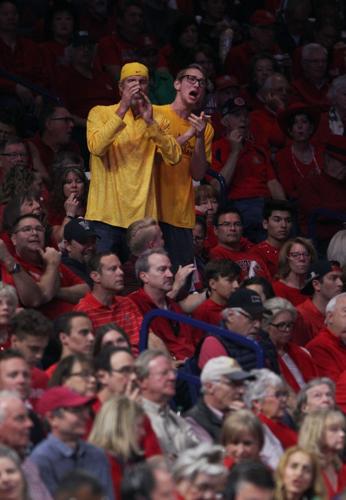
A pair of Arizona State fans cheer on their team during the first half of the Sun Devil men’s basketball matchup against the Arizona Wildcats on March 9, 2019, at McKale Center in Tucson.
Dick Smith, president of the UA Alumni Association, disagreed. “We know we’ve outgrown our own league,’’ he said.
A few weeks later, Washington president John Hogness said he would not vote to add Arizona and ASU, citing “academic deficiencies.’’ The Pac-8 required a unanimous vote to expand. At the 11th hour, influenced by Washington athletic director Mike Lude, Hogness changed his vote.
Welcome to the Big Time.
Oh, what a ride. The Sun Devils and Wildcats, together forever, march into the Big 12 with one of America’s everlasting rivalries. Given the never-ending spice between Tucson and Tempe, iIt would be unimaginable for them to go solo.
Spice?
Football: Arizona is 633-499-33 overall. ASU is 635-427-24. That’s about as close as you can get. The Territorial Cup is even closer: Arizona leads by a bare 51-45-1.
Baseball: ASU has won five NCAA championships, Arizona four. Perhaps the greatest game, any sport, ever played in UA-ASU history was at the 1976 College World Series. Arizona stunned the No. 1 Sun Devils in the semifinals.

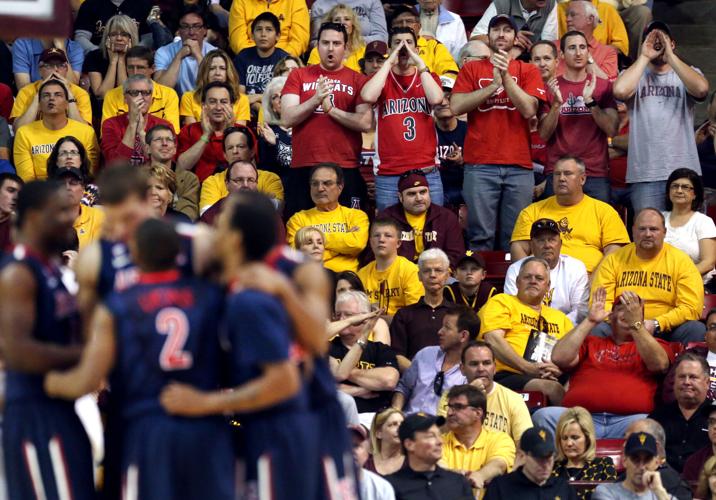
A group of Arizona fans cheers on their team during the first half of the UA men's basketball matchup against Arizona State on Jan. 19, 2013, at what was known then as Wells Fargo Arena in Tempe.
Two days later Arizona won its first of 22 national championships, all sports. Not that ASU quietly went away; the Sun Devils have won 23 NCAA championships.
True, Arizona has dominated its men’s basketball rivalry with ASU (161-86), but ASU has ownership of the women’s basketball rivalry (66-41).
The give-and-take has been sustainable. When Arizona won eight NCAA softball championships, the Sun Devils came off as irrelevant. But since then, ASU has won two national titles itself — Arizona zero — and lead the Wildcats 21-20 overall since 2011. That was unthinkable 15 years ago.
Each school has an answer for the other’s boasts.
Arizona has golf superstar Annika Sorenstam. ASU has Phil Mickelson.
Arizona has a statue of Lute Olson at McKale Center. ASU has a statue of Frank Kush at Sun Devil Stadium.
Arizona has baseball Hall of Famer Trevor Hoffman. ASU has Reggie Jackson.
Arizona has the “Bear Down’’ legacy of former quarterback Button Salmon. ASU has the legacy of Pat Tillman, his retired jersey No. 42, and the Tillman Tunnel.

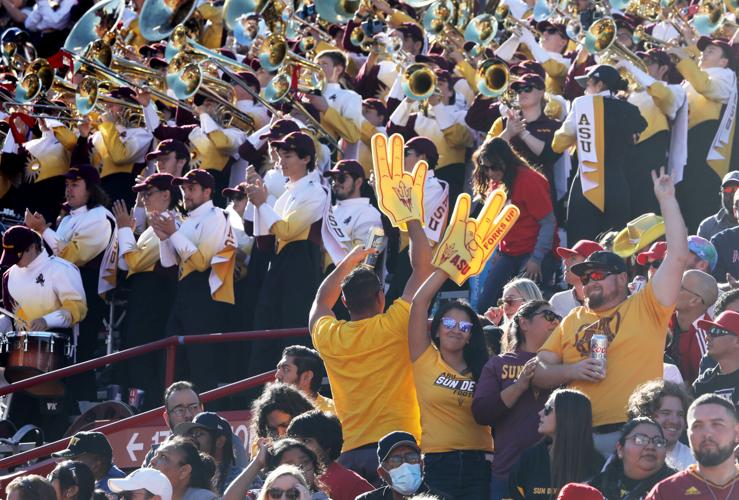
ASU fans celebrate a touchdown during the Sun Devils' football matchup with the rival Arizona Wildcats in Tucson on Nov. 25, 2022.
The Big 12 is blessed with juicy, historic, national-level rivalries: Kansas v. Kansas State. Texas Tech vs. Baylor. Utah v. BYU. The addition of Arizona-ASU won’t be muted just because it is no longer played to a Pac-12 After Dark audience.
In fact, it is likely to grow in the public mind. Mega-Big 12 cities in Houston, Cincinnati and Orlando, Florida will notice. West Virginia, Houston, Colorado, Iowa State and Oklahoma State don’t have a conference rival to match Arizona-ASU.
No longer will the Territorial Cup regularly get overshadowed by the Apple Cup, the old Oregon-OSU Civil War and whatever USC and UCLA call their rivalry.
When Arizona and ASU helped to create the WAC in 1962, commissioner Paul Brechler said one of the reasons for creating a new league was because of the “explosive growth of our western cities.’’
“Our schools are boomers,’’ said Brechler.
Many will view Arizona and ASU as the Big 12’s most visible, most accomplished schools. Together, they are a boom-boom package.

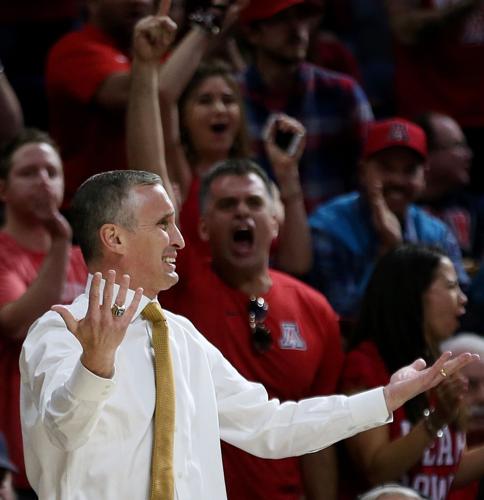
ASU men's basketball coach Bobby Hurley looks for an official's intervention as Arizona fans roar during the first half of the No. 17 Wildcats matchup against the No. 3 Sun Devils on Dec. 30, 2017, at McKale Center in Tucson.

