


The Pac-12 implemented a Most Improved Player of the Year award in 2009, which was far too late to put a deserving perspective to the careers of eight Arizona players who would surely have been MIPs during their Wildcat days.
Allow me to atone for the Pac-12s tardiness by putting into print the names of eight Wildcats who left school without a deserved MIP trophy:
Steve Kerr, who went from a 7.1 points-a-game scorer to 14.4 in his career.
Anthony Cook, who went from 6.1 points to 17.5.
Jud Buechler, who went from 4.7 points to 14.9.
Khalid Reeves, who went from 8.1 points to 24.2.
Damon Stoudamire, who went from 7.2 points to 22.8.
Miles Simon, who went from 8.9 points to 18.4.
Jason Terry, who went from 3.1 points to 21.9.
Luke Walton, who went from 5.7 points to 15.7.
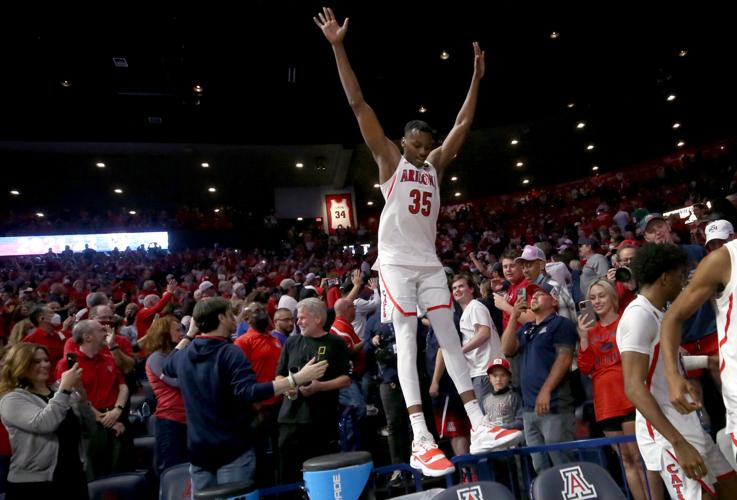
I bring this to your attention because UA junior center Christian Koloko is likely to be announced as the Pac-12’s MIP Tuesday, although there is a possible snag: Washington senior Terrell Brown Jr. led the league in scoring this season with 21.7 points per game, but the former Wildcat really didn’t improve as much as he got an opportunity to shoot a lot on what had been a really bad UW team.
Two years ago, Brown averaged 20.8 points per game as a Seattle U junior during the same season that Koloko, an Arizona freshman, averaged 2.3.
Who’s improved most? Koloko, no contest.
Koloko averaged 8.3 minutes per game as a freshman, which wasn’t a surprise. He didn’t even start full-time at the nation’s No. 1 prep school basketball team, Chatsworth, California’s Sierra Canyon. Earlier this year, UCLA coach Mick Cronin saluted Koloko’s growth and improvement by saying he drove to Sierra Canyon to evaluate Koloko after being hired by the Bruins.
But Cronin didn’t make Koloko an offer. In fact, Koloko’s other offers were from UC Davis, Northwestern, Creighton, Santa Clara and Long Beach State.
This is the definition of improvement: Koloko finished the Pac-12 regular season ranked No. 1 in blocked shots, No. 2 in field goal percentage and No. 5 in rebounds. Alas, not even the analytics people have been able to create a definitive category for Koloko’s combination of rim protection and intimidation.
Perhaps the most significant play of Arizona’s season wasn’t a game-turning dunk or a just-in-time 3-pointer, but rather Koloko’s smothering man-to-man defense on Oregon point guard Will Richardson in the final 10 seconds of Arizona’s 84-81 victory over the Ducks.
Richardson couldn’t get a shot off. The clock expired.
UA coach Tommy Lloyd issued the definitive statement about Koloko’s improvement on Thursday, following the Wildcats’ win over Stanford.
“Christian’s a special player,” Lloyd said. “I didn’t even realize he had 21 points and 10 rebounds. He should be able to dominate, when they switch guards on him. He should be able to dominate inside, whether it’s catching balls over the top, whether it’s posting a guard up, whether it’s catching a lob or grabbing offensive rebounds. That’s what he has to do for us, but by no means am I surprised. Seeing him make some free throws today was good. For us to be really good, ‘C-Lo’ has to be great.”
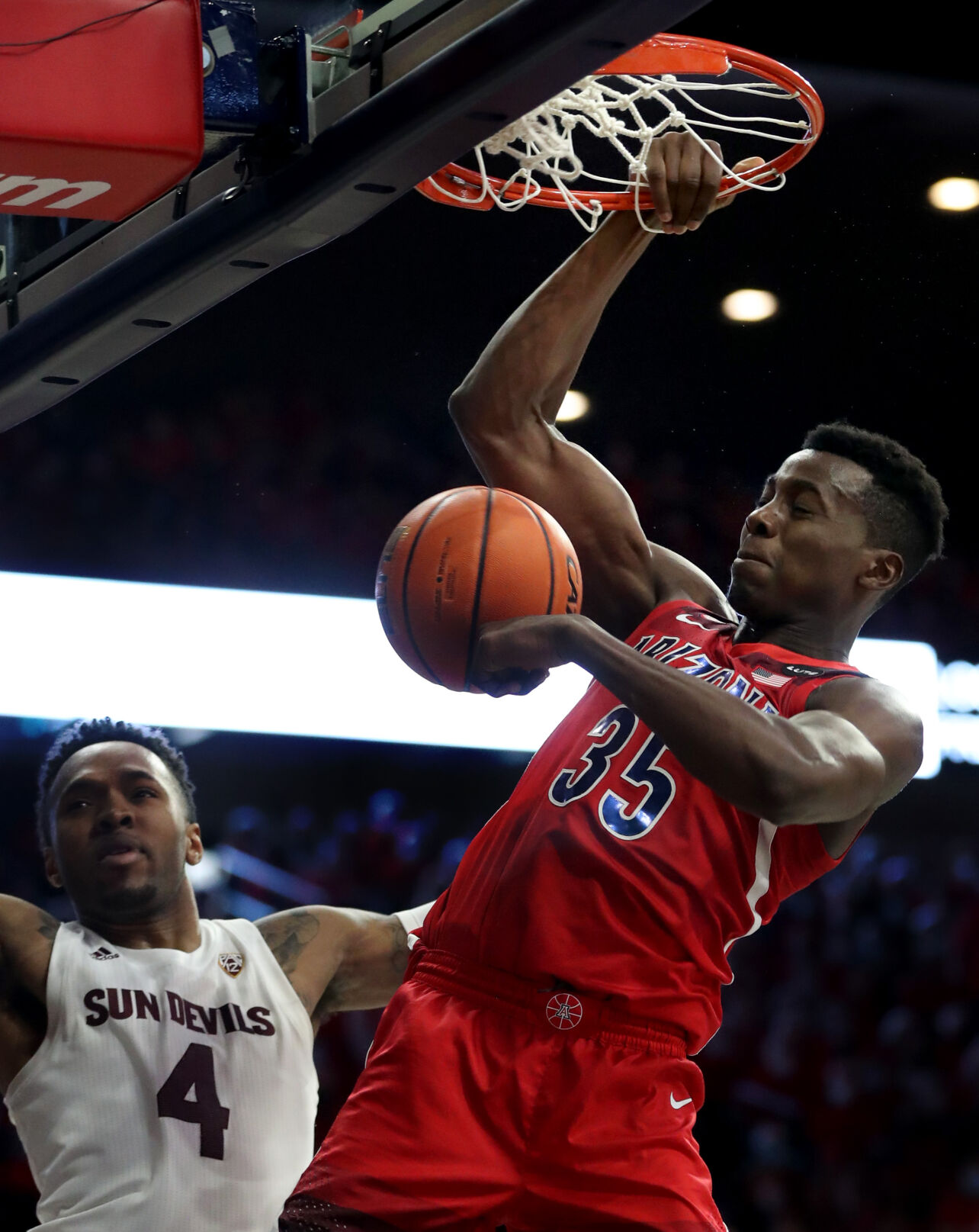
Arizona Christian Koloko finishes off his dunk and picks up the foul from Arizona State's Kimani Lawrence during the second half of their Jan. 29 rivalry game.
Improvement: Koloko shot 35% from the foul line as a freshman. Now he’s at 72%. His field goal percentage climbed from 52% last year to 61% today. His scoring average has gone from 5.3 points per game to 11.8.
Someday when he’s in the NBA, the Pac-12 might do well to name the annual MIP award the Koloko Trophy.
Until this year, I thought the most improved Arizona player of the last 40 years, start to finish, was Buechler, a top-50 high school volleyball standout. Buechler was a ’tweener at 6 feet 6 inches, who told me the spring 1986 day after he signed with Arizona: “I don’t expect to come in and start by any means. I’m a utility-type player. If I come off the bench, fine.”
Expectations were not great.
Buechler averaged 11 minutes and 4.7 points per game on Arizona’s 1988 Final Four team. Two years later he played 33 minutes a game, averaged 14.9 points and was the MVP of the Pac-10 Tournament, a first-team all-conference selection. He was tough, determined and smart. In his last three seasons at Arizona, the Wildcats went 89-14. If the Pac-12 ever creates a “Glue Guy” award, it could be the Jud Buechler Award.
Over the past 10 years, Arizona has been blessed with Buechler-type improvement from Kyle Fogg, Solomon Hill and Nick Johnson. Although they weren’t set apart as the league’s MIP winners, they carried on the legacy of those unofficial MIPs such as Kerr, Buechler, Terry and Walton.

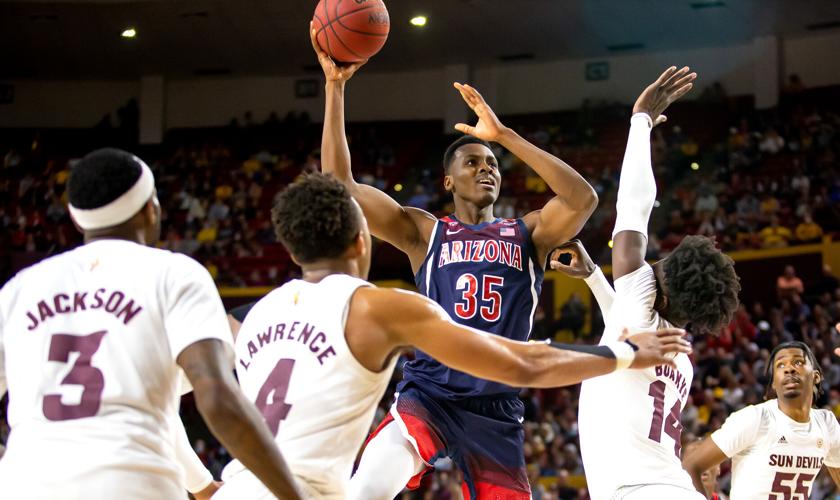
Arizona center Christian Koloko shoots over three Arizona State players during their Feb. 7 game.
Now comes Koloko. He doesn’t need any award to sanction his performance, because if he doesn’t win the MIP, he’s a lock to be the league’s Defensive Player of the Year, the first in Arizona history.
Now that’s a double-double.

