



You know how requests for tips seem to accompany even the most mundane transactions these days?
Wherever you buy something, it seems, you find tip jars at the counter, tip lines on the receipt, or a screen with different tipping percentages facing you.
If that seems a little excessive, well, you ain’t seen nothing yet.
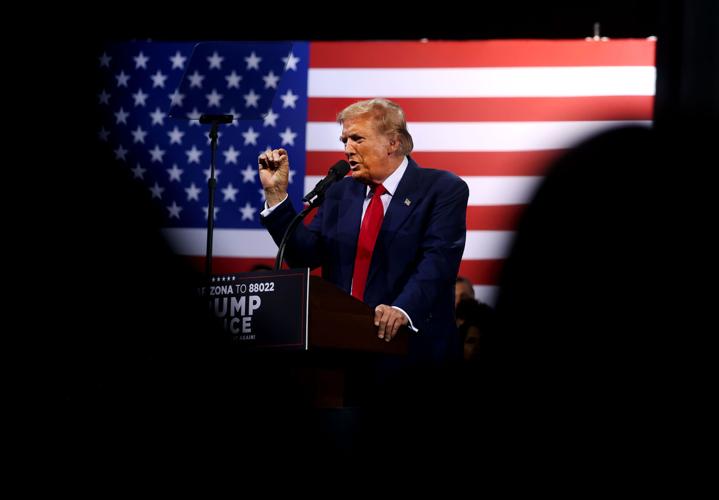
I attended Trump’s rally at the Linda Ronstadt Music Hall Thursday (more on that below), and there, printed on a backdrop behind the candidate, was a repeated phrase: “No Tax on Tips.”
It’s one of Trump’s three tax proposals, one of which he announced here Thursday: No tax on overtime. The other is no tax on Social Security.
They’re typical campaign fare in that they sound good on the surface, and may motivate some voters, but make less sense the more you dig into them. That’s especially true of the tips proposal, which rolls easily off the tongue and has been adopted by Kamala Harris as well.
Harris has said her “no taxes on tips” proposal applies only to income tax, not payroll taxes that fund Social Security and Medicare. Trump hasn’t specified, of course.
It sounds like a great deal for workers in places like Tucson, where so many people labor in hospitality jobs and get a lot of their income in tips. Restaurant servers and bartenders, of course, are the typical examples, but hotel cleaners, valets, car washers and others may make a significant amounts in tips, too.
The unfairness and unintended consequences of the idea are pretty worrisome, though.
Former President Donald Trump took the stage in Tucson Thursday afternoon for the first time this campaign cycle, vowing if elected to begin the "largest deportation operation" in the history of the United States.
Two delivery drivers
Think about two types of people who might show up at your door to make a delivery — that’s what Steven Rosenthal, a senior fellow at the Tax Policy Center in Washington D.C., told me Friday. The one bringing your pizza gets a tip, of course, but the one bringing your package from an online vendor does not.
“Food deliverers get tipped and might be happy about the exemption,” Rosenthal said. “but package deliverers today don’t get tips. They wouldn’t benefit. It’s hard to decide why we would subsidize food deliverers over package deliverers.”
Wage workers at a similar income level, such as warehouse workers, also would not get that help, he noted. Servers at high-end restaurants would get a big tax benefit, but McDonald’s workers would not.
“There’s a lot of similarly situated workers, and it’s hard to justify benefiting one over the other,” Rosenthal said.
Not only that — those same untipped workers, along with the rest of us, would potentially have to make up for missing tax revenue unpaid by tipped workers.
So, the idea is unfair. It also creates a spectacularly perverse incentive — to get as much income as possible from tips, not wages. Imagine a plumber or HVAC technician who charges a per-visit fee and an hourly “tip.” Or think about the possible changes in gig work, where tips may not make up so substantial a portion of income.
“Doordash, Uber drivers, TaskRabbit, independent contractors — they would shift compensation structures to request more tips and less wages,” Rosenthal said
Overall, he concluded, “I think you’d see an explosion in tip requests.”
Arizona’s choice on tips
While both presidential candidates are indirectly encouraging more tipped work through their tax proposals, there is a movement afoot to turn restaurant workers into regular wage-earners, or at least eliminate the sub-minimum wage for tipped workers.
In the abstract, I like this idea: It’s better to have a dependable source of income paid by the employer than a wildly variable income depending on how many customers you serve in a given shift. I know, though, that tipped workers tend to like the money they can take home from a good shifts.
If we were to move away from tipping, over time, the cost of shifting restaurant servers to wage work would be incorporated into prices, and the customer would pay the same in the end, tipping if they wish instead of having to. That’s how it would work ideally.
This year, an initiative was headed to the ballot in Arizona to gradually raise the state’s minimum wage to $18. Crucially it would also have eliminated the $3 per hour tax credit that allows restaurant owners to pay sub-minimum wages to tip earners, gradually forcing all those employees to be paid at least minimum wage.
The Arizona Restaurant Association filed suit against the initiative, and backers acknowledged they wouldn’t have enough signatures. So it’s not on the ballot, but a referendum from the Legislature will be. It’s backed by the restaurant association and would further entrench the tipping system we have.
Prop. 138, which began life as an alternative to the minimum-wage initiative, now stands alone. It would functionally reduce the wages employers have to pay tipped workers, by making the available tax credit equivalent to 25% of Arizona’s minimum wage. However, the total take-home pay would have to be at least the minimum plus $2 per hour.
So, rather than reducing dependence on tips, the only new proposal in Arizona would likely reduce wages further and increase dependence on tips.
The same thing, of course, would happen at the federal level, no matter who’s elected president, if they follow through on their slogans.
More from the Trump rally
The former president spent the first 10-15 minutes of his speech in Tucson‘s Linda Ronstadt Music Hall riffing on Kamala Harris — especially how he believes he had defeated Harris in Tuesday’s debate. That’s why, he said, he won’t do any more debates.
It smacked of defensiveness and brought to mind a political adage — “If you’re explaining, you’re losing.”
Soon after, Trump went on a nine-minute meander down memory lane about the 2016 election. He discussed all the pundits who told him he was going to lose, and how one smart adviser noted that all the people not answering exit polls probably voted for him. Improbably, he learned that day as the states fell for him, that he was going to win.
“We ended up winning,” Trump concluded. “That was quite a day, wasn’t it though?”
Supporters reveled in the memory. But it had the feel of a swan song.
As if to snap out of that sentimentalism, Trump said 2024 would be better, “because we’ve never had the enthusiasm we have now.”
All about the fear
To the extent there was a primary theme to Trump’s address, it was about threat and fear — his usual fare since 2015.
Mostly, as always, he talked about the threat of migrants who’ve crossed the border under Joe Biden’s presidency. He listed a variety of crimes he said migrants had committed and said that’s why he has appeared angry, as his critics have pointed out.
“I’m angry about young American girls being raped and sodomized and murdered by savage criminal aliens,” he said. “I’m angry about rampant inflation destroying our middle class.”
He, of course, talked about Springfield, Ohio and the false idea that Haitian migrants there have eaten residents’ pets. This commentary, which he’s stoked from Tuesday’s debate forward, has led to bomb threats in the town and school closures. The danger of vigilante action is real. But he continued with that rhetoric Friday, too, after leaving Tucson.
He also warned that under Harris low-income housing would be built in “safe” suburbs, bringing crime to these safe areas.
The final source of threat, after migrants and inflation: Communism.
“Kamala, a committed Marxist — you know her father is a Marxist professor — will be far worse than crooked Joe Biden because he doesn’t really believe it. She does believe it.”
The idea that either Biden or Harris is Communist, as Trump also said, may have no basis in reality, but it was lapped up by his supporters.
His biggest fan
Whenever international relations comes up, Trump likes to cite one of his greatest global backers — the prime minister of Hungary, Viktor Orban. He did it at the debate, and he did it again Thursday in Tucson.
“Viktor Orban, the prime minister of Hungary, said you’ve got to bring Trump back or this whole world is going to blow up,” Trump said.
Orban is a darling of the American far right, because of his anti-immigrant actions, his pro-fertility policies, and his autocratic style of rule. But one thing few of them notice is that Hungary is a small country of 9.6 million offering little for the United States of America to aspire to.
Its GDP is less than half of Arizona’s GDP, though Arizona has 2 million fewer people. Its judiciary and civil society have been decimated by Orban’s rule. It’s apparently an example, though, of the way Trump and some supporters would like to see America turn.
Photos: Former President Donald Trump holds rally in Tucson
Former President Donald Trump, 2024 election
Updated
Former President Donald Trump speaks during a rally at the Linda Ronstadt Music Hall in Tucson, Ariz. on September 12, 2024.
Former President Donald Trump, 2024 election
Updated
Supporters take photos and videos of former President Donald Trump as he takes the stage during a rally at the Linda Ronstadt Music Hall in Tucson, Ariz. on September 12, 2024.
Former President Donald Trump, 2024 election
Updated
Former President Donald Trump speaks during a rally at the Linda Ronstadt Music Hall on September 12, 2024.
Former President Donald Trump, 2024 election
Updated
Former President Donald Trump speaks during a rally at the Linda Ronstadt Music Hall in Tucson, Ariz. on September 12, 2024.
Former President Donald Trump, 2024 election
Updated
Former President Donald Trump speaks during a rally at the Linda Ronstadt Music Hall in Tucson, Ariz. on September 12, 2024.
Former President Donald Trump, 2024 election
Updated
Supporters of former President Donald Trump dance as the song “Surfin' USA" by The Beach Boys plays through the speakers before a rally at the Linda Ronstadt Music Hall in Tucson, Ariz. on September 12, 2024.
Former President Donald Trump, 2024 election
Updated
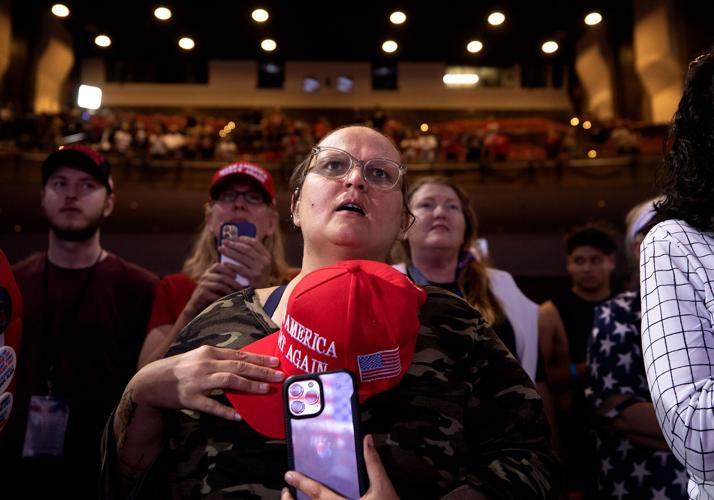
A supporter sings along to the National Anthem before former President Donald Trump spoke during a rally at the Linda Ronstadt Music Hall in Tucson, Ariz. on September 12, 2024.
Former President Donald Trump, 2024 election
Updated
Former President Donald Trump pauses for applause before speaking at a rally at the Linda Ronstadt Music Hall in Tucson, Ariz. on September 12, 2024.
Former President Donald Trump, 2024 election
Updated
A supporter records a video of former President Donald Trump as he speaks during a rally at the Linda Ronstadt Music Hall in Tucson, Ariz. on September 12, 2024.
Former President Donald Trump, 2024 election
Updated
Former President Donald Trump speaks during a rally at the Linda Ronstadt Music Hall in Tucson, Ariz. on September 12, 2024.
Former President Donald Trump, 2024 election
Updated
Supporters cheer as former President Donald Trump speaks during a rally at the Linda Ronstadt Music Hall in Tucson, Ariz. on September 12, 2024.
Former President Donald Trump, 2024 election
Updated
Former President Donald Trump points towards the crowd after speaking at a rally at the Linda Ronstadt Music Hall in Tucson, Ariz. on September 12, 2024.
Former President Donald Trump, 2024 election
Updated
Former President Donald Trump gives his crowd of supporters some dance moves after speaking at a rally at the Linda Ronstadt Music Hall in Tucson, Ariz. on September 12, 2024.
Former President Donald Trump, 2024 election
Updated
A couple cuddles together as they listen to former President Donald Trump speak during a rally at the Linda Ronstadt Music Hall in Tucson, Ariz. on September 12, 2024.
Former President Donald Trump, 2024 election
Updated
Supporters exit the Linda Ronstadt Music Hall in Tucson, Ariz. after former President Donald Trump held a rally on September 12, 2024.
Former President Donald Trump, 2024 election
Updated
Marilyn Suhay uses her Trump/Vance signs to shield herself from the sun as she waits to enter the Linda Ronstadt Music Hall to hear former President Donald Trump speak in Tucson, Ariz. on September 12, 2024.
Former President Donald Trump, 2024 election
Updated
Drivers stuck in the traffic blockade at Granada Ave. and Congress Street get cell phone video and photos as Donald Trump's motorcade arrives for a speech at Ronstadt Music Hall, Tucson, Ariz., September 13, 2024.
Former President Donald Trump, 2024 election
Updated
A crowd lines Granada at Calle Carlos Arruza as the escort for Donald TrumpÕs motorcade arrives at the Ronstadt Music Hall for a speech, Tucson, Ariz., September 13, 2024.
Former President Donald Trump, 2024 election
Updated
Members of the crowd along Granada get cell phone video as Donald TrumpÕs motorcade arrives for a speech at Ronstadt Music Hall, Tucson, Ariz., September 13, 2024.

