


The Tucson Symphony Orchestra ended Thursday's "Fiesta" series kickoff concert at its beginning.
In what many in the audience might argue was the highlight of an evening filled with highlights, the orchestra replayed Arturo Márquez's Danzón No. 2, which opened the concert. Only the second time around, conductor George Hanson and his musicians — energized after an evening of spirited, soulful, Latin-influenced works — were accompanied by University of Arizona dance students. Márquez's delightful, energetic dance piece sounded more alive through UA School of Dance Director Jory Hancock's original choreography.
"Bolero, Tango and Dance" lived up to its name, featuring a popular warhorse in Ravel's "Bolero" and the first time the orchestra has ever performed an accordion concerto.
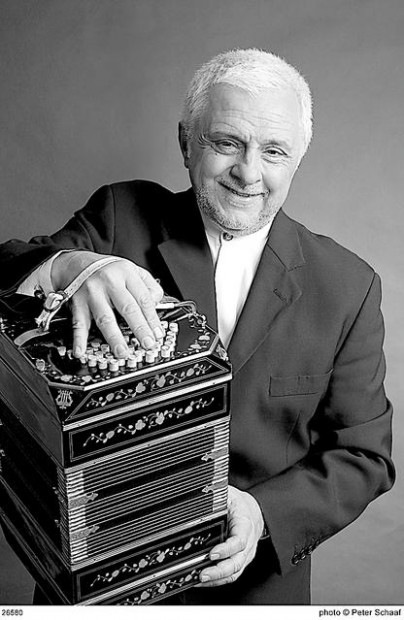
World-renowned Argentine bandoneón player Daniel Binelli introduced the TSO audience of just under 1,400 to his country's distant cousin of the accordion. Unlike the accordion, the bandoneón does not have keys; it is played with buttons at both ends. Its sound is akin to an organ.
Argentinean composer and tango genius Astor Piazzolla played the instrument and championed it. In 1979, he composed his Concerto for Bandoneón, which was given its premiere in Mexico City in 1994, two years after he died.
Binelli, dressed in a tux and resting his bandoneón on his right knee, perched on a wooden stool next to his music stand. His stance looked impossibly uncomfortable from the audience, but Binelli seemed perfectly at ease. In the opening movement's two cadenzas, he captivated with his taut playing that emphasized the various shades of his instrument. One moment it sounded akin to a violin, the next it morphed into organ. When he dueted with the harp in the second movement, the sound was achingly beautiful.
After each of the three movements, the audience applauded, but curiously only a handful offered a standing ovation at the end.
The orchestra, dressed down in casual black, sans any suitcoats, followed Piazzolla with Osvaldo Golijov's "Last Round," a piece for strings that tips its hat to the tango king. It was one of three works on the program that the TSO had never played before.
"Last Round" employs strings divided in two sections and double bass to re-create the sound of the bandoneón. Golijov wrote the first half with the idea that the strings would battle for attention, which Hanson emphasized with urgent, dramatic tempos and sharply accentuated dissonant passages. At one point, in the height of this confrontation, bows pierced the air and seemed to crisscross in a strangely fascinating musical dance.
Midway into the piece, the tempo changes abruptly and gives way to a somber, mourning tango in memory of Piazzolla. Guest concertmaster Karla Donehew Perez, a recent Cleveland Institute of Music master's graduate, took the movement's lead with graceful passion.
Also new to the orchestra was Michael Daugherty's Superman-inspired "Red Cape Tango" from "Metropolis Symphony." Hanson played the piece with equal measures of urgency and sexual energy, which the UA dance school's Hancock emphasized in a steamy, machismo-injected dance.
The TSO's partnership with UA Dance in recent seasons has proved to be a crowd pleaser, but in past concerts the dancers have been more window dressing and spice than integral partner. Hancock's dance for "Red Cape Tango" changed that, investing the dancers as equal partners with the musicians. His choreography, not to mention the tastefully revealing black-and-white costumes, gave a physical form to the idea of Superman. Hancock envisioned him as man and woman, both eager to one-up their nemesis — in this case, it was dancers dressed in white versus those in black. The women faced off with swords, and the men wrestled with ropes and poles, all in an effort to be the last one standing.
A half-dozen standouts among those dancers returned for the Danzón No. 2 encore, which followed a spellbinding performance of Ravel's "Bolero." Hanson's delivery of the "Bolero" was nothing short of spectacular and earned him a resounding standing ovation.
"Fiesta" continues Tuesday with Hanson leading "Fiesta Salon" at the Tucson Symphony Center. The series runs through early March and includes the Romero Guitar Quartet March 5, 6 and 8.
Review
•Tucson Symphony Orchestra Thursday with bandoneón player Daniel Binelli. The concert repeats at 2 p.m. Sunday at the Tucson Music Hall.
•Today: The TSO performs a special concert with pianist Cecile Licad at 8 p.m. at the Music Hall. Tickets: www.tucsonsymphony.org

