



The ways in which our palates evolve are fascinating to me.
In the early ’80s, when I lived in Jackson, Mississippi, and wrote about food for the state’s largest paper, I learned about a Depression-era favorite dessert called lemon ice box pie
from my predecessor at the paper.
For years, I made Susan’s lemon ice box pie just the way she wrote her recipe. I wasn’t yet a confident enough cook to know what I could — and, more importantly, what I couldn’t — tamper with in the recipe. Why mess with success?
Then one day, I realized that lemon ice box and key lime pie are made by the same method, with the same ingredients except for their citrus. They both rely on acidic juice from the citrus to thicken the sweetened condensed milk and egg yolks in the filling. Both may be made with a pastry crust or a crumb crust, depending on the cook’s whim. Both want drifts or dollops of lightly sweetened whipped cream at serving.
So for a while, I goofed around with citrus ice box pies.
Orange juice, I found, is not acidic enough to thicken the filling, and orange ice box pies were a flop (although I learned along the way that I could skip the eggs in the filling and replace them with dissolved gelatin for a sliceable pie).
Sometimes I changed them up by changing the crust, from pastry to crumb, and then varying what the crumbs were from. A lemon ice box pie with a gingersnap crust turned out to be lively in the mouth, while one made with Biscoff cookies seemed ultra-luxurious. A key lime pie with a graham cracker crust tickled my memories of the first time I ate that pie on a childhood trip to Florida with my father, but one made with a crust of crushed amaretti cookies rivaled anything I’d eaten in upscale white-tablecloth seafood restaurants during my career.
In my most recent fiddling, I’ve made lemon-drop martini pies by adding a little vodka to the lemon pie filling, and gin fizz pies by adding gin. I learned that you mustn’t use too much booze, or it will interfere with the filling’s thickening. About three tablespoons seem to be the maximum.
A key lime pie logically wants tequila (aha! Margarita pie!) or, as in today’s recipe, mint muddled with rum to make a mojito pie.
Incidentally, although we call it “key lime” pie, you’ll actually use Persian limes in this recipe. Key limes are much smaller — about the size of a walnut, with only a thimble full of juice each — so you’d spend all day juicing enough true key limes to get the requisite amount of lime juice for this recipe. Key lime juice is available in bottles, however, and you can use that in this recipe if you wish.
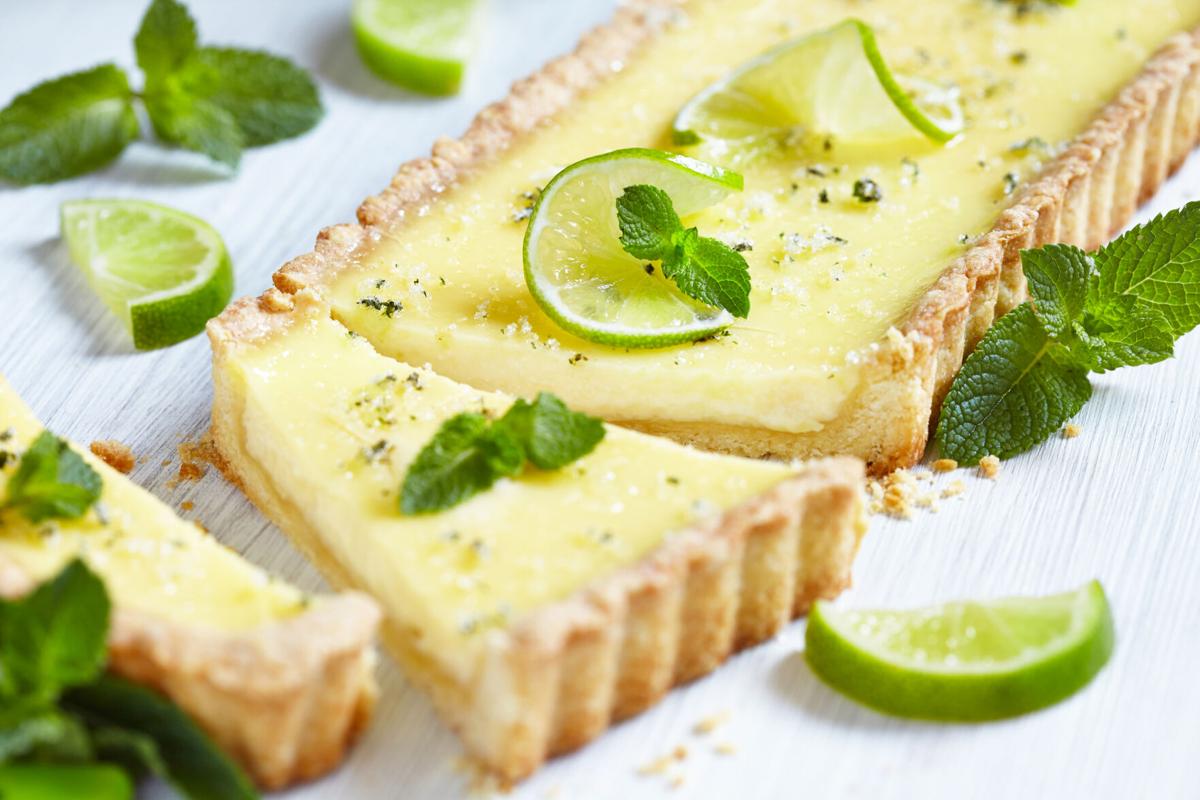
Mojito tart
Makes about 8 servings
I like to make tarts in a rectangular pan because I think they look more professional, but I admit that’s just personal preference. You’ll need 5 limes for this tart; remove the zest from one before squeezing its juice and reserve one for the garnish.
Ingredients
Pastry dough for a 7- by 11-inch rectangular tart pan or 9-inch round tart pan
½ cup lime juice, from about 4 limes
¼ cup mint leaves, packed
1 14-ounce can sweetened condensed milk
2 large egg yolks
¼ cup sour cream
1 tablespoon lime zest, from 1 lime
3 tablespoons rum
Garnishes: whipped cream, torn mint leaves, lime wedges or slices
Preparation
Preheat the oven to 350 degrees.
Line a rectangular or round tart pan with pastry dough. Dock the pastry by pricking all over with the tines of a fork to help prevent shrinkage. Bake the pastry for 15 minutes, or until golden. Remove and set aside. Leave the oven on.
In a medium bowl combine lime juice and mint. Muddle mint until broken down. Using a fine mesh strainer, strain lime juice into a measuring cup. Discard mint.
In another medium bowl, whisk together sweetened condensed milk, egg yolks and sour cream. Add lime juice, zest, and rum and mix until incorporated.
Pour into crust and bake until just set in the middle, 15 minutes.
Let cool at room temperature, then refrigerate until firm, at least 2 hours.
When ready to serve, pipe whipped cream around the edge of the pie or down its center and top with lime wedges or slices and mint leaves.
We’ve all been there - you start baking something delicious only to realize you don’t have one essential ingredient. Here are some substitutions you can make with things already in your home so you don’t have to go to the store.

