


Based on 115 years of statistics, the steep decline in copper prices over the past few years could be on the verge of reversing, says the head of a University of Arizona mining institute.
The longest period of either continuous gains or declines in global copper prices since 1900 has been five years, said Mary Poulton, director of the UA’s Lowell Institute for Mineral Resources, a multidisciplinary research institute. Typically since that time, copper prices have declined for an average of 2.4 consecutive years before rising, and risen an average of two years before dropping, she said.
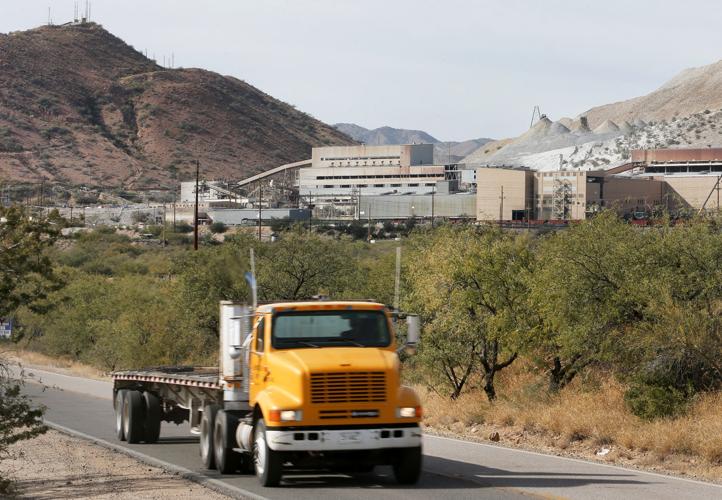
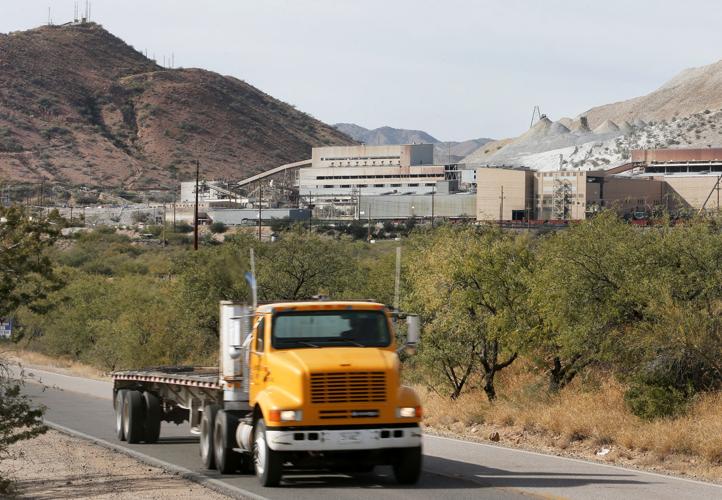
The global price decline has triggered major job cutbacks at Arizona’s copper mines only a few years after some mining companies were so prosperous that they had trouble finding enough qualified employees. Most prominent among 2015’s cuts locally was the recently announced shutdown of Freeport McMoRan’s Sierrita Mine south of Tucson, which until recently employed well over 1,000.
The copper price drop also puts a question mark over the future of the proposed Rosemont Mine southeast of Tucson. Its owner Hudbay Minerals Inc. hopes to start construction this year if it can get its final two federal permits. But it has said it won’t open any new mine — not just Rosemont — until copper prices return to $3.50 a pound, compared to today’s price of barely $2.
“We are in our fifth year of down prices,” Poulton told a recent interviewer on the monthly “Arizona Mining Review” webcast presented by the Arizona Geological Survey, a state agency. “History will tell us that 2016 will be a better year. (But) maybe we will break the historical record. I am cautiously optimistic that 2016 and 2017 will be better years for copper.”
Her view is hardly unanimous among experts. John Tilton, a Colorado School of Mines mining economist, said via email that he’s not optimistic about copper prices coming back any time soon. The investment banking firms Goldman Sachs and Citigroup recently issued very pessimistic and very optimistic copper price forecasts, respectively. Analysts for another investment firm, Morgan Stanley Investment Management, are also pessimistic.
The International Copper Study Group, a global organization that researches copper issues, predicted during fall 2015 that the global copper supply would run a slight deficit in 2016, due not to high demand but to copper production cuts triggered by this year’s sharp price declines. Such deficits can lead to higher commodity prices but the study group didn’t forecast copper prices.
And since Poulton’s Arizona Mining Review interview ran in early fall 2015, she has said it may be 2017 or 2018, not 2016, before copper prices begin a significant recovery.
“I’m right if the price goes up a penny (in 2016) — all it has to do is have an average price in 2016 higher than 2015, but a penny doesn’t do anybody any good,” Poulton said in an interview last week.
The big unknown driving much of the uncertainty — and pessimism — about copper prices is China.
China consumes about 40 to 45 percent of copper produced worldwide. Its economy has been gradually slowing — more precisely, its rate of economic growth has been slowing — since the beginning of this decade. This year the growth-rate decline proved sharper than expected, triggering a yearlong price drop for copper and numerous other commodities.
“The big question is what happens to China, also Russia; you’re seeing them get hit pretty hard,” Poulton said on the webcast. “Brazil is also down — that’s where the growth has been. It’s never been a U.S.-European story. The U.S. and Europe are very static and very stable.”
Poulton linked the global copper price trends to cement production figures in China. From 1970 to 1990, cement production trends were fairly flat, she said. Starting in about 1990, “we started to see big increases in production.” Since 2010 when production peaked, “there’s been a precipitous decline” in cement production, she said.
The twin recent trends of declining copper prices and declining Chinese cement production “tells us that the decline of the Chinese economy is a real thing — very serious,” Poulton said.
On Dec. 31, global copper prices closed at $2.12 a pound, a penny below the previous day’s price, which hit a seven-week high. At the start of 2015, prices exceeded $2.80, still well below their $4.29 to $4.40 range of late December 2010.
“Any significant recovery will require a rise in the global economy. While the U.S. economy is doing nicely, the rest of the world, including China, Japan, and Western Europe, seems in the doldrums,” Tilton wrote in an email last week to the Star. “The good news for many copper producers is falling production costs. Some of this is painless, such as lower prices for energy and other inputs. However, decisions to lay off employees and to cut capital expenditures can be much more painful.”
Tilton described himself as “a great fan of Mary Poulton.” She is not an economist but a trained geological engineer who has extensively researched mineral exploration, sustainable development as it relates to mining, and water resource management.
But Tilton doubts that analyses of past price trends are all that useful in predicting the next year or two. More reliable copper price predictions are likely to come from careful analysis of pending changes in industry-wide production capacity and accurate assessments of future global economic trends, he said.
“I do not see China’s growth accelerating over the next several years. If anything, it is likely to experience slower growth,” said Tilton, acknowledging that global “macroeconomics” is not his specialty, either. “Japan and Western Europe could enjoy faster growth in 2017 and 2018. The same is true for Brazil and other emerging markets. On balance, however, I am not very optimistic.”
Poulton doesn’t totally disagree with Tilton’s skepticism of using the past to predict the future. But she does see value in reviewing 115 years of data, given that it covers two world wars, the Great Depresion, a number of recessions, the Cold War and the rise and fall of many economies worldwide.
“That’s a lot of history at a global level,” Poulton said. “Do we think today is special in the world economy or not? I think that’s the big uncertainty. Is the situation really new and different today compared to the last 115 years? That’s the question on everybody’s minds and nobody’s got a crystal ball to know that.”
For the much longer term, Poulton, like many mining industry analysts, sees more positive trends. If global demand for copper rises 2.2 percent annually, for instance, “by 2050 we’d need to produce 45 million tons” of copper. We’re now producing about 18 million tons.”
Tilton is correct, she said, that a lot of the future of copper prices will depend on China’s performance, as well as that of Europe, Russia, Japan, Korea “and basically everybody. The U.S. having more growth would be a factor, too.
“I would say China’s growth is going to have to improve, but the rest of the world would have to grow” too, Poulton said.

