


Southern Arizona business and political leaders involved in cross-border economic initiatives are scrambling to quell resentment and fear over the feud between the U.S. and Mexican presidents.
A demand that Mexico pay for a proposed border wall resulted in Mexican President Enrique Peña Nieto calling off a scheduled visit to Washington.
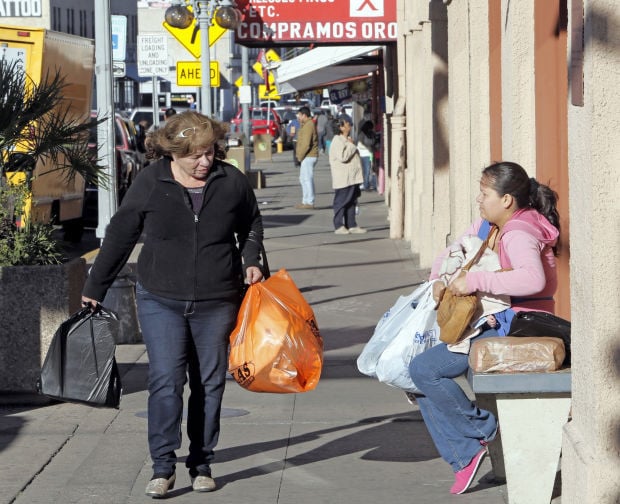
Closer to home, many residents in northern Mexico who would have made a trip north to Tucson’s malls this weekend stayed home and are urging friends and relatives to stop buying U.S. products or eating at U.S. chain restaurants operating in Mexico.
“There are many implications to the country as a whole, but to border communities especially,” said J. Felipe Garcia, executive vice president of Visit Tucson. “Mexicans are offended and want to stop shopping in the U.S. and stop buying U.S. products.
“We need that market of shoppers who spend $1 billion a year in Pima County.”
But, might there be some who think it’s a good thing for those shoppers to stay south of the border?
“We need those sales tax collections,” Garcia said. “If we lose that sales tax we have to make up for it somehow, like higher taxes.”
Lea Márquez-Peterson, president of the Tucson Hispanic Chamber of Commerce, said there is already concern from business owners in Tucson, Nogales, Douglas and Sierra Vista.
“We must consider the impact and threat to our local economies; to the business owner’s loss of revenues and the loss of sales tax, hotel taxes, gas taxes, etc.,” she said.
Shopping dollars lost by securing the border pale in comparison to what U.S. residents will save, said Ira Mehlman, media director with the Federation for American Immigration Reform.
“Enhanced border security needs to be brought to fruition, no matter who pays for it,” he said. “Even if U.S. citizens paid for it, it would be worth it versus what it costs to take care of illegal immigrants.”
Improved security wouldn’t just benefit U.S. residents, Mehlman said.
“It would also benefit the people coming across to shop and do legitimate things,” he said.
Garcia said there are social media efforts underway to keep Mexicans from spending money on U.S. products.
“Vamos a Tucson” (Let’s go to Tucson) signs have been photoshopped to read “íbamos a Tucson” (We used to go to Tucson).
“What’s happening is bringing out nationalism on both sides of the border,” Garcia said. “No one wins in that situation.”
TRADE RELATIONSHIP
HANGS IN THE BALANCE
Manufacturers already doing business in northern Mexico are nervously watching the political drama.
As the White House throws out ideas such as a 20 percent tax on imports from Mexico to pay for the border wall, top Mexican officials say the country might simply walk away from NAFTA.
Mexico has trade agreements with 45 countries and could cozy up to the Chinese if no longer bound by NAFTA.
“China is very active in Mexico,” Garcia said. “If the U.S. decides to take a side role with trade, China is ready to step up. This is a big disruption.”
Márquez-Peterson said the chamber is working with other chambers to drive that message to D.C.
“We plan to continue our advocacy … on building rather than diminishing the relationship with Mexico to remain globally competitive against China,” she said.
Since taking office in 2011, Tucson Mayor Jonathan Rothschild has made improved relations with Mexico a top priority.
“The only remedy is constant communication, letting our friends and business partners in Mexico know that there are many of us in Arizona who believe these policies are wrong,” he said. “I will be asking Gov. Ducey, who has based much of his prosperity plans for the state on trade relations with Mexico, to speak up.
“Senators (John) McCain and (Jeff) Flake must also continue to speak up against what they know is damaging to the state and country.”
The Tucson-based Offshore Group is the largest private-sector employer in Sonora. Its manufacturing parks in Empalme and Guaymas have clients from around the world, and Offshore provides the labor and support.
It employs more than 20,000 employees in Mexico; 14,000 of them in Sonora. The tough talk coming out of the White House has put many employees and clients on edge.
“The idea that the U.S. economy is stronger by excluding its neighbors is equivalent to the idea the U.S.’s global interests are safer without its allies around the world,” said Eduardo R. Saavedra, executive vice president of business development for Offshore. “The challenge Americans and more specifically Arizonans face today is to understand how our economic, social and political relationship with Mexico strengthens us globally.
“If we took the same energy expended today to derail what has been built over the years and instead improved upon it, logic would say we will be better off.”
He said many people lack an understanding of how the cross-border relationship is beneficial.
“We owe it to ourselves to be informed on this critical issue from reliable sources, which is proving to be harder than ever,” Saavedra said. “We must become skilled now at deciphering between fact and fiction from our political leadership.”

