

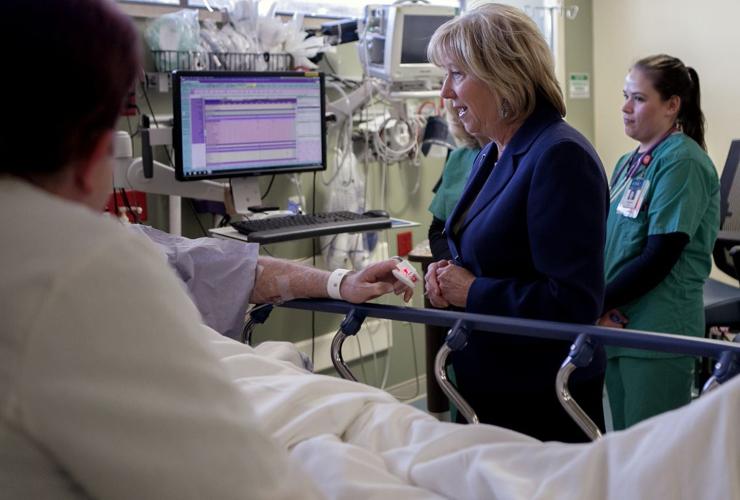
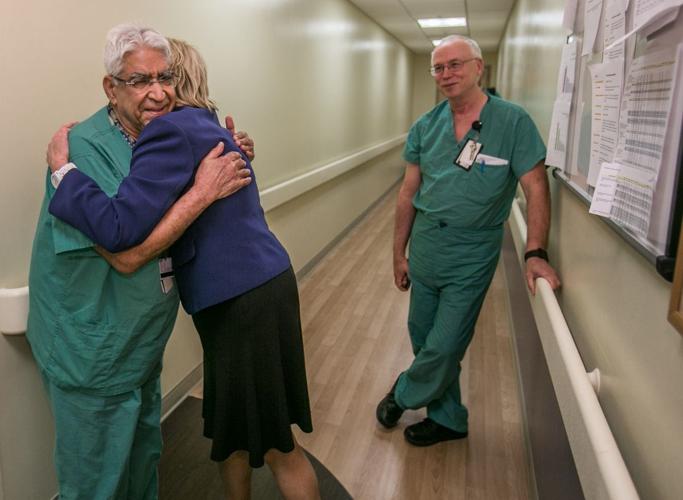
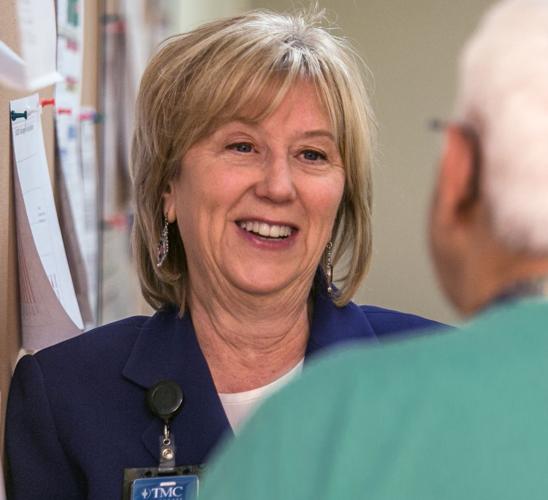


Judy Rich whirls into Tucson Medical Center’s administrative office on behalf of a hospital visitor.
She has just met an older woman, distressed by her inability to find a parking spot in the hospital lot.
Rich told her to park in an empty space reserved for physicians.
“Are you sure I can park here?” the woman wondered.
Rich flashed her badge: president and CEO of TMC Healthcare.
“One of the things that is sort of a policy here is that if a patient is lost or having trouble, that is the only reason to be late for a meeting,” says Julia Strange, TMC’s vice president of community benefit and spokeswoman.
For Rich, it has always been about the patients — first as a caregiver for her siblings, later as an ICU nurse and now as the CEO and president of a hospital with about 600 beds and 3,700 employees.
Bedside
Rich decided to go into health care after she lost her father to Hodgkin’s lymphoma, also known as Hodgkin’s disease.
She remembers donning her cap and gown and peering through a window into her father’s isolated room so he could see her on high school graduation day. He died three days later.
“Losing my father made me really positive I wanted to become a caregiver,” says Rich, who has a bachelor’s degree in nursing from Roberts Wesleyan College and a doctorate degree from the University of Pennsylvania. “I have four siblings, and they were all still at home. So I ended up taking on a caregiver role in our family.”
For eight years, she worked as a nurse in intensive care units in Philadelphia and New York — days, nights and weekends — long enough to become frustrated with bureaucracy she believed made caring for her patients more difficult.
“I had a patient who wanted to see the pope (John Paul II) when he came to Philadelphia,” Rich says. “She needed a transfusion of blood, and she really believed, and so did I, that if she could get this transfusion of blood, she could go see the pope, because he was like a block away from the hospital.”
But it was 4 a.m. and the blood bank wouldn’t let Rich have the blood without a signature from the resident on call.
“My patient died,” she says. “She never saw the pope. ... Now, I don’t know if the blood transfusion would have saved her, but it felt to me like a process kept me from getting what I needed for my patient, and I guarantee you there are people who feel that way today in this hospital.”
Java with Judy
As a way to mitigate those feelings, Rich has implemented regular town halls and monthly coffee breaks she calls “Java with Judy.” Staff can bring issues and questions directly to her.
Kelly O’Brien, a TMC nurse, took advantage of that about 18 months ago while she was training for an Ironman triathlon.
O’Brien had purchased a $3,000 bike for the competition, but she didn’t want to leave it locked outside TMC after her commute. Since the hospital’s handful of bike lockers were already rented out, she approached Rich about adding a few lockers.
“It was done within two weeks,” says O’Brien, who has worked at the hospital since 2009.
In her experience at TMC, “there is no repercussion for going to your higher-ups” with concerns or ideas.
Greg Vigdor, the president and CEO of the Arizona Hospital and Healthcare Association, has worked in health care for more than 30 years and says Rich has a reputation as a team-builder that extends beyond the state.
“A little unique is this notion of trying to work with others to find solutions,” Vigdor says. “And I know she does that in the medical center and when she was chair” of the Arizona Hospital and Healthcare Association.
Rich has served on a variety of other boards and is currently on the Southern Arizona Leadership Council board and the Sun Corridor, Inc. Chairman’s Circle. She also serves as chair of VHA West Coast.
Raising kids
Rich admits she is a workaholic, but it’s easier now that her three children are adults.
From staff nurse to nursing manager to nursing director to chief operations officer at Wellmont Health System in Tennessee, Rich took her first executive position when she had three kids in three separate schools.
A single mom, she couldn’t wait for the day her son got his driver’s license. She would spend evenings with her kids and then work late after they went to sleep.
She knows from experience what many on her staff juggle.
In 2003, Rich took a job as the chief operations and chief nursing officer at Tucson Medical Center. But in 2005, she and other executives were let go in an attempt by the hospital to cut costs.
Her youngest daughter, a high school freshman at the time, refused to move, so for about two years, Rich spent Monday through Thursday on the East Coast working as a healthcare consultant. She grew to recognize El Paso, Texas, from the sky on her Thursday night flights back to Tucson.
With her other two kids in college, she worried about affording tuition.
“It took its toll,” she says. “I’ll never forget it.”
Nursing a hospital
Rich came back to TMC amid a leadership shakeup as hospital administrator and executive vice president in 2007, along with several other former executives.
She had work to do.
In the first half of 2007, before Rich returned, Tucson Medical Center was almost $11 million in the red. The hospital was also under inspection by the Arizona Department of Health Services for dozens of complaints about the seclusion and restraint of psychiatric patients, according to Star archives.
Rich’s predecessor Frank Alvarez had already begun cost-saving measures, laying off about 100 workers and cutting vacant positions. Rich continued to shave costs by renegotiating the expense of supplies, eliminating several hundred full-time equivalent positions and restructuring debt. Policies and procedures were overhauled.
Rich regularly told hospital staff they were “living out of the pantry,” borrowing a phrase her mother used during the cash-strapped weeks of Rich’s childhood.
About two years after her arrival, the board decided it did not need to sell the hospital. TMC would remain independent.
“She had the confidence to roll up her sleeves with us to do the hard work,” Strange says.
Rich was officially named president and CEO in 2009.
A nurse at heart
Each morning when Rich arrives at the hospital, she checks on the previous night — the number of surgeries performed, the babies delivered.
“My job is to trust all the people who keep the business going everyday, to stay close enough to it that I can feel it — I’m a nurse, I like to palpate it — but to stay enough above it that I can keep planning for the future,” she says.
Since Rich took over, Jon Young, the chair-elect of the hospital board and chairman of the finance committee, identifies “vision and team leadership” as some of her “strongest qualities.”
He points specifically to the hospital’s early use of an electronic health record system and its enrollment into accountable care organizations before many other hospitals. Under Rich’s leadership, the hospital also completed the construction of a four-story orthopedic and surgical tower in 2013.
“We’re trying to differentiate ourselves from everyone else by saying, ‘This is the only community hospital,’” Young says. “And I think in Tucson, that’s a big deal.”
Rich saw the acquisition of the University of Arizona Health Network by Banner Health as “a gauntlet laid down,” Young says.
So TMC has contracted with Phoenix Children’s Hospital, partnered with Mayo Clinic and allied with rural hospitals.
Local ownership means flexibility, Rich says. Eliminating bureaucracy propelled her into leadership in the first place.
“Right now, the default is that there will be a few big health systems controlling the world,” Vigdor says. “Leaders like her will have to prove the local model.”
For Rich, part of that model is not just treating sickness, but promoting a healthier community.
“She just has this compassion for the mission of the field in taking care of people,” Vigdor says. “It sounds silly, but sometimes we lose that in the business aspect of health care. She really lives and breathes that.”

